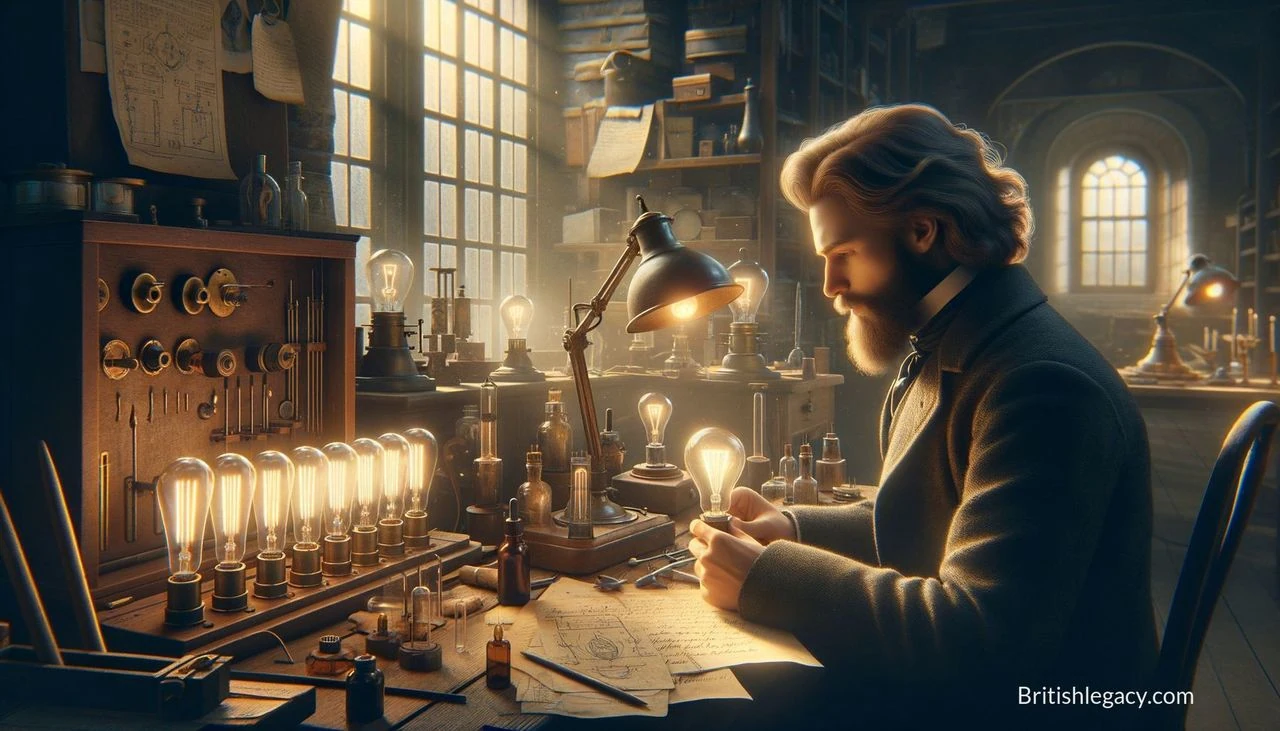
Making a lamp glow was not the same as making electric light useful. A filament had to burn brightly without quickly burning away; the air in its glass enclosure had to be removed; and the arrangement had to work reliably beyond a laboratory demonstration. Joseph Wilson Swan, born in Sunderland, spent decades grappling with those practical problems. His achievement was not a solitary invention that instantly transformed daily life, but sustained work that helped carry incandescent lighting from experiment into British use.
The challenge of useful light
Electricity had produced light before Swan’s most successful experiments. Humphry Davy demonstrated arc lighting in the early nineteenth century. Arc lamps could be brilliant, but their intense glare suited large spaces better than domestic rooms. Other experimenters enclosed glowing materials in evacuated bulbs. These designs showed what might be possible, but cost, fragility and the difficulty of sustaining a vacuum stood between a promising effect and a practical lamp.
The problem was one of materials and engineering as much as electrical principle. A filament needed to become hot enough to glow without being consumed too quickly. Oxygen had to be excluded, so the bulb needed a good vacuum. The filament also had to work without demanding an impractical amount of current. A lamp that shone briefly in a demonstration was not yet a dependable source of light for a home, business or public building.
Swan’s early lamps used carbon elements that could produce light but were awkward for a commercially useful system. A low-resistance element could require heavy current and short conductors, limiting its practical value. The leap from a spectacle to a serviceable lamp was therefore technical, not rhetorical: it depended on improving the relationship between the filament, the vacuum and the electrical supply.
Incandescent lighting did not emerge from one patent, one country or one moment of inspiration. It took shape through experiments, technical dead ends, legal disputes and commercial refinements. Swan was one of several inventors addressing the same problem. His particular importance lies in his long effort to improve the lamp and demonstrate it in settings where people could see how electric light might be used.
A chemist returns to the problem
Swan was born in Sunderland on 31 October 1828. He was apprenticed to a pharmacist and entered business with John Mawson, whose chemical manufacturing firm provided a setting in which he developed his skills. His interest in electric lighting reached back to the 1840s. Chemistry was more than a background qualification: the lamp’s performance depended on how materials behaved under heat and treatment, and on the conditions inside its glass enclosure.
In 1850 Swan began making carbon filaments from carbonised paper. By 1860 he had placed a filament inside a glass bulb from which much of the air had been removed. The result was promising but unsatisfactory. The bulb darkened internally, and the filament did not last well. Swan had identified a problem he could not yet overcome: the available vacuum was not good enough to produce a durable lamp.
That technical limit helps explain the long gap between his early experiments and later demonstrations. Better pumping methods became available in the mid-1870s, particularly the Sprengel pump, giving Swan a better chance of removing air from the bulb. He returned to the work with improved means of addressing a difficulty that had held back his earlier design.
The development was gradual rather than a clean passage from idea to finished product. Swan worked at the problem, found that the materials and equipment of the time were inadequate, and resumed when technical advances made further progress possible. His experiments required practical knowledge of carbon, glass, heat and air, and repeated testing of whether the lamp could last and operate usefully.
The imported account describes a later filament made from treated cotton thread, or “parchmentised” thread. The fuller account also describes changes in vacuum techniques and filament materials over time. These details support a story of successive development, rather than a single moment when every difficulty was resolved. In 1878 Swan demonstrated an incandescent lamp, and his work thereafter continued to develop towards practical use.
From Newcastle demonstration to domestic installation
A demonstration to the Newcastle Chemical Society on 18 December 1878 is often associated with Swan’s incandescent lamp. By early 1879 he was giving working demonstrations in Newcastle. The imported account also describes a demonstration in his own home that year, making the lamp’s domestic possibilities visible. These events mattered because the lamp could be seen working; they did not, by themselves, mean that electric lighting had become an everyday service.
The next test was installation. In 1880, Swan worked with William Armstrong at Cragside in Northumberland. The house’s library received an early domestic installation of Swan’s incandescent bulbs, powered as part of the estate’s hydroelectric system. Here, the lamp was joined to a source of power and used in a real home. Electric light was no longer only a scientific display: it was being tried within domestic life.
London’s Savoy Theatre offered a larger public demonstration. When it opened in 1881, it was lit entirely by electricity, using more than 1,200 Swan bulbs. Lighting a theatre meant making electric illumination visible in a busy public setting, where the experience of the building mattered to its audience. The change in scale—from a demonstration, to domestic installation, to a public venue—shows how the technology could be encountered in different parts of British life.
These milestones should not be made to carry more certainty than the supplied accounts support. They establish an important role for Swan’s lamps in British settings, not that he alone invented the incandescent bulb or that every later electric-light system followed directly from his designs. His contribution was not simply a claim to priority. He helped make the lamp a practical presence people could encounter in a home and a major public building.
Swan, Edison and the making of an industry
Thomas Edison was working independently on incandescent lighting in the late 1870s. Swan and Edison’s work overlapped, but their contributions were not identical. Swan’s lamps used an evacuated glass bulb, platinum lead wires and a carbon light-emitting material. Edison pursued a very thin, high-resistance filament and approached the lamp as part of a wider system of generation and distribution. That system-level approach helped make large-scale commercial deployment more feasible.
Swan’s British patents and technical progress also had commercial consequences. The fuller account dates his lamp patent to 27 November 1880. The Edison & Swan United Electric Light Company, commonly known as Ediswan, was formed in 1883. The two interests coming together was not simply a footnote to a dispute over credit: it was one route by which development of the lamp became an industrial enterprise.
Swan continued to improve the technology. His cellulose filament was used in Ediswan lamps from 1881, and variations of it became an industry standard beyond the company. This places his work beyond the first burst of recognition. Refinements in materials could affect what manufacturers were able to produce and what customers could use. The story is consequently one of invention and improvement, as well as collaboration and commercial development.
The familiar contrast between a celebrated American inventor and a supposedly forgotten British one is too simple. Swan’s contribution can be recognised without diminishing Edison’s or treating either man as the sole source of a complex technology. Their different approaches, the legal and commercial overlap between their interests, and the formation of Ediswan all belong to the history of how an invention moved towards industrial production.
Photography, printing and recognition
Electric lighting was only one part of Swan’s inventive life. He also worked in photography and printing, fields that depended on close understanding of materials and processes. He developed carbon-printing techniques and patented that process in 1864. By 1871 he had devised a method of drying wet photographic plates, and his work also included the dry-plate photochemical process.
These achievements put the lamp in context. Swan’s work was not confined to a single celebrated object; it ranged across practical problems involving light, images, surfaces and chemical treatment. In each field, the importance lay in devising or improving a process that could be used, rather than producing a striking effect that remained an isolated experiment.
Swan’s professional recognition followed this wider body of work. He became a member of the Institution of Electrical Engineers in 1881 and served as its president in 1898–99. He was elected a Fellow of the Royal Society on 7 June 1894 and was knighted in 1904. These honours mark his standing within British scientific and engineering life.
He died in 1914, after electric lighting had begun to establish itself and newer lamp designs were improving on the carbon-filament era. Swan’s first solutions did not have to remain final for his work to matter. He helped move incandescent lighting towards use in homes, public buildings and industry, part of a technical development that continued after his own designs.
Why Joseph Wilson Swan deserves a place in British Legacy
Joseph Wilson Swan deserves a place in British Legacy because his work connected scientific possibility with identifiable places and uses in Britain. Born in Sunderland, he developed and demonstrated incandescent lamps in the north-east, saw them installed at Cragside in Northumberland, and supplied the lamps used to light the Savoy Theatre in London. Those settings chart more than a sequence of impressive firsts: together they show electric lighting entering a home and a public building, where it could be experienced as part of domestic and shared life rather than as a laboratory curiosity.
His achievement also illustrates what practical invention requires. Swan’s progress depended on chemistry, improved equipment, repeated experiments and changes in materials. His early lamps were not the end of the story, nor was a successful demonstration. He worked in a field where Edison and other experimenters were also making advances; his later collaboration with Edison’s interests helped connect technical development with industry. Recognising Swan does not require erasing collaborators or claiming that he alone created modern electric lighting.
His work in photography and printing adds another dimension to his legacy. Across different fields, he applied practical knowledge to processes that could be improved and used. His British significance therefore rests on more than the fame of the light bulb: it lies in sustained technical work, visible domestic and public applications, and a contribution to the development of an industry. Remembering Swan keeps that fuller history in view—the local experiments, the collaborative progress and the engineering steps that helped make electric illumination part of British life.