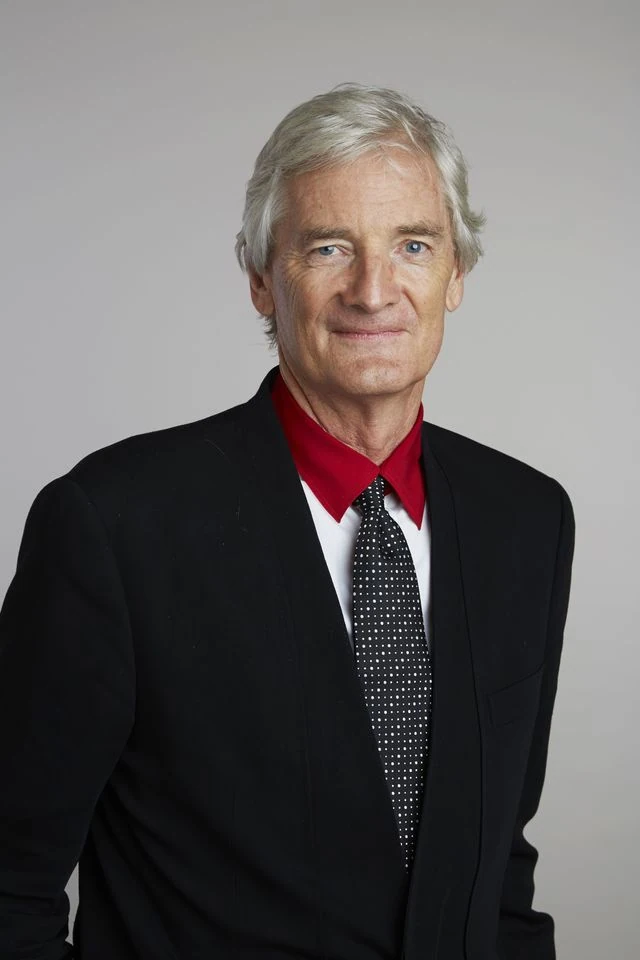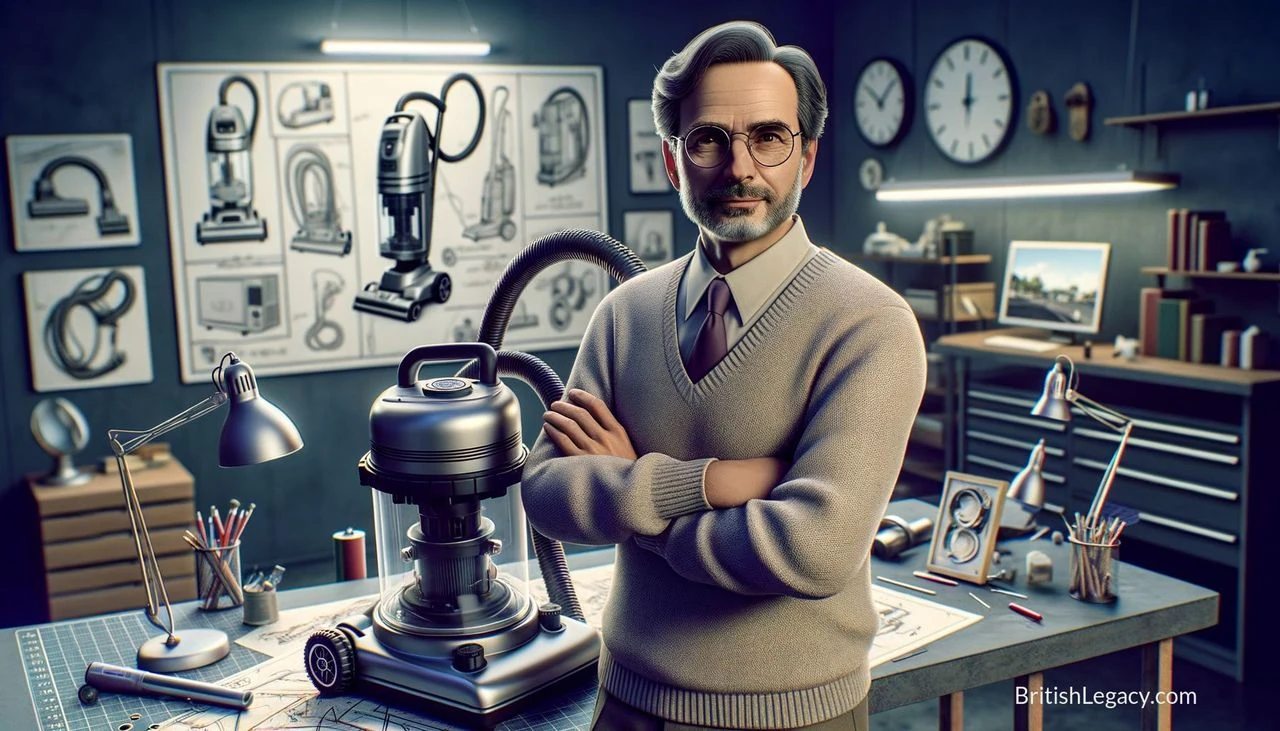
James Dyson’s best-known invention began with a familiar frustration: his Hoover Junior vacuum cleaner lost suction as its dust bag clogged. He set out to make a cleaner that separated dust from the airflow without relying on a bag. Five years and about 5,127 prototypes later, his G-Force cleaner was launched in Japan. British manufacturers had declined to take it on; Dyson eventually built a company around the technology they had rejected.
Learning to design by making
Dyson was born in Cromer, Norfolk, on 2 May 1947. He attended Gresham’s School in Holt before studying at the Byam Shaw School of Art from 1965 to 1966. At the Royal College of Art, where he studied furniture and interior design between 1966 and 1970, he moved towards product and industrial design. The structural engineer Anthony Hunt was among those who influenced that change.
His first original invention was the Ballbarrow, a modified wheelbarrow that replaced the conventional wheel with a ball to improve manoeuvrability. The design appeared on the BBC programme Tomorrow’s World. Dyson continued exploring the possibilities of a ball in place of a wheel: he invented the Trolleyball, a trolley for launching boats, and designed the Wheelboat, which could travel on both land and water.
Those early projects established a practical approach: identify a limitation in an ordinary object, then test a different mechanism. It would become central to his work on vacuum cleaners. Rather than accept the gradual loss of suction as inevitable, he treated it as a design problem that might be solved by separating dust from air more effectively.
Five years of prototypes
In the late 1970s, Dyson developed the idea of using cyclonic separation in a vacuum cleaner. His inspiration came from a sawmill that used cyclone technology to separate particles from air. He filed patents for a dual-cyclone cleaner in 1980, but manufacturers and distributors in the UK would not handle the product. One reason was that a bagless cleaner threatened a market built around replacement dust bags.
Dyson launched the G-Force in Japan in 1983, selling it through catalogues. Its bright-pink casing and high price made it a distinctive product; it sold for the equivalent of about US$2,000. The cleaner later won the International Design Fair Prize in Japan in 1991. The route from prototype to product was not a quick commercial triumph: Dyson’s account of the process is one of repeated testing, with about 5,127 prototypes developed over five years.
After British manufacturers rejected the design, Dyson set up his own manufacturing company, Dyson Ltd. In June 1993, he opened a research centre and factory in Malmesbury, Wiltshire, and launched the DC01. Promoted with the phrase “say goodbye to the bag”, the Dyson Dual Cyclone became the fastest-selling vacuum cleaner ever made in the UK. The design was no longer merely an alternative to established products: its success helped prompt other major manufacturers to sell their own cyclonic cleaners.
Dyson’s company later challenged Hoover in court over its Triple Vortex bagless cleaner. In 1999, the High Court found that Hoover had deliberately copied a fundamental part of Dyson’s patented designs; Hoover agreed to pay £4 million in damages. The case showed that protecting an invention could involve years of commercial and legal work as well as the engineering that produced it.
Design beyond the vacuum
The company extended its product range to other household appliances. In 2000 it introduced the ContraRotator washing machine, which used two drums rotating in opposite directions. The product was not a commercial success and was discontinued in 2005—a reminder that not every new design found a lasting market.
Other products proved more enduring. The Airblade hand dryer, launched in 2006, used a thin sheet of air to remove water from the skin rather than relying on heat. In 2009, Dyson introduced the Air Multiplier fan, with no external blades; heating, air-purifying and humidifying functions were added to later versions. The Supersonic hair dryer followed in 2016. In 2014, Dyson introduced the 360 Eye robotic vacuum cleaner, which used scanning and mapping to navigate.
Dyson also pursued electric-vehicle development. In 2017 he announced plans for a vehicle, backed by a team of more than 400 people and a proposed investment of £2 billion. The project was cancelled in 2019 because it was not commercially viable. Its cancellation belongs in the account of his work alongside the products that reached customers: ambition and investment did not guarantee a saleable design.
Research, education and recognition
Research and development became a substantial part of Dyson’s business. In 2014, he announced a further £1.5 billion investment in research and technology, including an expansion of the Malmesbury campus. In 2016, the company announced a second research and development centre at a former Ministry of Defence site in Hullavington, Wiltshire. Dyson said the expansion reflected the need to develop new technology and products as the business grew.
In 2017, he launched the Dyson Institute of Engineering and Technology at the company’s Wiltshire campus. He had also served as provost of the Royal College of Art from 2011 to 2017, returning to an institution central to his own development as a designer. The James Dyson Foundation, established in 2002, supports design and engineering education. Its work includes resources for schools and universities and the James Dyson Award, which recognises young design engineers.
His honours include the Prince Philip Designers Prize in 1997, appointment as a Commander of the Order of the British Empire in 1998 for services to industrial design, and a knighthood in 2007 for services to business. He was elected a Fellow of the Royal Society in 2015 and appointed to the Order of Merit in 2016. These distinctions recognised work spanning invention, industrial design and business, rather than a single appliance.
Why James Dyson deserves a place in British Legacy
Dyson’s place in British Legacy rests on a specific achievement: he took a design problem that manufacturers had little incentive to address and developed a product that changed competition in a familiar industry. The bagless cleaner depended on cyclonic separation, but turning the idea into a successful British business required more than a technical insight. Dyson spent years refining prototypes, filed patents, found a market in Japan and, after UK manufacturers declined the technology, established his own company and manufacturing base in Wiltshire. The later success of the Dual Cyclone and the spread of cyclonic cleaners among competitors demonstrate the reach of that work.
His career also connects invention with the systems that sustain it. Research centres, product development and engineering education became part of the business’s story, while the James Dyson Foundation and its award provide support and recognition for younger designers. Dyson’s record includes unsuccessful work as well as products that endured: the ContraRotator did not last, and the electric-car project was cancelled. Those outcomes make the achievement clearer, not smaller. His British legacy is not simply a catalogue of appliances or a claim that every venture succeeded. It is the example of an engineer who turned persistent experimentation into a major design-led company and helped make practical engineering more visible to the public.
Sources
James Dyson — Wikipedia revision 1378939333 · James Dyson — Wikipedia
Adapted in part from James Dyson by Wikipedia contributors, under CC BY-SA 4.0. Text has been edited and combined with the existing article; this adapted text is shared under the same licence. Contributor history.