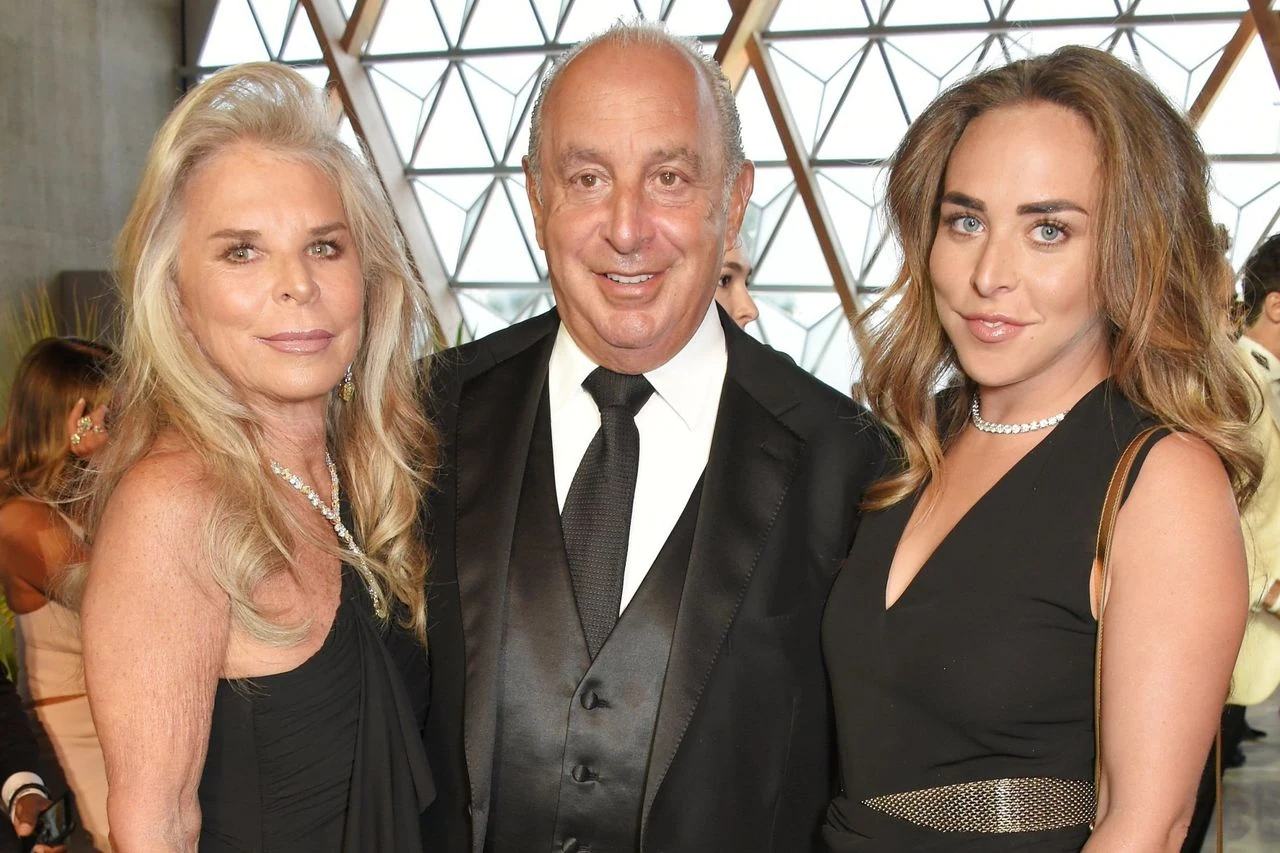
At its height, Philip Green’s Arcadia Group brought a large part of the British clothing high street under one owner. Topshop and Topman, Dorothy Perkins, Burton, Wallis, Evans and Miss Selfridge were among its brands; Arcadia also operated thousands of shops, concessions and overseas franchises. The group’s reach made Green one of the most prominent figures in British retail. Its administration in 2020, after years of pressure on high-street sales, marked the end of that business and exposed the risks behind its expansion.
A start in importing and discount retail
Philip Nigel Ross Green was born in Croydon on 15 March 1952. After leaving boarding school at 15 without O-levels, he worked for a shoe importer in east London. He travelled in the United States, Europe and the Far East, and, aged 21, started a business importing jeans from the Far East for London retailers. A family-backed loan helped him establish it. In 1979, he bought the stock of ten designer-clothing businesses that had gone into receivership, preparing the garments for resale through a shop he had acquired.
In 1988 Green became chairman and chief executive of Amber Day, a quoted discount retailer. Its shares initially performed well, but a series of profit downgrades followed. He resigned in 1992 after the company failed to meet its forecast. The episode preceded a change in scale: Green went on to acquire established retail businesses, while not every attempt succeeded. He made unsuccessful bids for Marks & Spencer in 1999 and 2004.
In 1999, Green acquired Sears plc. The following year he bought British Home Stores (BHS) for £200 million. In 2002, his wife Cristina Palos, known as Tina, purchased Arcadia, then a group of high-street clothing chains. The business was briefly owned by Green before being transferred to her; he served as its chief executive. Describing the deal simply as Green’s purchase of Arcadia misses that distinction.
Arcadia’s high-street reach
At its peak, Arcadia owned Topshop and Topman, Dorothy Perkins, Burton, Wallis, Evans, Miss Selfridge and Outfit. Its footprint included more than 2,500 outlets in the UK, concessions in department stores including Debenhams and Selfridges, and several hundred franchises abroad. BHS was part of Arcadia from 2009 until 2015. The group made Green a powerful presence in a sector whose familiar shops shaped the way many people encountered everyday fashion.
Topshop became the most visible of the group’s names. Its Oxford Street flagship in London was a prominent destination for shoppers, and the brand developed a following in the United States. The original article characterises Arcadia’s mid-2000s clothes as affordable and trend-setting and describes Topshop as an ambassador for British fashion. Those judgements reflect the brands’ public image, rather than measurable claims about how all customers dressed. More concretely, Arcadia’s stores and concessions gave its labels a substantial presence on British high streets and in department stores.
Green also had interests beyond his companies. He supported the Fashion Retail Academy and the Retail Trust. In 2010, Prime Minister David Cameron asked him to review government procurement and spending. Green’s report, published that October, argued that government was failing to use its purchasing scale and credit rating effectively, and identified poor data and processes as problems. Cameron welcomed the review. The commission showed how Green’s standing in retail had brought him into a debate about public-sector efficiency, although the report concerned government procurement rather than the performance of Arcadia.
BHS and the responsibilities of ownership
The fate of BHS became the most consequential controversy associated with Green’s business record. He had bought the retailer for £200 million in 2000 and sold it for £1 in 2015. When BHS entered administration in 2016, it had debts of £1.3 billion, including a pension deficit of £571 million. During Green’s 15 years of ownership, he and his family had received £586 million in dividends, rental payments and loan interest, according to the Wikipedia account used for this edition. The figures sharpened public and parliamentary scrutiny of what owners owe a company’s employees and pension scheme.
Green disputed the conduct of the inquiry into BHS and called for the chair of the Work and Pensions Select Committee, Frank Field, to resign. The committee chair responded that the deficit was a fact and that Parliament, not Green, decided who chaired its committees. The controversy continued after BHS’s collapse: in 2016 MPs backed a motion asking that Green’s knighthood be forfeited. The vote was not binding. In 2017 Green agreed to a voluntary settlement of £363 million for the pension scheme. He was not banned from being a company director in 2018.
There were also criticisms of Arcadia’s treatment of workers and its tax arrangements. Anti-sweatshop groups criticised conditions and pay in supply chains, and Green denied allegations about overseas factories. In 2010, Channel 4’s Dispatches alleged that workers in British factories used by the group were paid less than half the legal minimum wage. Green was also targeted by the activist group UK Uncut over alleged corporate tax avoidance. These were contested and politically charged issues; they formed part of the scrutiny surrounding his businesses, rather than a substitute for the specific record of BHS.
Administration and a divided record
Arcadia’s difficulties unfolded as retail shifted towards online shopping and high-street sales weakened. The COVID-19 pandemic further affected sales in 2020. On 30 November, the group entered administration. During the pandemic, it closed 550 UK stores and furloughed 14,500 workers; the company publicly sought taxpayer support for the furloughed staff. In 2021, ASOS acquired the Topshop, Topman and Miss Selfridge brands. The sale preserved those names under new ownership, but it did not restore Arcadia as the large group that had operated them.
Green was made a Knight Bachelor in the 2006 Birthday Honours for services to the retail industry. That honour remained a subject of controversy after BHS’s collapse, but the parliamentary motion calling for its removal was not binding and the honour was not forfeited. His career therefore resists a single, uncomplicated verdict: it includes the creation of a far-reaching retail group, public service as a government procurement reviewer, and scrutiny of corporate decisions with serious consequences for workers and pensioners.
Why Philip Green deserves a place in British Legacy
Green belongs in a history of British business because Arcadia’s rise and collapse illuminate the scale and influence of the high-street clothing trade. The group’s thousands of UK outlets, department-store concessions and overseas franchises carried brands such as Topshop, Burton and Dorothy Perkins to a wide public. Topshop’s Oxford Street flagship became a conspicuous London retail destination, while the group’s range showed how a single owner could gather distinct labels into a powerful presence on British shopping streets. This is a specific part of Britain’s commercial and cultural history: the shops, brands and choices through which fashion became part of everyday life.
That legacy also requires attention to what happened when the business model failed. BHS’s £571 million pension deficit and the £363 million settlement agreed for its scheme make the responsibilities of ownership more than an abstract question. Arcadia’s administration and the later sale of three of its best-known brands show how dramatically a high-street empire can change as consumer habits and sales shift. Remembering Green in British Legacy means holding both parts of the record together: the breadth of the retail operation he helped lead, and the disputes over the effects of business decisions on employees and pensioners. That tension makes his career useful for understanding not just a prominent retailer, but the obligations and vulnerabilities of British commerce.
Sources
Philip Green — revision 1379071597 · Philip Green
Adapted in part from Philip Green by Wikipedia contributors, under CC BY-SA 4.0. Text has been edited and combined with the existing article; this adapted text is shared under the same licence. Contributor history.