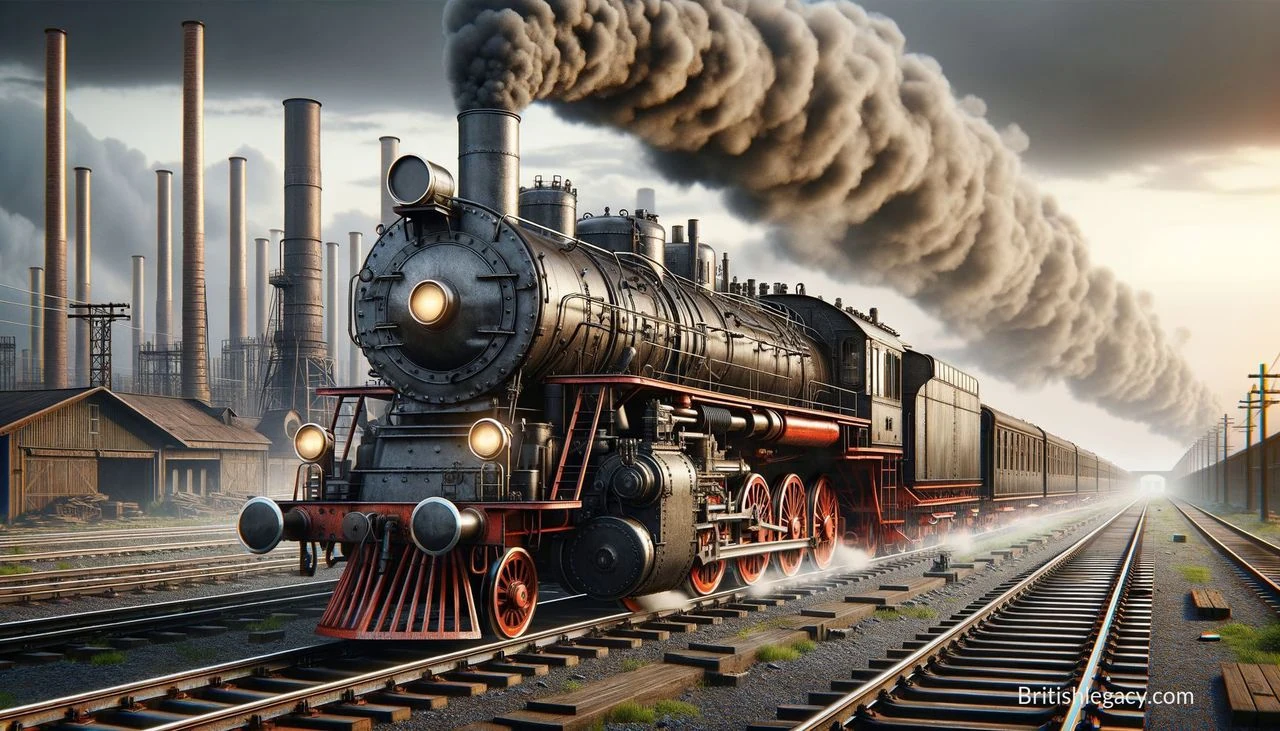
The railway locomotive did more than move a train. In Britain, it altered the practical size of the country. Journeys that had depended on the pace of a horse, the turn of a canal boat or the reach of a local market could be organised by timetable, volume and speed. Coalfields, ports, factories and towns drew closer together. George Stephenson stands at the centre of that change, not as the sole inventor of steam traction, but as an engineer who helped make it reliable and useful on public railways.
Steam locomotives had precedents before Stephenson’s work: Richard Trevithick and other engineers had already explored the possibility of steam-powered rail travel. Stephenson’s contribution was to join engines, track, routes and commercial purpose into a workable system. From the collieries of Northumberland to the Stockton & Darlington and Liverpool & Manchester railways, he helped turn locomotive power from an experiment into a practical instrument of transport.
Learning among the coalfields
Stephenson was born at Wylam, near Newcastle upon Tyne, in 1781. He had little formal schooling. As a young man working around the North-East coal industry, he paid for lessons in reading, writing and arithmetic. His education was closely connected to the machines he encountered at work: engines, rails and wagons were not abstractions but equipment expected to do a job day after day.
That experience shaped an approach grounded in observation, repair and improvement. At Killingworth Colliery, Stephenson worked on engines and on the practical problems of moving coal. A locomotive was useful only if it could haul its load, work with the track and prove dependable enough for regular service. An engine that slipped, damaged rails or cost too much to run could not transform transport, whatever its ingenuity.
In 1814, Stephenson built a locomotive called Blucher. The supplied account identifies it as the first locomotive to use flanged wheels on smooth iron rails. The detail illustrates the connected nature of his work: progress depended not simply on producing an engine, but on understanding the relationship between wheels and rails, and how a machine could haul a load along a working line.
That practical focus matters when describing his achievement. Stephenson did not create the idea of steam traction from nothing. He helped address the harder question of whether a locomotive could be strong, dependable and economical enough to earn its place in regular transport. His importance lies in developing and applying railway engineering, not in claiming an isolated first for every element of the technology.
Stockton and Darlington: steam enters public life
The Stockton & Darlington Railway offered a decisive public test. Conceived by Edward Pease and George Stephenson to connect a coalfield with Darlington and Stockton, the scheme had considered horse traction. Stephenson helped persuade its promoters that steam locomotives could be worth the risk and worked on a line suited to their use.
The railway opened on 27 September 1825, with Locomotion No. 1. Its significance was larger than the performance of one engine. The line became the first public railway designed for locomotives, and Locomotion No. 1 carried passengers on a public rail line. Steam haulage, already explored in other settings, had become an event in public life: visible to travellers, merchants, investors and those still uncertain about the new technology.
The opening also marked a step in the development of standard gauge. Stockton & Darlington used a track spacing of 4 ft 8½ in, influenced by earlier wagonway practice and carried forward through Stephenson’s work. Gauge is a technical measurement with far-reaching practical consequences: it affects whether engines, wagons and traffic can move between connected lines. A common standard can make a railway system easier to extend and use.
It would be misleading to present Stephenson as the sole originator of that measurement. Its history reached back into earlier railway practice. His significance was in fixing and extending a gauge that later became standard, as part of a broader effort to make railway operation consistent. The wider lesson of Stockton & Darlington was that locomotives, track and commercial purpose had to work together.
Rainhill and the test of the Rocket
Four years later, the Rainhill Trials helped determine what kind of locomotive might serve the Liverpool & Manchester Railway. Held in October 1829, the trials asked competing engineers to demonstrate engines capable of performing on the demanding route. Stephenson’s name became closely associated with the winning locomotive, Rocket, but the event is best understood as a test of practical performance, rather than a simple contest in spectacle.
Five machines competed: Cycloped, Novelty, Perseverance, Sans Pareil and Rocket. Rocket was the only one to complete the trials successfully. It averaged 12 miles per hour and reached 30 miles per hour. These figures helped make its case, but reliability mattered just as much. A railway company needed an engine it could trust with the substantial commitments of investment, timetables and public confidence.
The design brought together features including a multi-tube boiler and a blast-pipe in a form influential to later locomotives. That does not mean every element was invented by Stephenson or that subsequent engineers had nothing left to improve. It does mean that Rocket presented a persuasive practical model at a moment when railway promoters needed to decide whether locomotive power could be depended upon.
The Liverpool & Manchester Railway opened on 15 September 1830. Rocket was involved in the accident near Parkside in which William Huskisson MP was fatally injured. The tragedy belongs in an account of the opening, not as a footnote that obscures the line’s wider importance. The railway demonstrated the possibility of locomotive-powered travel between major urban centres, while making the danger and discipline of the new form of mobility painfully clear.
Engineering the railway, not just the engine
Stephenson’s work cannot be reduced to a single locomotive. A railway had to be designed as a system: the permanent way, gradients, bridges, tunnels, cuttings, traffic and motive power all had to fit together. A powerful engine could not compensate for a route that it could not use effectively. Stephenson’s engineering therefore extended beyond the machines themselves to the infrastructure that allowed them to operate.
The Liverpool & Manchester Railway involved the Sankey Viaduct, the skew bridge at Rainhill, the Wapping Tunnel and the Olive Mount cutting. These structures show the scale of the practical challenges involved in creating a railway route. They also help explain why Stephenson’s locomotive work had such broad consequences: the engine became useful through its place in a line built to carry it.
Railway engineering required decisions about width and gradients as well as bridges and tunnels. Stephenson’s preference for standard width and relatively gentle gradients formed part of this integrated approach. His adopted gauge became standard on much of the world’s railway network. That spread was not inevitable or the result of one man’s work alone. But standards can make connections possible, and the gauge associated with Stephenson’s railways became an important inheritance of his engineering practice.
The effects of railway construction reached beyond the track. Railways accelerated the movement of coal, raw materials and finished goods, bringing industrial districts into closer connection with ports and cities. They made travel more regular and predictable, and towns that had once seemed distant became more accessible. The locomotive was the visible machine, but its influence depended on the networks that it helped bring into being.
Influence and recognition
Stephenson became a founder of the Institution of Mechanical Engineers and its first President in 1847. The appointment recognised a career that joined practical workmanship with the planning and construction of major infrastructure. His reputation as the “Father of Railways” can overstate the part played by any one engineer if taken literally. Railways and steam traction developed through the work of many people. Yet the title also reflects the breadth of Stephenson’s contribution: colliery engineering, public locomotive railways, major routes and a gauge that became widely adopted.
His achievement was not simply that an engine could move faster than a horse-drawn vehicle. He helped show that locomotive transport could be built into a repeatable system, supported by routes and structures and capable of carrying goods and passengers. That shift involved engineering, investment and public confidence. The railway became more than a novel machine in motion: it became infrastructure around which commerce and everyday journeys could be organised.
There is a useful distinction between the story of invention and the story of implementation. Earlier engineers established important precedents for steam locomotives. Stephenson’s work helped make the technology credible on public railways, and the projects associated with him helped turn a series of experiments into a transport network. His importance is clearest when those stages are understood together.
Why George Stephenson deserves a place in British Legacy
George Stephenson deserves a place in British Legacy because he helped make the steam locomotive a practical part of British public transport. The claim is more precise, and more revealing, than saying that he invented the railway locomotive outright. Trevithick and other engineers had established precedents; Stephenson’s contribution was to develop the technology and help put it to work. At Killingworth, Stockton & Darlington and Liverpool & Manchester, the locomotive moved from the world of experiment towards regular service. His work joined the machine to the route, and the route to the needs of industry and travellers.
The benefits of that achievement were tangible. Railways made the movement of coal and other goods faster and more regular, linked towns and industrial districts with ports and markets, and gave people a new way to travel between places. Stephenson’s significance also endures in the engineering of railway structures and in the adoption of a standard gauge that helped make networks compatible. The story is not one of solitary genius: it is one of practical engineering carried out in a wider tradition, with important earlier contributors and later improvements. Remembering Stephenson accurately honours both his particular achievement and the collaborative nature of technological change. He helped turn railway power into public infrastructure, and that infrastructure changed how Britain moved, traded and connected its communities.