
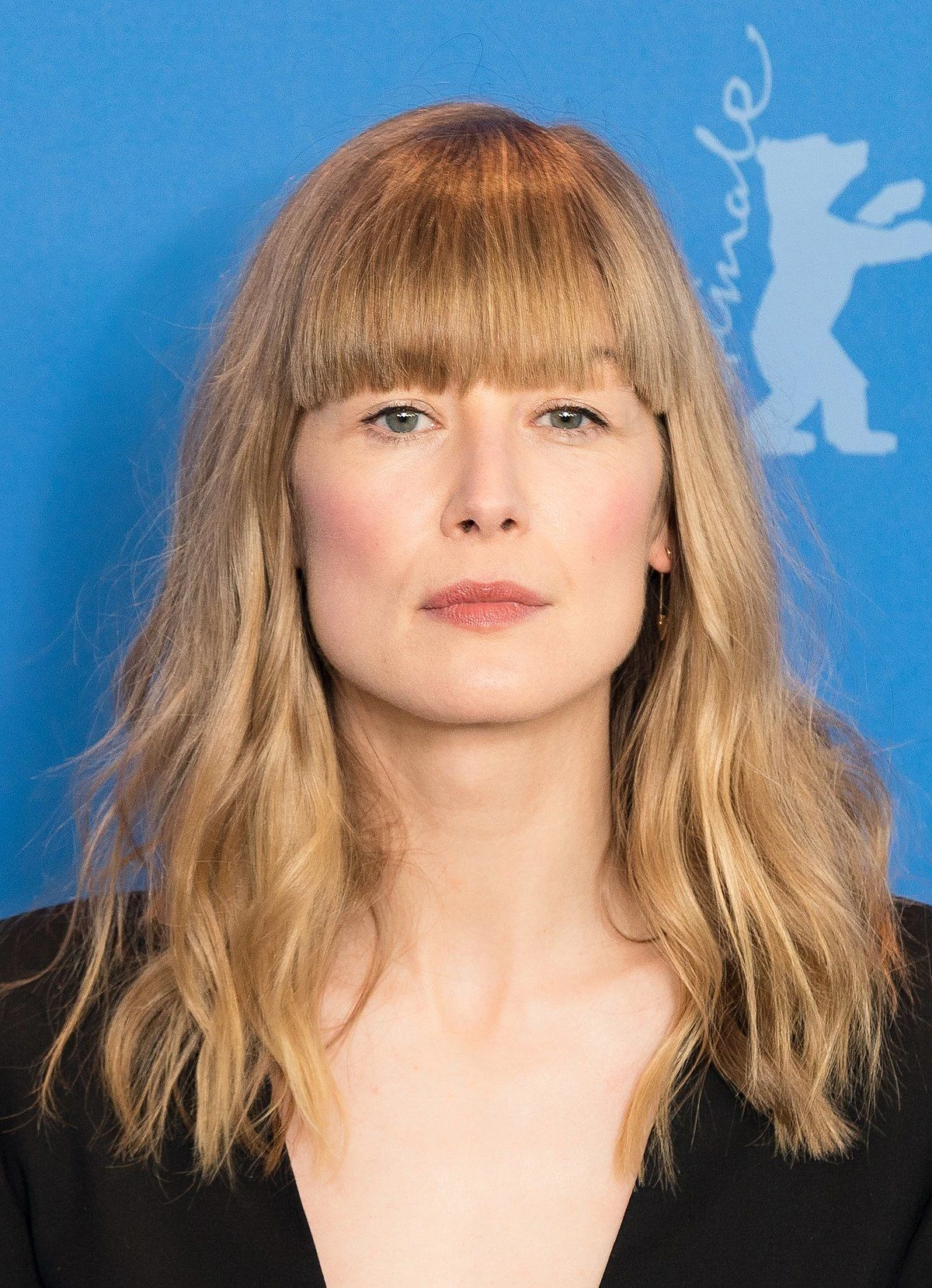
Rosamund Pike’s career has moved between intimate stage work, mainstream films and television, with roles ranging from Jane Bennet in Pride & Prejudice to the calculating Amy Dunne in Gone Girl. Her performance in the latter brought an Academy Award nomination. She has also worked as a producer and taken part in humanitarian initiatives, including becoming an ambassador for the Mines Advisory Group.
Oxford, theatre and an early screen career
Born in Hammersmith, London, in 1979, Pike was the only child of opera singers Julian Pike and Caroline Friend. She attended Badminton School in Bristol and developed an interest in acting while still young. As Juliet in a National Youth Theatre production of Romeo and Juliet, she attracted the attention of agent Dallas Smith, who helped her begin her professional career.
Pike went on to study English literature at the University of Oxford, where she was an undergraduate at Wadham College. She acted in and directed plays while at university, and took a year away from her studies to pursue acting work. Her stage experience included David Hare’s Skylight, Arthur Miller’s All My Sons and Shakespeare productions. She graduated in 2001 with an upper second-class honours degree.
Her early screen work included the television productions A Rather English Marriage (1998), Wives and Daughters (1999) and Love in a Cold Climate (2001). In 2002, she made her professional film debut as Miranda Frost, an MI6 agent, in the James Bond film Die Another Day. She later appeared in The Libertine (2004), playing Elizabeth Malet; the role earned her a British Independent Film Award for Best Supporting Actress.
From period dramas to Gone Girl
In Pride & Prejudice (2005), Pike played Jane Bennet, the elder sister of Keira Knightley’s Elizabeth. She continued to move between genres and formats, appearing in films including Fracture (2007), An Education (2009) and Made in Dagenham (2010). Her work also included West End theatre: she appeared in Terry Johnson’s Hitchcock Blonde, Tennessee Williams’s Summer and Smoke and the Donmar Warehouse’s West End season of Madame de Sade.
Pike’s portrayal of Amy Dunne in David Fincher’s psychological thriller Gone Girl (2014) became a defining screen role. The film, based on Gillian Flynn’s novel, centres on a woman who disappears on her fifth wedding anniversary. Pike’s performance received wide critical acclaim and brought nominations for the Academy Award and BAFTA for Best Actress, as well as nominations from several other awards bodies.
She followed the film with roles that continued to span different subjects and styles. In A United Kingdom (2016), she played Ruth Williams Khama; in A Private War (2018), she portrayed war correspondent Marie Colvin. For the latter, she received Golden Globe and Satellite Award nominations. Other credits include the science-focused biopic Radioactive, in which she played Marie Curie, and the thriller I Care a Lot (2020). Her performance in the latter won the Golden Globe for Best Actress in a Motion Picture – Comedy or Musical.
Television, voice work and producing
Pike’s work has extended well beyond feature films. She played Louise in the comedy series State of the Union (2019), winning a Primetime Emmy Award for Outstanding Actress. She later appeared as Moiraine Damodred in the fantasy series The Wheel of Time, released in 2021, and also served as a producer on the programme. Her television credits include voice roles in Thunderbirds Are Go, Watership Down and Moominvalley.
Her voice work has also included audiobooks and radio. In 2010, she voiced Pussy Galore in BBC Radio 4’s adaptation of Ian Fleming’s Goldfinger. She narrated James Bond audio books and later recorded books in Robert Jordan’s Wheel of Time series. In 2021, she starred in and executive-produced the scripted podcast Edith!, playing First Lady Edith Wilson in a dramatisation of the period when President Woodrow Wilson was incapacitated by a stroke.
Pike took on another producing role as an executive producer of Netflix’s 3 Body Problem (2024). In 2023, she appeared in Emerald Fennell’s film Saltburn. Her career has therefore encompassed acting across film, television, theatre and audio, alongside work behind the scenes as a producer.
Humanitarian engagement and a return to the stage
Pike has participated in advocacy as well as acting. In 2015, she signed an open letter organised by the ONE Campaign, urging Angela Merkel and Nkosazana Dlamini-Zuma to give attention to women as they set development priorities ahead of a United Nations summit. In 2021, she became the first ambassador for the Mines Advisory Group, which assists people affected by landmines, unexploded ordnance and small arms and light weapons.
After a 15-year absence from the stage, Pike returned in 2025 in Suzie Miller’s play Inter Alia at the Royal National Theatre. She won the Laurence Olivier Award for Best Actress for her performance. The role brought her back to the London stage after a career in which theatre had featured from its earliest years, alongside an expanding body of screen and audio work.
Why Rosamund Pike deserves a place in British Legacy
Pike’s British connection is grounded in her London birth, education in Bristol and Oxford, early work with the National Youth Theatre, and substantial British stage and screen credits. Her career also illustrates how an actor can move between different parts of the performing arts. From Shakespeare and West End productions to Bond, period drama and psychological thrillers, she has worked in forms that reach distinct audiences. Her performance in Gone Girl brought international recognition, while her Golden Globe-winning work in I Care a Lot and Emmy-winning television performance in State of the Union demonstrate the breadth of her achievements.
Her place in British Legacy also rests on the range of work beyond acting in films. Pike has returned to the stage, contributed voice performances to radio, audiobooks and animation, and taken producer and executive-producer roles. Her humanitarian engagement is more specific than a general claim of public advocacy: she signed a ONE Campaign letter on development priorities and became an ambassador for the Mines Advisory Group. That combination of British training and stage experience, internationally recognised screen work, and documented support for humanitarian causes gives her career cultural reach as well as variety. It is a record of sustained work across industries, rather than a legacy attached to a single celebrated role.
Sources
Adapted in part from Rosamund Pike by Wikipedia contributors, under CC BY-SA 4.0. Text has been edited and combined with the existing article; this adapted text is shared under the same licence. Contributor history.
.jpg)