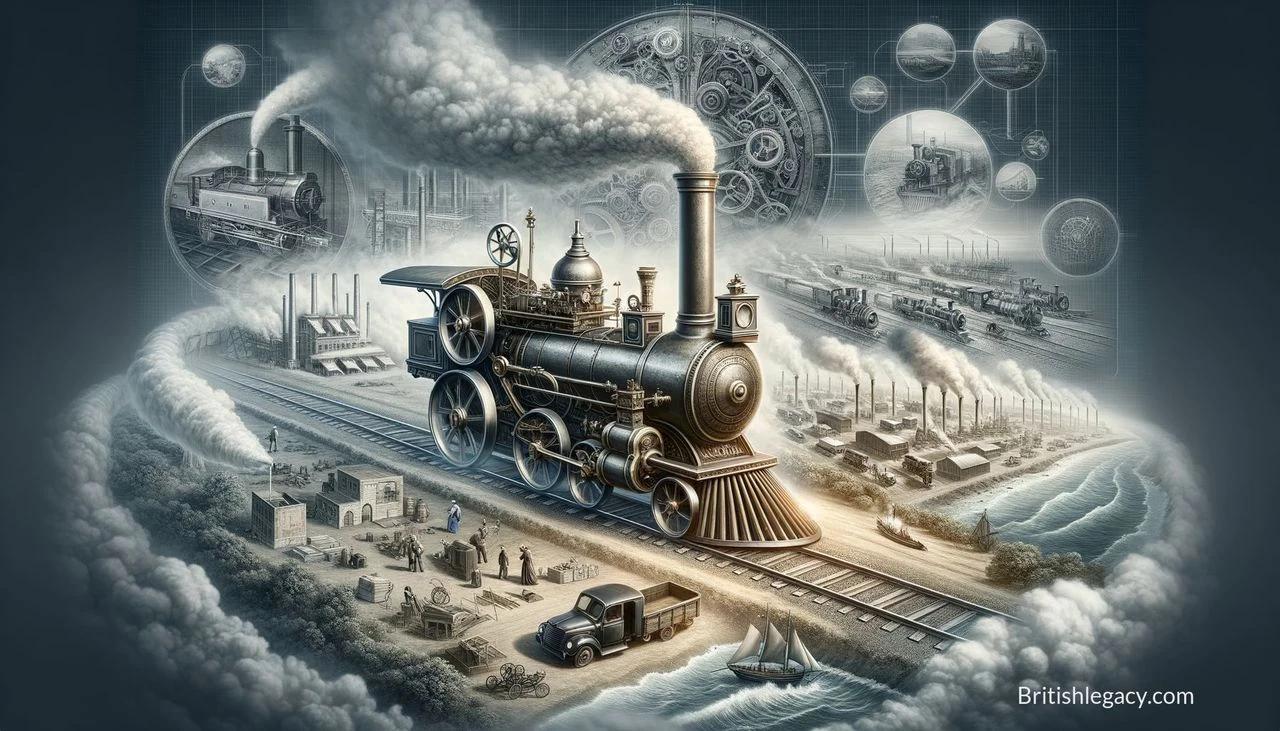
The first great age of steam began not with a railway whistle but beneath the ground, where water threatened to make Britain’s mines unworkable. In 1712, Thomas Newcomen produced a practical atmospheric engine for pumping water from mines in the Black Country. More than half a century later, James Watt identified a costly weakness in the machine and devised an improvement that made steam power substantially more efficient. With the manufacturing partnership of Matthew Boulton, Watt’s engine became more adaptable, helping power a shift from mine drainage to factory production. Their achievement was not a single invention made in isolation, but a sequence of practical engineering and commercial work that changed where people could obtain mechanical power.
Before steam, watermills and windmills supplied useful energy, but their location and operation depended on rivers, weather and geography. Steam engines offered a different possibility: a source of power that could be installed where work demanded it. The story starts with a pumping problem, yet leads towards mines, mills and factories, and eventually to steam-powered transport and electricity generation. Newcomen and Watt did not create industrial Britain on their own. They helped provide one of its essential conditions: controllable mechanical power.
Newcomen and the flooded mines
Thomas Newcomen was an English ironmonger from Dartmouth. He worked in an age when mining had to contend with water accumulating in deeper workings. If miners could not drain it, they could not reach the coal and other minerals beneath it. Newcomen’s engine addressed that immediate difficulty. An earlier inventor, Thomas Savery, had patented a steam-powered water pump in 1698; Newcomen’s achievement was to develop a commercially successful engine that could deliver continuous power to machinery.
The engine associated with the Dudley and Tipton area in the Black Country in 1712 helped pump water from mines. Its importance reaches beyond the machinery at the pithead. Drainage allowed access to minerals, especially coal, that were needed by the growing industries of the period. Coal could fuel furnaces and other engines, so the engine that helped extract it also supported the development of further industrial activity. By the time Newcomen died in 1729, at least 100 engines of this type were in use across Europe.
Newcomen’s machine used an atmospheric principle. Steam entered a cylinder beneath a piston. A jet of cold water then condensed the steam, creating a partial vacuum. Atmospheric pressure pushed the piston down; a beam and connecting rods conveyed that movement to the mine pump. The cycle turned heat into a repeated mechanical stroke, using components whose operation could be understood and maintained.
A practical engine with a costly weakness
The Newcomen engine was a practical breakthrough, but it consumed substantial fuel. Since the steam condensed inside the working cylinder, each cycle cooled the cylinder; it then had to be heated again by incoming steam. This repeated heating and cooling wasted heat. At a mine, where coal was available and removing water was essential, the trade-off could be worthwhile. Where fuel was less accessible, the engine was less economical.
That limitation helps explain why Watt’s contribution mattered. Newcomen had shown that steam could reliably power a machine, particularly a pump. The challenge was to reduce the energy wasted in the process and make the engine useful in a wider range of settings. Watt’s work did not erase the earlier achievement. It built on a working design and tackled the source of its inefficiency.
Watt’s separate condenser
James Watt was a Scottish instrument maker. In 1763, while repairing a model Newcomen engine for Glasgow University, he noticed how much steam was lost through repeatedly cooling and reheating the cylinder. His solution was to condense the spent steam in a separate vessel kept cool, while leaving the working cylinder hot. This separate condenser allowed the engine to avoid the wasteful temperature changes that had limited Newcomen’s design.
Watt developed the improvement in working form by 1765 and patented it on 5 January 1769. The principle was clear, but making it into dependable industrial machinery required years of effort. He continued to refine the engine and secure the manufacturing support needed to produce it. From 1775, he worked in partnership with Matthew Boulton in Birmingham. The first commercial Boulton & Watt engines were installed in 1776. They were pumping engines, but they showed that the improved design could work beyond the model and in commercial service.
The separate condenser was not Watt’s only contribution. His improvements included the double-acting engine, a throttle valve, a centrifugal governor, expansive working and the parallel motion linkage. Together, the improvements made Boulton & Watt engines about five times as efficient in fuel use as Newcomen engines. Their significance was not simply that a familiar machine performed better. Greater efficiency made steam power more economically useful beyond places where coal was immediately plentiful.
From pumping to factory work
A pumping engine moved its beam up and down. To power many forms of manufacturing, machinery needed continuous rotary movement. Watt designed rotative engines that converted the beam’s reciprocating motion into rotation suitable for mill work. A surviving Boulton & Watt rotative engine made in Birmingham in 1788 was double-acting and served as an early example of steam power applied to the firm’s own works.
This shift widened the engine’s role. Steam was no longer only helping mines remove water; it could drive manufacturing machinery directly. Factories had previously relied heavily on access to rivers for water power. Steam made it possible to site new factories more widely and to operate them throughout the year. Production could be concentrated around machinery rather than constrained as closely by the location and seasonal behaviour of a river.
The consequences reached across industries. Steam assisted coal mining; coal, in turn, supplied fuel for iron production and more engines. Textile manufacturers gained a steadier source of motion, while breweries, mills and foundries could consider transport, labour and markets without being tied so tightly to a suitable stream. Work that had been dispersed among cottages and small workshops could be brought together around machines. Production became more regular and could be undertaken at greater scale.
None of this means that the steam engine alone created the Industrial Revolution. It was one part of a wider transformation, and it depended on makers, fuel, investment and people able to use the machinery. But it supplied an important ingredient: mechanical power that could be controlled and placed where it was needed. That altered the relationship between industry and geography and helped make large-scale production more practical.
Steam moves beyond the factory
The development of steam did not stop with stationary engines. After 1800, high-pressure engines helped make steam small and powerful enough for transport. Richard Trevithick’s locomotive hauled a railway journey in south Wales on 21 February 1804. George Stephenson’s Locomotion worked on the Stockton and Darlington Railway in 1825. His Rocket helped define a later stage of railway development in 1829, before the Liverpool and Manchester Railway opened in 1830 using steam power for passengers and freight.
These locomotives were not simply Newcomen or Watt engines put on wheels. They belonged to later developments in steam engineering. But their story follows the same broad progression: the use of heat to produce motion, and the conversion of that motion into work. Steam engines also drove ships. Later, steam turbines took over much of marine propulsion and power generation. In the twentieth century, turbines became the dominant form of large-scale steam use in generating stations. The machinery changed, but the principle of turning heat into motion remained important.
Why the steam engine deserves a place in British Legacy
The steam engine deserves a place in British Legacy because its history shows how a local practical problem can lead to a wider change in how work is done. Newcomen’s engine was developed to pump water from mines. It helped people reach coal and other minerals that would otherwise have remained inaccessible. Watt then identified why the existing engine wasted heat and developed a separate condenser to improve its fuel economy. Boulton’s partnership provided manufacturing support, helping turn the improved design into commercial machinery. Across Dartmouth, the Black Country, Glasgow and Birmingham, the story belongs to a chain of engineering, improvement and production rather than to one isolated flash of inspiration.
The benefits were concrete. More effective mine drainage supported mineral extraction; improved fuel efficiency made steam useful beyond the coalfield; and rotary engines gave manufacturers a way to drive machinery without relying so closely on a river. Steam also became part of the later development of railways, shipping and power generation. These changes helped alter production and transport in Britain and influenced industrial development more widely. The story should not be made into a simple celebration: steam power belonged to an age of hard industrial labour and changing patterns of work. Its legacy is most meaningful when that context is recognised alongside its achievements. Newcomen and Watt helped turn steam from a demonstrated possibility into serviceable power. That transition reshaped what mines, factories and transport could do, and makes their work an enduring part of Britain’s engineering history.