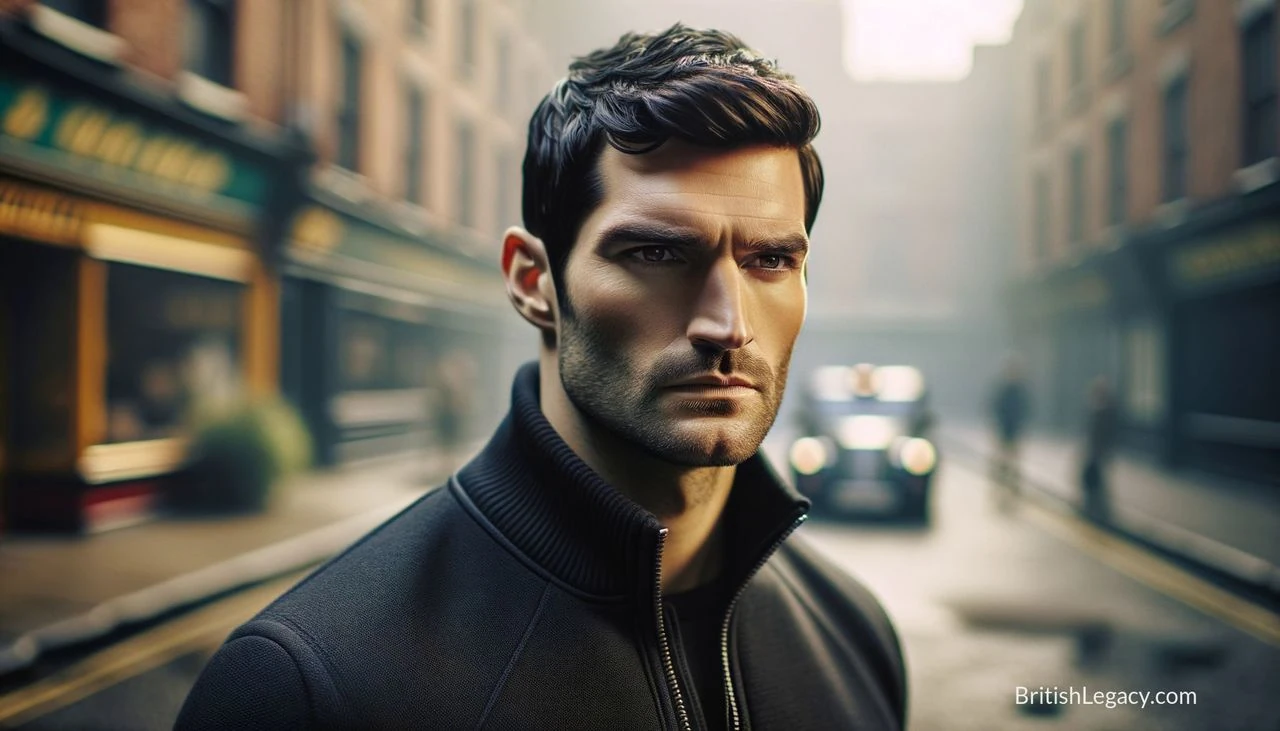
Tom Hardy’s career has taken him from a debut in a Second World War drama to a masked villain in a Batman film, a nearly silent wanderer in a post-apocalyptic action picture and a television gangster whose appearances can shift from menace to comedy. The variety is not incidental: he has built a body of work around characters with forceful, often unpredictable inner lives, moving between British stage and television work and major international productions.
Training and early roles
Edward Thomas Hardy was born in Hammersmith, London, on 15 September 1977, the only child of artist and painter Anne Barrett and novelist and comedy writer Edward “Chips” Hardy. He grew up in East Sheen and studied at Tower House School, Reed’s School and Duff Miller Sixth Form College before training at Richmond Drama School and the Drama Centre London.
In 1998, while studying at the Drama Centre, Hardy won a modelling competition on The Big Breakfast. He left the course early after being cast as Private John Janovec in the HBO-BBC miniseries Band of Brothers. His feature-film debut followed in Ridley Scott’s Black Hawk Down (2001). Early screen parts included the Reman Praetor Shinzon in Star Trek: Nemesis and roles in British productions such as RocknRolla.
He was also establishing himself on stage. His performances in Blood and In Arabia We’d All Be Kings earned him the 2003 London Evening Standard Theatre Award for Outstanding Newcomer. The latter brought a Laurence Olivier Award nomination. Hardy continued to work in theatre, including productions at the Royal Court, Hampstead Theatre, the Crucible in Sheffield and the National Theatre. In 2010, he appeared in The Long Red Road at Chicago’s Goodman Theatre.
Breakthrough and range
Bronson (2008), in which Hardy played the English prisoner Charles Bronson, brought him critical attention for a physically and vocally transformative performance. He gained three stone for the role. The part was a prominent step in his career, but not its beginning: by then he had already worked in film, television and theatre for several years.
In Christopher Nolan’s Inception (2010), Hardy played Eames, a skilled member of a team entering people’s dreams. The film introduced him to a much wider international audience and began a recurring collaboration with Nolan. Hardy later played Bane in The Dark Knight Rises (2012), and appeared as an RAF fighter pilot in Nolan’s Dunkirk (2017).
Other roles resisted a single screen persona. In the television drama Stuart: A Life Backwards (2007), Hardy played Stuart Shorter, a homeless man who had endured years of abuse. He was Heathcliff in the 2009 television adaptation of Wuthering Heights, and played Ivan Locke, the sole on-screen character in the film Locke (2013). These performances placed close attention on the pressures shaping a character, whether in a large ensemble or in an unusually confined setting.
Hardy’s 2015 films showed the breadth of his work at a particularly busy point. In Mad Max: Fury Road, he took on Max Rockatansky, conveying much of the character through physical action and sparse dialogue. In Legend, he played both Reggie and Ronnie Kray. In The Revenant, he portrayed John S. Fitzgerald, a role that brought him an Academy Award nomination for Best Supporting Actor. That year he also won the British Independent Film Award for Best Actor for Legend.
British television and international films
Alongside film, Hardy has taken significant roles in British television. He joined the BBC drama Peaky Blinders in its second series as Alfie Solomons, a Camden-based gang leader. His performance made Solomons a distinctive presence in the series, which ran from 2014 to 2022. Hardy also co-created Taboo with Steven Knight and his father, Chips Hardy, and starred as James Delaney in the BBC One drama, which he co-produced.
His film work has continued to move between different scales and genres. He played Eddie Brock, whose relationship with the alien symbiote Venom drives Sony’s Venom films. The first film appeared in 2018; Hardy returned for Venom: Let There Be Carnage (2021) and Venom: The Last Dance (2024). He also played Al Capone in Capone (2020), and appeared in the 2023 film The Bikeriders. The sequence of roles demonstrates a career that has not depended on one kind of production: television drama, independent films and franchise pictures have all formed part of it.
Recognition has followed across several fields. Hardy received the BAFTA Rising Star Award in 2011 and was appointed a Commander of the Order of the British Empire in the 2018 Birthday Honours for services to drama. His honours sit alongside nominations for major film, television and theatre awards, reflecting work across those different forms rather than a career confined to cinema.
Work beyond acting
Hardy’s work has also included writing, producing and collaboration with other artists. He co-created and co-produced Taboo, and served as an executive producer on television projects including A Christmas Carol (2019). His involvement with the Venom films extended beyond acting: he co-wrote the story for the second film. These roles behind the camera add a production dimension to a career more commonly identified with performance.
His early interest in hip-hop included recording a mixtape with Edward Tracy in 1999, which remained unreleased until 2018. Later, Hardy collaborated with the hip-hop collective Czarface under the name Frankie Pulitzer. He is also an ambassador for the Prince’s Trust, a British youth charity that supports young people through training, mentoring and other forms of practical assistance. These activities are distinct from his screen career, but they show the range of work and public commitments associated with his name.
Why Tom Hardy deserves a place in British Legacy
Tom Hardy’s place in British Legacy rests on an identifiable contribution to British acting and screen culture: a career that connects theatre, British television and international film without being confined to any one of them. His early stage work earned professional recognition in London, while roles in productions such as Stuart: A Life Backwards, Peaky Blinders and Taboo made British television an important part of his working life. He has also taken British stories and settings to audiences through projects including Legend and Dunkirk, while working with directors on films made for global audiences.
His performances show how a British actor can move between forms and scales: from the contained drama of Locke to the physical demands of Mad Max: Fury Road, from a supporting role in The Revenant to a long-running comic-book film character. That range is a more concrete legacy than broad claims of national “excellence”. Hardy’s BAFTA Rising Star Award and CBE recognise, in different ways, his place in the profession; his Prince’s Trust ambassadorship also connects his public profile with a British organisation supporting young people. Together, these achievements make his career relevant to a record of British performers whose work travels internationally while remaining connected to the country’s stages, broadcasters and cultural institutions.
Sources
Tom Hardy — Wikipedia, revision 1379301594
Adapted in part from Tom Hardy by Wikipedia contributors, under CC BY-SA 4.0. Text has been edited and combined with the existing article; this adapted text is shared under the same licence. Contributor history.