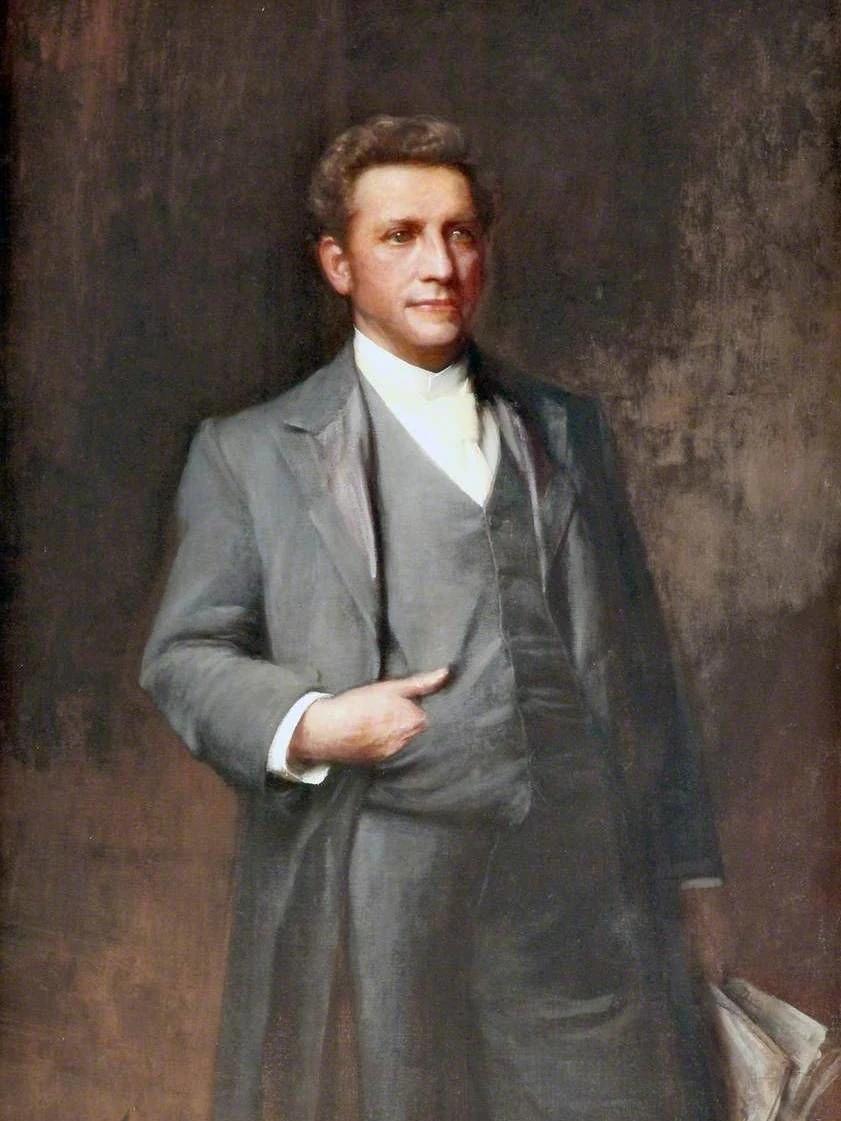
William Hesketh Lever began work in his father’s Bolton grocery business at 15. He went on to build a soap enterprise whose brands included Sunlight, Lifebuoy and Lux, and to establish Port Sunlight on the Wirral. His career joined ambitious marketing and large-scale manufacturing to philanthropy and civic projects. It also left harder questions: the model village that offered workers better housing was governed by rules that intruded on their lives, while Lever’s African business relied on a colonial system of forced labour.
From the family shop to Sunlight Soap
Born in Bolton on 19 September 1851, Lever was the eldest son of grocer James Lever and Eliza Hesketh. He attended local schools, including Bolton Church Institute, before joining the family business shortly after his fifteenth birthday. His early jobs included sweeping and practical work in the wholesale trade. Later he reorganised the firm’s accounts and worked as a travelling sales representative, gaining experience in buying, selling and the differences between branded goods and commodities.
In 1879 the family business acquired a failing wholesale grocer in Wigan, giving Lever a chance to manage an expanding operation. His work involved finding suppliers in Ireland, France and elsewhere in Europe. He developed an interest in advertising and branding, and in 1884 set his sights on making soap as well as selling it. Instead of selling soap by weight, his plan was to offer products in smaller, individually wrapped bars under recognisable names. He registered Sunlight among a series of trade marks.
At first, Lever relied on outside soap-makers to produce goods to his specifications. Problems with consistency prompted him to take control of production. In August 1885, Lever and Company added soap manufacturing to its business. The arrangement should be distinguished from the establishment of Lever Brothers: the company was set up with his brother James in 1886. Its early growth rested on making soap from vegetable oils and selling it under a distinct brand. Sunlight’s range included soaps differentiated by colour and a product marketed for washing clothes.
Lever’s advertising helped turn that brand into a household name. Posters, billboards, product instructions, competitions and promotional publications carried messages about the convenience of soap and the work of keeping a home. The company also expanded overseas, establishing factories in several countries by 1900, while adding brands such as Lifebuoy, Vim and Lux. Its marketing was inventive, but it also used persuasive appeals directed at women, including claims that housework accelerated ageing.
Port Sunlight: housing, community and control
When the Warrington production site could no longer meet demand, Lever sought a larger location near Birkenhead. He bought land on the Wirral in 1887, where the soap works and Port Sunlight village took shape. The community was designed to house employees and provide amenities. Its housing and facilities represented a substantial investment in workers’ surroundings, and the village became a lasting part of Lever’s public reputation.
That provision came with conditions. The village’s tied cottages meant that a worker who lost a job could also lose a home. Company authority extended into aspects of social life, and some employees resented what they regarded as paternalistic oversight. Port Sunlight’s history is therefore not simply a story of improved housing: it also shows how employer-provided benefits could increase an employer’s power over the people who depended on them.
Lever did sometimes allow residents a say in local decisions. In 1900 a temperance establishment known as the Bridge opened in the village. When residents sought a licence, he called for a referendum that included women, with a 75 per cent threshold for approval. More than 80 per cent voted in favour. Although petitions asked him to override the result, Lever did not do so. The episode offers a specific example of a decision made by local vote within a community where many other arrangements remained under company influence.
Business ambition and a public reckoning
Rising prices for soap-making materials put pressure on the industry in 1906. Lever took part in efforts to coordinate soap-makers, an arrangement intended to control competition and prices that became known as the Soap Trust. The proposal attracted a hostile press campaign. The Daily Mail and other newspapers accused the combine of harming consumers and workers; Lever rejected attacks on his integrity and sued Associated Newspapers for libel.
The case opened in Liverpool in July 1907. The defendants withdrew their imputations and apologised, and a settlement followed. Lever received damages, including £50,000 agreed during the proceedings and a further sum from individual newspapers. Rather than use the money to shore up Lever Brothers, he gave it to the University of Liverpool, supporting areas that included town planning, tropical medicine and Russian studies. The episode combined a genuine legal victory with a public controversy over the business practices that had prompted the press campaign.
Lever also entered politics. A Liberal, he represented Wirral as an MP from 1906 to 1909 and used his maiden speech to call for a national old-age pension. He was made a baronet in 1911, became Baron Leverhulme in 1917 and was elevated to viscount in 1922. The title’s “Hulme” element honoured his wife, Elizabeth, whom he had married in 1874. He died at his Hampstead home on 7 May 1925, aged 73, and was buried at Christ Church, Port Sunlight.
Empire, Lewis and the limits of his schemes
Lever’s expansion depended on raw materials, including palm oil. In 1911 he secured a concession in the Belgian Congo and established Huileries du Congo Belge, a subsidiary of the Lever consortium. The company expected to provide services such as schools, hospitals and rations, but its demands for labour did not attract enough voluntary workers. It turned to the Belgian colonial authorities, whose forced-labour system enabled recruitment. Historical accounts of the enterprise describe the gap between its claims of socially minded business and the harsh conditions and coercion involved. Lever’s record in Africa cannot be reduced to the benevolent language used to promote his projects.
In 1918 Lever bought the Isle of Lewis, followed by South Harris in 1919. He planned an integrated fishing business, with improved harbour facilities, processing plants, refrigerated transport and retail outlets. The enterprise included Mac Fisheries, which grew into a chain of more than 400 shops. But his development plans clashed with crofters and supporters of land reform on Lewis. In 1919, people began occupying farms and dividing land into plots. Lever opposed the land raids, while refusing to prosecute the ex-servicemen involved, and pressed instead for islanders to join his industrial scheme.
The dispute was not resolved on his terms. In 1920, amid financial pressures, he announced that he would abandon development in rural Lewis and concentrate on Stornoway and Harris. In 1923 he offered land to local bodies; Stornoway accepted land and established a trust, but the larger Western Isles scheme did not endure. After his death, Lever Brothers ordered development on Harris to stop. His experience there illustrates the limits of applying a centrally designed commercial plan to communities with their own livelihoods and priorities.
Art, education and civic gifts
Lever collected art from the 1890s and used imagery in the promotion of soap. He founded the Lady Lever Art Gallery at Port Sunlight in 1922, dedicating it to Elizabeth. The gallery placed his collection in a public institution and remains a prominent part of the village’s cultural landscape.
His benefactions also reached Bolton and beyond. He bought and restored Hall i’ th’ Wood as a museum, donated land for Lever Park and for Bolton’s Leverhulme Park, and supported the development of Bolton School. He endowed a school of tropical medicine at Liverpool University and gave Lancaster House in London to the British nation. The Leverhulme Trust was established to fund education and research. These were distinct gifts and institutions; the Trust was not an institution of Liverpool University.
Why William Lever deserves a place in British Legacy
Lever’s place in British history rests on more than the scale of his business. He helped make branded, packaged soap a recognisable part of everyday commerce, built manufacturing capacity and developed advertising methods that competitors adopted. His company’s growth helped create an enterprise that became part of Unilever. Port Sunlight, the Lady Lever Art Gallery and the public projects he supported in Bolton are also tangible legacies: they connect industrial wealth to housing, cultural access, education and public space.
A worthwhile account of that legacy must also retain its qualifications. Port Sunlight offered homes and amenities, but tied housing and company oversight restricted workers’ independence. In the Belgian Congo, the company’s need for labour became entangled with forced recruitment under colonial authorities. On Lewis, Lever’s ambitious economic scheme collided with demands for land and the continuation of crofting. Those contrasts make his story more instructive, not less significant. They show the reach of industrial power in Britain and overseas, and the mixed consequences of a model in which one employer or benefactor could shape work, housing and community life. Remembering both the achievements and the costs gives British Legacy a fuller account of how commercial influence can leave a durable mark on places and people.
Sources
William Lever, 1st Viscount Leverhulme · William Lever, 1st Viscount Leverhulme
Adapted in part from William Lever, 1st Viscount Leverhulme by Wikipedia contributors, under CC BY-SA 4.0. Text has been edited and combined with the existing article; this adapted text is shared under the same licence. Contributor history.