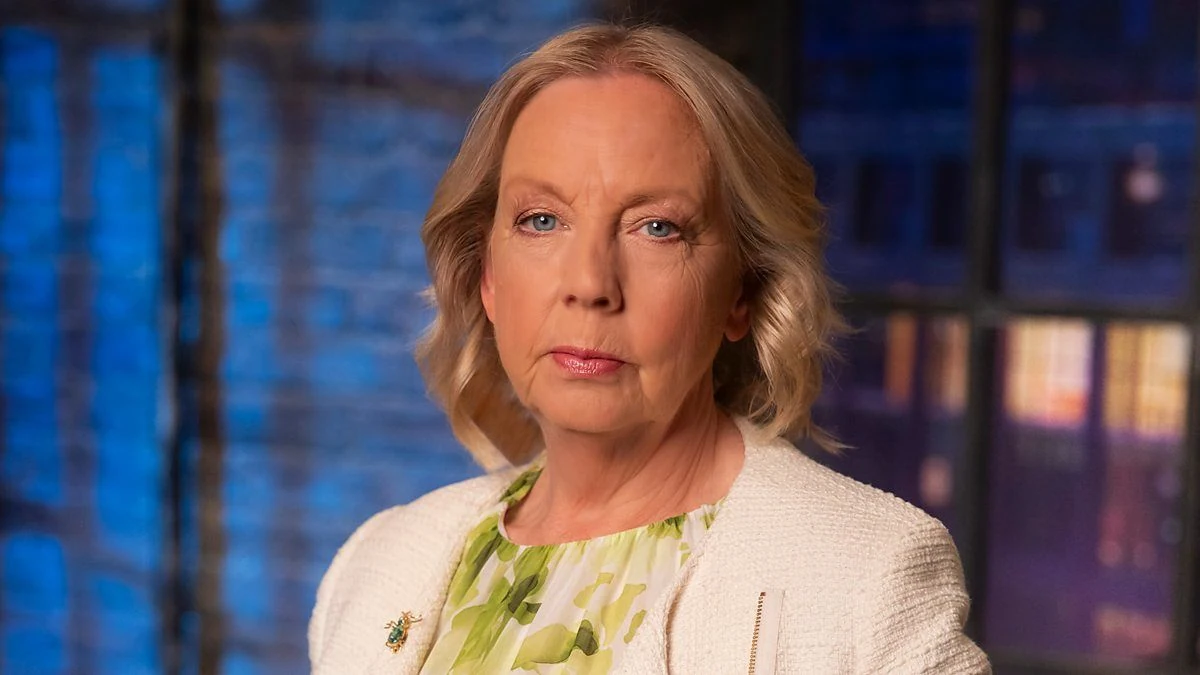
Deborah Meaden’s business career has taken her from a glass and ceramics export agency in Italy to the boardroom of a family holiday company and, from 2006, the television pitches of the BBC’s Dragons’ Den. The route was not a simple rise from one success to another: her first company failed, and she later sold out of a textile franchise before moving into leisure and retail. Her work at Weststar Holidays brought her to wider prominence; television then made her a familiar face to viewers considering how businesses grow, raise money and make their case.
Early ventures and a move into leisure
Meaden was born in Taunton, Somerset, on 11 February 1959. After her parents divorced, her mother moved with Meaden and her older sister to Brightlingsea in Essex. Meaden attended Godolphin School in Salisbury for a time, then Trowbridge High School, leaving at 16. She studied business at Brighton Technical College and worked as a sales-room model in a fashion house after graduating.
At 19, she moved to Italy and set up an agency exporting glass and ceramics. Its products reached retailers including Harvey Nichols, but the business failed after 18 months. She and a partner later bought one of the first Stefanel textile franchises in the UK, based in the West Country. Two years later, Meaden sold her share to her partner for £10,000. She went on to take part in several leisure and retail businesses, including operating a prize-bingo venue at Butlin’s in Minehead.
In 1988, Meaden joined her family’s business, running its amusement-arcade operations. Four years later she moved to Weststar Holidays, a family-owned holiday-park operator based in Exeter, with its main sites in south-west England. This was the business that would define her early career as an owner and operator.
Building and selling Weststar Holidays
Meaden led a management buyout of Weststar in 1999 and acquired a majority shareholding. By the time she began selling her interest, the company was providing holidays for more than 150,000 people a year and had earnings before interest, tax, depreciation and amortisation above £11 million. Those figures give a more concrete measure of the company’s scale than general claims of rapid growth.
The exit took place in stages, rather than in a single sale. In 2005, Weststar was sold to Phoenix Equity Partners in a deal worth £33 million, and Meaden made a partial exit. In August 2007, the business was sold to Alchemy Partners for £83 million; Meaden’s remaining 23 per cent stake was liquidated, with the stake valued at about £19 million. The distinction matters: the £33 million figure relates to the earlier sale, while the later transaction completed the disposal of her remaining holding.
Her work was not confined to holiday parks. In 2009, she acquired Somerset textile mill Fox Brothers alongside fellow shareholder Douglas Cordeaux, a former design director at Pepe Jeans London. The mill, established in 1772 and based in Wellington, was also part of a wider effort to sell British-made goods: in 2011, Meaden launched The Merchant Fox, an online shop for luxury products presented with their provenance.
From investor to television personality
Meaden joined Dragons’ Den in August 2006, entering the third series alongside Richard Farleigh as investors. The BBC Two programme gives entrepreneurs the opportunity to present business proposals to a panel of potential investors. Meaden’s role on the panel connected her experience of building and selling companies with a public format in which founders must explain their plans, costs and prospects.
Her television work has extended beyond the Den. In 2013, she took part in the eleventh series of Strictly Come Dancing, partnered with Robin Windsor, and was eliminated on 26 October. Across her television career she has also appeared on programmes including Have I Got News for You, Pointless and Good Morning Britain. These appearances sit alongside, rather than replace, her work as a businesswoman.
Meaden has also written for younger audiences. She published Common Sense Rules in 2009. In 2023, she published Why Money Matters, aimed at children aged six to nine and illustrated by Hao Hao; the following year, Deborah Meaden Talks Money was aimed at young adults. The titles place financial understanding and business experience in a form intended for readers at different stages of life.
Environmental work and public roles
Meaden’s involvement in environmental organisations is more specific than broad descriptions of her as an ethical investor. She is a member of the World Wildlife Fund’s Council of Ambassadors, an ambassador for the Marine Conservation Society and the Dogs Trust, and an ambassador for the Tusk Trust. She joined Tusk’s board of trustees in 2016. She has also co-presented The Big Green Money Show on BBC Radio 5 Live with Felicity Hannah. Beginning in March 2022, the weekly series examined how businesses and individuals were responding to climate change.
Those roles establish an active connection with conservation and environmental discussion, but they do not by themselves demonstrate that every business in which Meaden invests follows a particular ethical or sustainability standard. Her public work is better understood through the organisations and programmes in which she has taken part than through sweeping claims about the character of her entire investment portfolio.
Her business interests have also intersected with local planning. In 2009, a planning inspector described her evidence to an inquiry as “implausible” in a dispute over village-green status for land on which Mudstone LLP, a firm in which she was a partner, wished to build 48 homes. The episode is a matter of public record and a reminder that business activity can bring scrutiny as well as commercial success.
Why Deborah Meaden deserves a place in British Legacy
Meaden’s place in British Legacy rests first on a substantial, identifiable record in British business. She joined Weststar Holidays, led its management buyout and built a majority stake in a company serving more than 150,000 holidaymakers annually. The business’s two-stage sale, including the £33 million 2005 transaction and the £83 million sale in 2007, shows both the scale of the operation and the complexity of a business exit. Her later involvement with Fox Brothers and the launch of The Merchant Fox connect her work to a Somerset textile mill and the sale of British-made goods. These are tangible links to regional enterprise, employment and commerce, rather than abstract claims about national character.
Her television career has brought business decision-making into a format watched by a broad audience. On Dragons’ Den, she is part of a panel to which entrepreneurs present ideas and seek investment; her own earlier experience of failed ventures, operating leisure businesses and selling a major company gives that public role a business history behind it. Her books for children and young adults extend her work into financial education, while her roles with conservation organisations and on a climate-focused radio programme show how she has taken part in environmental debate. Together, those strands make her career relevant to a British legacy concerned with enterprise in practice: building companies, communicating about business and engaging with the social and environmental questions around it.
Sources
Deborah Meaden — Wikipedia revision 1378634039
Adapted in part from Deborah Meaden by Wikipedia contributors, under CC BY-SA 4.0. Text has been edited and combined with the existing article; this adapted text is shared under the same licence. Contributor history.