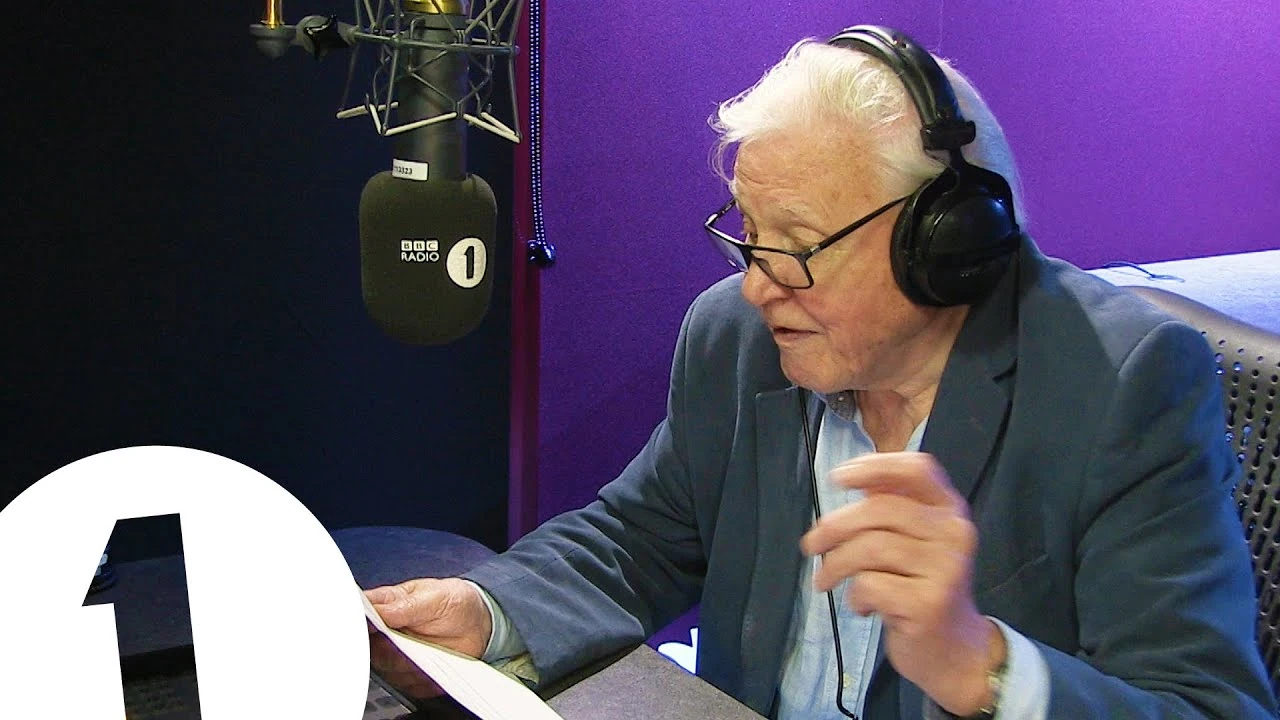
David Attenborough’s broadcasting career has taken him from the early days of British television to documentaries watched around the world. His contribution is not confined to the familiar narration of wildlife films: he helped shape BBC Two, presented landmark natural-history series and built a body of work that has brought the diversity of life—and, increasingly, the pressures upon it—into public view.
A naturalist finds his way into television
David Frederick Attenborough was born in Isleworth, Middlesex, on 8 May 1926. He grew up in Leicester, where his father was principal of University College Leicester. As a child, he collected fossils, stones and other natural specimens. He studied geology and zoology at Clare College, Cambridge, graduating in natural sciences, and later completed two years of national service in the Royal Navy.
Before joining the BBC, Attenborough edited science textbooks for children. He entered the corporation in 1952, initially as a producer in its Talks department. His early work included factual programmes such as Animal, Vegetable, Mineral? and Song Hunter. Natural history became central to his career through Animal Patterns, a studio programme featuring animals from London Zoo. A planned series about an animal-collecting expedition then led to Zoo Quest. When its intended presenter, Jack Lester, fell ill, Attenborough took his place. The series first aired in 1954 and established him as a presenter as well as a producer.
In 1957, the BBC asked him to join its newly formed Natural History Unit in Bristol. He declined, preferring to remain in London with his young family, and instead formed a Travel and Exploration Unit. That arrangement allowed him to continue with Zoo Quest and develop other factual programmes. It also reflected an early feature of his career: natural-history broadcasting was one strand of a wider interest in how television could explain the world.
Shaping BBC Two, then returning to the field
Attenborough became Controller of BBC Two in 1965. The channel had struggled to establish an identity, and he set out to make its schedule varied and distinct. Under his tenure, it included science and natural history alongside arts, archaeology, travel, sport, business, drama and comedy. Programmes commissioned during this period included Monty Python’s Flying Circus, The Old Grey Whistle Test, Chronicle and The Money Programme.
In 1969, he became director of programmes for BBC Television, with responsibility for both BBC channels. The senior role brought budgets and management duties that took him away from making programmes. He left in 1973 to return to full-time broadcasting. The decision cleared the way for a project that would become a landmark in his career: Life on Earth.
First broadcast in 1979, Life on Earth set out an account of evolution through the diversity of living things. It was made on an international scale and drew on new filming techniques to show animal behaviour that had rarely been captured on screen. Attenborough’s presence as presenter gave viewers a guide through the material, while the series gave its subjects room to hold the audience’s attention. Its success helped establish a distinctive model for ambitious, authored natural-history documentaries.
The work continued with The Living Planet (1984), which explored how living things adapt to their surroundings, and The Trials of Life (1990), about animal behaviour. Later instalments widened the picture: The Private Life of Plants used time-lapse photography to make plant growth visible; The Life of Birds examined avian behaviour; and Life in the Undergrowth turned to invertebrates. With Life in Cold Blood in 2008, Attenborough completed a collection covering the major groups of terrestrial animals and plants. He subsequently described First Life as completing that wider undertaking by looking further back into evolutionary history.
Beyond the Life series
Attenborough’s work for television extended well beyond one sequence of programmes. He presented The First Eden (1987), on the natural history of the Mediterranean, and Lost Worlds, Vanished Lives (1989), which explored fossils. He narrated the long-running BBC wildlife series Wildlife on One and contributed to Natural World. His programmes gave the BBC’s Natural History Unit a recognisable public voice while covering habitats, species and subjects beyond the scope of the Life collection.
Among the later landmark series, The Blue Planet (2001) surveyed marine life, with Attenborough as narrator. The production team reunited for Planet Earth (2006), the BBC’s first wildlife series filmed in high definition. Attenborough returned as narrator and presenter for Planet Earth II in 2016, and presented Blue Planet II in 2017. Subsequent work has included the polar series Frozen Planet, Dynasties, Attenborough’s Life in Colour and, in 2025, Wild London.
His contribution has also included work away from the camera. As Controller of BBC Two, he helped commission programmes across a wide range of subjects and contributed to the channel’s developing identity. His long collaboration with the BBC Natural History Unit connected his presenting career with the work of producers, camera teams and researchers, while his writing and narration extended the reach of its films.
From wonder to environmental urgency
Environmental questions became more prominent in Attenborough’s authored documentaries over time. State of the Planet (2000) examined human impacts on nature; The Truth About Climate Change (2006) addressed global warming; and How Many People Can Live on Planet Earth? (2009) considered population growth. In 2019, Our Planet placed greater emphasis on the effects of human activity. That year, Climate Change – The Facts and Extinction: The Facts addressed climate change and biodiversity loss. His 2020 film A Life on Our Planet looked back on environmental change during his lifetime and set out concerns about the future.
Attenborough has also supported conservation organisations and campaigns. He backed efforts to protect albatrosses from longline fishing and to secure protection for rainforest in Borneo. He helped launch ARKive, a project to gather natural-history media in a digital library, and supported the World Land Trust’s work to create a rainforest reserve in Ecuador. In 2022, the United Nations Environment Programme named him a Champion of the Earth for his work in documenting and advocating for the protection and restoration of nature.
His views have developed publicly alongside this work. He has said that a lecture in 2004 convinced him of human responsibility for climate change, after which he began speaking more directly about the issue. At the opening ceremony of the 2021 United Nations climate conference, COP26, he urged action and expressed hope that a decline in nature could be followed by recovery. The shift towards more explicit environmental messages has not been without debate: he has also cautioned that repeated warnings can turn some viewers away. His record therefore includes both the growing urgency of his films and his attention to how audiences receive them.
Recognition and a lasting public role
Attenborough was appointed a Commander of the Order of the British Empire in 1974 and knighted in 1985. He became a Member of the Order of Merit in 2005, and was appointed a Knight Grand Cross of the Order of St Michael and St George in 2020 for services to television broadcasting and conservation. His awards also include the Kalinga Prize for the Popularisation of Science, the Royal Society’s Michael Faraday Prize and the United Nations Environment Programme’s Champion of the Earth award.
His influence is reflected in the breadth of the recognition he has received: honorary degrees, scientific and broadcasting honours, and the naming of a British polar research ship, the RRS Sir David Attenborough. But such markers sit alongside a more everyday achievement. Across successive generations of television, his programmes have made it possible for audiences to encounter animals, habitats and ecological processes that many would otherwise know only by name. His characteristic presenting style serves that purpose by making complex subjects accessible without displacing the natural history itself.
Why David Attenborough deserves a place in British Legacy
David Attenborough’s place in British Legacy rests on a substantial and specific contribution to British broadcasting. He joined the BBC when television factual programming was still developing, became a producer and presenter of natural-history programmes, and later helped define BBC Two as Controller. His commissions ranged across the arts, science, sport and entertainment; his return to programme-making then produced a sustained series of ambitious natural-history documentaries, beginning with Life on Earth. That combination of institutional influence and creative work connects his personal career with the development of public-service television in Britain.
The benefit of that work is not simply that it has entertained viewers. Through programmes such as The Blue Planet, Planet Earth and the successive Life series, Attenborough has helped make knowledge of the natural world widely accessible. His later documentaries have brought climate change, species loss and the effects of human activity more directly into that public conversation. His conservation support, from rainforest protection to natural-history archiving, extends the record beyond broadcasting. Recognising him in British Legacy also acknowledges the teams and public institutions through which this work has reached audiences. His career shows how British television can join scientific subject matter, careful explanation and popular reach—and how that reach can be used to encourage attention to the living world.
Sources
Adapted in part from David Attenborough by Wikipedia contributors, under CC BY-SA 4.0. Text has been edited and combined with the existing article; this adapted text is shared under the same licence. Contributor history.