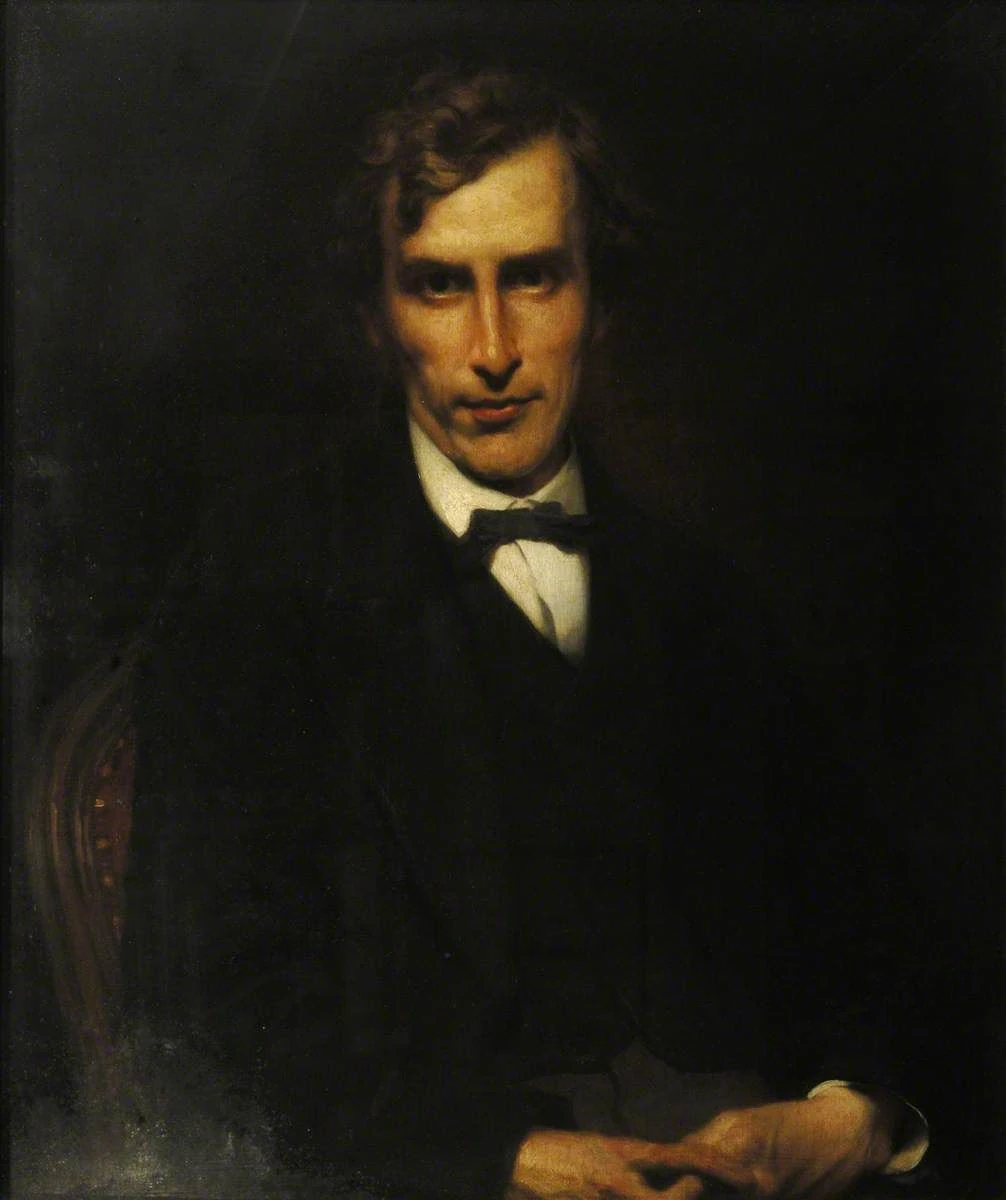
Albert Venn Dicey made the British constitution a subject of systematic legal study. In Introduction to the Study of the Law of the Constitution, first published in 1885, he set out an account of parliamentary sovereignty and the rule of law that became a lasting point of reference for constitutional argument. His importance lies not in offering a neutral description of political life, but in giving those ideas a forceful and influential formulation.
From Lutterworth to the Oxford law chair
Dicey was born on 4 February 1835 in Lutterworth, Leicestershire, the son of Thomas Edward Dicey and Annie Marie Stephen. His father owned the Northampton Mercury and was chairman of the Midland Railway. Dicey later recalled his mother’s influence as particularly important to him. He was educated at King’s College School in London and Balliol College, Oxford, where he gained first-class results in classical moderations in 1856 and in literae humaniores in 1858.
In 1860 he won a fellowship at Trinity College, Oxford. He was called to the bar by the Inner Temple in 1863, and in 1882 became Vinerian Professor of English Law at Oxford. He held the chair until 1909. In 1890 he was appointed Queen’s Counsel. After leaving Oxford, he became one of the first professors of law at the newly established London School of Economics. His academic career brought together legal practice, university teaching and writing at a time when constitutional questions were being argued in public as well as in courts.
A book about the constitution
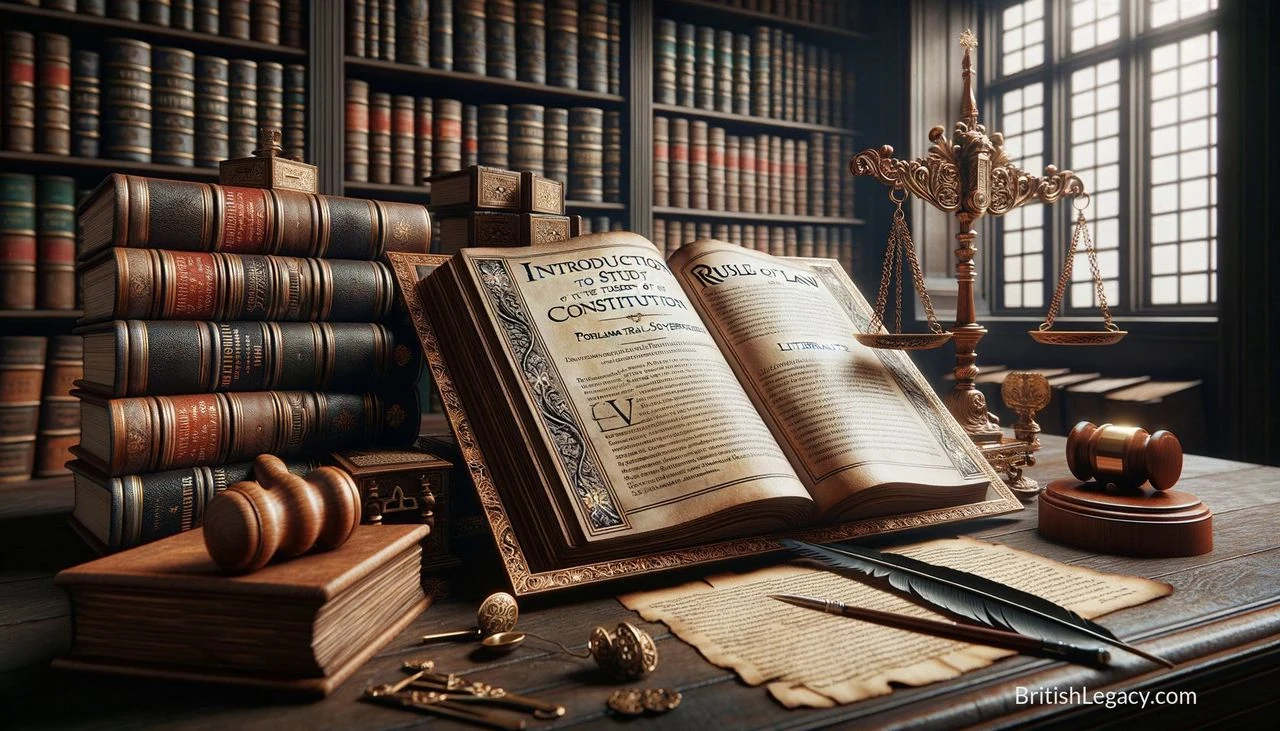
Published in 1885, Introduction to the Study of the Law of the Constitution became Dicey’s best-known work. He used “constitutional law” broadly, to include rules that directly or indirectly affected how sovereign power was distributed or exercised in the state. Rather than treating the constitution as a single written document, he examined the legal principles and institutions through which government operated.
Two doctrines stand at the centre of his account. The first is parliamentary sovereignty: Dicey described Parliament as an absolutely sovereign legislature, with the right to make or unmake any law. He also argued that no Parliament could prevent a later Parliament from changing its legislation. In this formulation, the authority to legislate belonged to Parliament, while the continuing authority of future Parliaments meant that today’s laws could not permanently bind their successors.
The second doctrine is the rule of law. Dicey helped popularise the phrase, although it had been used before his time. He connected the principle to the protection of personal liberty and to the role of impartial courts, free from governmental interference. His account placed common law and judicial decisions alongside parliamentary authority as important parts of the constitutional order. Those ideas are not identical to a complete modern theory of rights; they are Dicey’s own way of explaining the legal foundations of British government.
Scholarship beyond one book
Dicey’s work ranged beyond constitutional law. He published Conflict of Laws in 1896, developing a subject concerned with which legal rules apply when a case crosses jurisdictional boundaries. His earlier and later writing also addressed democracy, referendums and the relationship between law and public opinion. In 1905 he published Lectures on the Relation between Law and Public Opinion in England during the Nineteenth Century, extending his inquiry from legal doctrine to the ways that public opinion and law affect one another.
His scholarship attracted international attention, and his constitutional arguments have been studied and debated beyond Britain. The reach of his writing is part of its significance, but influence did not make his positions uncontested. Dicey was a Liberal Unionist and an outspoken opponent of Irish Home Rule. From 1886 until shortly before his death, he argued against granting self-government to Ireland; the Anglo-Irish Treaty of 1921, which established the Irish Free State as a self-governing dominion separate from the United Kingdom, left him bitterly disappointed.
Principles and political limits
Dicey welcomed the extension of the franchise in 1867 and was associated with the University Liberals, a group whose members contributed to Essays on Reform. He described personal liberty as the basis of national welfare. Yet his political commitments did not amount to a consistent modern programme of democratic equality. He opposed women’s suffrage and proportional representation, while acknowledging that the existing first-past-the-post system was imperfect.
He also rejected the idea that citizens had a general right to ignore unjust laws. For Dicey, the need for a stable legal system outweighed the injustice that might result from obeying a particular law, although he allowed that armed rebellion could be justified in exceptionally rare circumstances. These positions matter when reading his work: his account of constitutional authority was shaped by political judgments as well as legal analysis. Its continuing value as an object of study does not require treating every judgment he made as a principle to endorse.
Later writing and remembrance
After leaving his Oxford chair in 1909, Dicey continued to write on law and politics. His work included A Leap in the Dark, or Our New Constitution (1893), A Digest of the Law of England with Reference to the Conflict of Laws (1896), and later writing on the Parliament Act, the referendum and the relationship between law and public opinion. In 1920 he co-authored Thoughts on the Union between England and Scotland with Robert S. Rait.
Dicey died in Oxford on 7 April 1922, aged 87. The historian Harold Laski later memorialised him as the most considerable figure in English jurisprudence since Maitland. That assessment captures his standing among legal scholars, while his varied publications show why his reputation rests on more than one constitutional treatise.
Why A. V. Dicey deserves a place in British Legacy
Dicey deserves a place in British Legacy because he gave enduring shape to arguments about how political power is exercised and controlled in Britain. His 1885 book made parliamentary sovereignty and the rule of law its organising ideas, and his account of constitutional law helped generations of readers approach a constitution not collected in a single written text. By setting out Parliament’s power to make or unmake law and describing the importance of courts and legal process, he supplied a vocabulary that remains useful for understanding British constitutional debate.
That legacy should be presented with its tensions intact. Dicey’s writing travelled internationally, and his scholarship ranged from constitutional theory to the conflict of laws and the relation between law and public opinion. At the same time, his opposition to Irish Home Rule and women’s suffrage shows that influential legal thought can be bound up with political exclusions and commitments of its own. Remembering both the reach of his ideas and the limits of his outlook gives readers a fuller account of British legal history. His place in the story is not that he settled constitutional questions for all time, but that he made them harder to avoid and gave later debate a powerful framework to examine, contest and revise.
Sources
A. V. Dicey — Wikipedia, revision 1379202415
Adapted in part from A. V. Dicey by Wikipedia contributors, under CC BY-SA 4.0. Text has been edited and combined with the existing article; this adapted text is shared under the same licence. Contributor history.