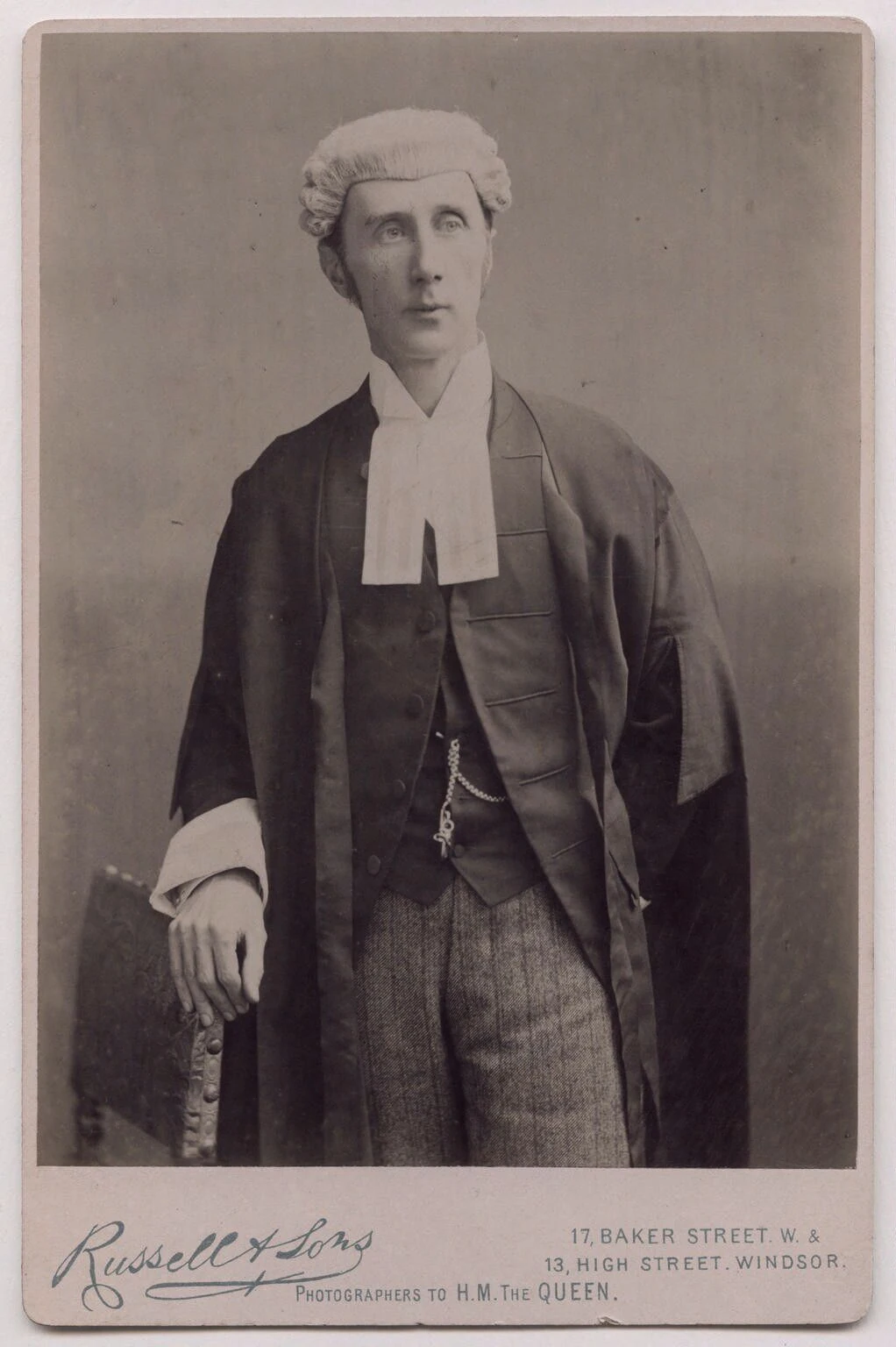
Henry Fielding Dickens grew up in the household of a celebrated novelist but made his career in the courts. Called to the Bar in 1873, he became a King’s Counsel and, in 1917, Common Serjeant of London, judging criminal trials at the Old Bailey for more than 15 years. He also carried his father’s writing to new audiences: from 1914, his recitals raised money for the Red Cross Society.
A Dickens son, educated for the law
Born in London on 16 January 1849, Henry was the eighth of the ten children of Charles Dickens and Catherine Hogarth. He was named after the novelist Henry Fielding, one of his father’s favourite authors. As a boy at the family home, Gad’s Hill Place, he and his brother Edward started a small family newspaper, the Gad’s Hill Gazette. Its contributors included Charles Dickens and Henry Fothergill Chorley.
Henry attended Wimbledon School and a boarding school run by Mr Gibson in Boulogne-sur-Mer. He was the only one of Charles Dickens’s seven sons to attend university. From 1868 he studied at Trinity Hall, Cambridge, graduating in mathematics in 1872 as 29th Wrangler, before studying law. A scholarship he won in 1869 was a source of particular pride to his father. Henry later recalled that Charles first responded with a brief “Capital! capital!” and only afterwards, during their journey home, showed his emotion and congratulated him warmly.
From the Bar to the Old Bailey
Dickens was called to the Bar in 1873 and appointed King’s Counsel in 1892. He became a bencher of the Inner Temple in 1899. His work included criminal cases, among them the 1902 defence of Kitty Byron, who was convicted of murdering her lover. Dickens’s defence attracted public support for a reduced sentence; the account records that a public petition helped secure it.
For a time he served as Recorder of Deal and Maidstone. In November 1917 he succeeded Sir Frederick Albert Bosanquet as Common Serjeant of London, the second most senior judicial office at the Old Bailey after the Recorder of London. In that role Dickens judged criminal trials for more than 15 years, retiring in October 1932. The distinction matters: he became Common Serjeant, not Recorder of London, as the earlier account stated.
Dickens repeatedly declined nominations to stand for Parliament, believing that doing so would harm his legal practice. His career also had an occasional reminder that his surname was already famous. When a prisoner told him that he was “not a patch” on his father, Dickens agreed and asked what the man knew of Charles Dickens. The prisoner replied that he had read some of his books in prison; Dickens observed that he would have 18 months to resume his studies. The anecdote captures the name’s presence in the courtroom without confusing Henry’s legal work with his father’s literary career.
Public readings and family life
From October 1914, Dickens gave recitals of his father’s writing to raise money for the Red Cross Society. His programme included passages from David Copperfield, A Christmas Carol, The Chimes and The Cricket on the Hearth. The performances raised £1,200. At family Christmas gatherings, he also imitated his father’s readings, using the same velvet-covered reading stand and wearing a geranium, Charles Dickens’s favourite flower. Older listeners said his performances closely resembled those of his father. For his eightieth birthday in 1929, Henry recited all of A Christmas Carol.
He married Marie Roche in London on 25 October 1876. They had four sons and three daughters. Their son Cedric was killed at the Battle of the Somme during the First World War. Henry’s connections to the Dickens family’s literary history also continued through later generations, including his son Henry Charles, father of the author Monica Dickens.
Dickens was a Life President of the Dickens Fellowship. His publications included Memories of My Father, published in 1928, and The Recollections of Sir Henry Dickens, K.C., published posthumously in 1934. These books, alongside his public recitals, kept his father’s life and work in circulation while recording Henry’s own perspective.
His final years
Dickens was appointed a Knight Bachelor in 1922. He retired from his judicial post in 1932 and died in London on 21 December 1933, aged 84. Five days earlier, he had been struck by a motorcyclist while crossing Chelsea Embankment. The account records that he was holding up his walking stick to warn motorists as he stepped into the road. He was the last surviving child of Charles Dickens and was buried at Putney Vale Cemetery.
Why Henry Fielding Dickens deserves a place in British Legacy
Henry Fielding Dickens deserves a place in British Legacy for an achievement that should be understood on its own terms, not treated simply as an extension of his father’s fame. He built a substantial career in the English legal profession: called to the Bar, made King’s Counsel, and appointed Common Serjeant of London. In that judicial office, he presided over criminal trials at the Old Bailey for more than 15 years. Those roles placed him within the working life of the courts, where legal decisions affected defendants and the public, rather than in the shadowy category of a famous person’s relative.
His public readings add another dimension to that record. By performing his father’s works for the Red Cross from 1914 and raising £1,200, he used a family inheritance in a specific, practical act of wartime fundraising. He also helped sustain public knowledge of Charles Dickens’s writing through recitals and his own publications. The combination is distinctive: Henry served as a senior London judge while also becoming a performer and recorder of his father’s literary legacy. His British connection lies in these documented contributions to the courts, charitable fundraising and the continuing public life of Dickens’s works.
Sources
Henry Fielding Dickens (revision 1341788387)
Adapted in part from Henry Fielding Dickens by Wikipedia contributors, under CC BY-SA 4.0. Text has been edited and combined with the existing article; this adapted text is shared under the same licence. Contributor history.