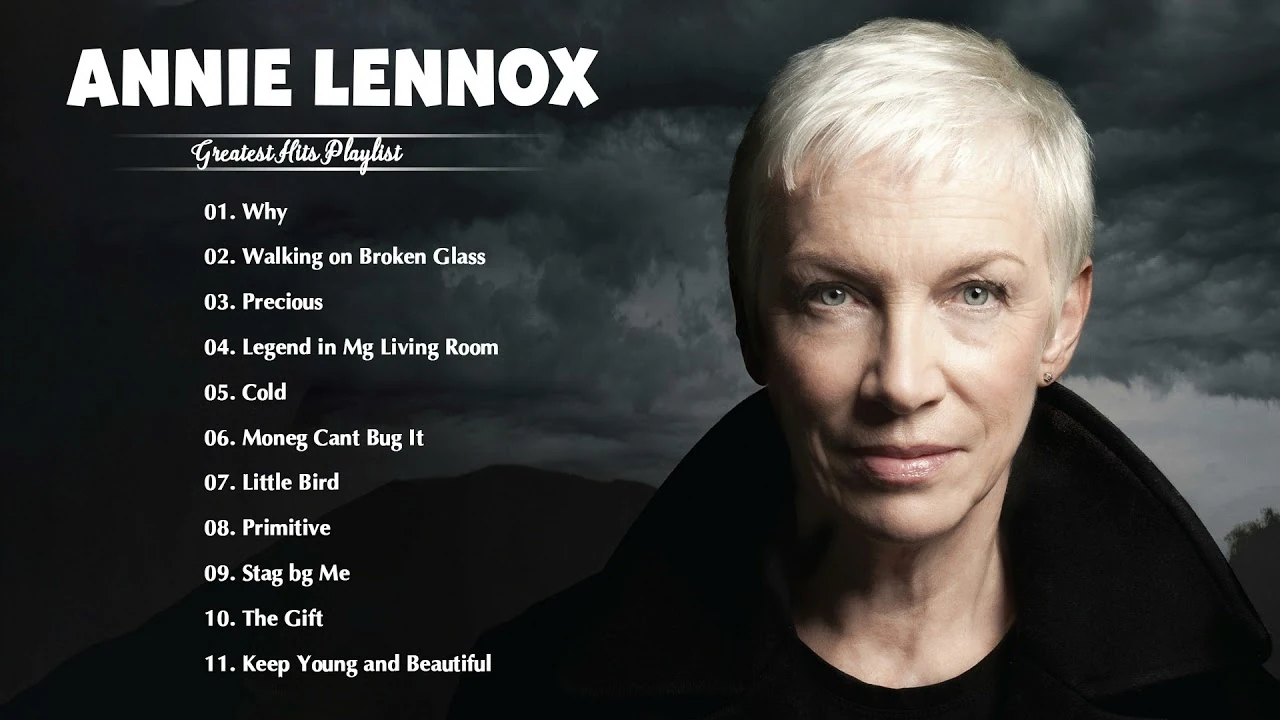
Annie Lennox’s path from Aberdeen to international pop stardom has never been only a story of a distinctive voice. As Eurythmics’ singer and co-creator, then as a solo artist, she helped make ambitious, electronically driven pop part of Britain’s cultural export. Her career has also joined performance to public advocacy, particularly through campaigns concerning HIV and AIDS and women’s rights.
Aberdeen, music and a change of direction
Born Ann Lennox in Torry, Aberdeen, on 25 December 1954, she attended Aberdeen High School for Girls, where she studied music and learned flute and piano. She sang in the school choir and performed with orchestras and military bands. Dalcroze eurhythmics classes introduced her to an approach to music education whose name would later be echoed in the spelling of Eurythmics.
In 1971, Lennox began a music performance degree at London’s Royal Academy of Music. She studied flute, piano and harpsichord, but did not complete the course. The demands of classical training left her questioning whether that was the musical life she wanted. She supported herself with jobs including work as a waitress, barmaid and shop assistant, while also playing and singing with bands. The decision to leave the Academy was not a rejection of music; it marked a search for a form of it in which she could write and perform on her own terms.
In 1976 she played flute with Dragon’s Playground, leaving before the group appeared on the television talent programme New Faces. From 1977 to 1980 she was lead singer of the Tourists, a British pop band and her first musical collaboration with Dave Stewart. That partnership continued after the Tourists, but in a markedly different musical setting.
Eurythmics: a new sound and a vivid image
Lennox and Stewart formed Eurythmics in 1980. Their synth-pop sound combined keyboards and electronic production with Lennox’s soulful, forceful vocals. The breakthrough came with “Sweet Dreams (Are Made of This)”, released in 1983. The song reached number two in the UK and number one in the United States, and helped establish the duo internationally. Later hits included “Love Is a Stranger”, “Here Comes the Rain Again”, “There Must Be an Angel (Playing with My Heart)” and “Sisters Are Doin’ It for Themselves”.
The image Lennox presented was as distinctive as the music. In the “Sweet Dreams” video she appeared with closely cropped orange hair, wearing a suit. Her androgynous styling challenged familiar expectations of how a female pop singer should look, while the videos for songs such as “Love Is a Stranger” and “Who’s That Girl?” extended that visual experimentation. The image was not a decorative extra: it became part of the way Eurythmics communicated their independence and unsettled pop conventions.
Lennox and Stewart made a clear break as collaborators in 1990, but Eurythmics did not end permanently. They reunited in the late 1990s and released Peace in 1999, their first album of new material in a decade. The accompanying concert tour directed profits to Greenpeace and Amnesty International. Their later reunions included performances at the 2019 Sting benefit concert and the 2022 Rock and Roll Hall of Fame induction ceremony.
A solo voice, on her own terms
Lennox began her solo career with Diva in 1992. The album reached number one in the UK and produced the singles “Why” and “Walking on Broken Glass”. Its success established her as more than the voice of a celebrated duo: she was a songwriter and performer with a separate musical identity. “Why” won the MTV Video Music Award for Best Female Video, while the period-costume video for “Walking on Broken Glass” featured actors Hugh Laurie and John Malkovich.
Her follow-up, Medusa (1995), was made up of covers of songs originally recorded by male artists, including “No More ‘I Love You’s’”, “A Whiter Shade of Pale” and “Waiting in Vain”. It topped the UK album chart. Lennox continued to release solo albums across different styles: Bare (2003), Songs of Mass Destruction (2007), the seasonal collection A Christmas Cornucopia (2010) and the jazz- and blues-influenced Nostalgia (2014). In 2019, she released Lepidoptera, an EP of four improvised piano pieces associated with her art installation “Now I Let You Go...”.
Her work also reached beyond her own albums. Lennox co-wrote and performed “Into the West” for The Lord of the Rings: The Return of the King. The song won the Academy Award and Golden Globe for Best Original Song, as well as a Grammy. She performed “Little Bird” at the closing ceremony of the London 2012 Olympic Games. In 2015, she became the first woman to be made a fellow of the British Academy of Songwriters, Composers and Authors, now The Ivors Academy.
Music in the service of causes
Lennox’s public activism has developed alongside her music career. Her involvement in AIDS-awareness work included recording Cole Porter’s “Ev’ry Time We Say Goodbye” for the 1990 benefit album Red Hot + Blue. She later worked with Nelson Mandela’s 46664 campaign and South Africa’s Treatment Action Campaign. These links informed “Sing”, a track on Songs of Mass Destruction made with 23 prominent female artists. The project sought to raise both funds and awareness for people affected by HIV and AIDS, particularly women and children.
In 2007, Lennox established the SING Campaign to support that work. The following year she founded The Circle, a charitable organisation that networks and raises funds for women’s projects around the world. Her advocacy has also included support for Amnesty International and Greenpeace. Lennox and Stewart directed the profits from Eurythmics’ 1999 Peace tour to those organisations.
Her campaigning has taken place in public forums as well as through music. She has spoken about HIV and AIDS, women’s rights and humanitarian issues, and in 2009 opened the Edinburgh Festival of Politics with criticism of the effects of public arguments about condom use on HIV prevention in Africa. In 2023 she signed an Artists4Ceasefire open letter; at the 2024 Grammy Awards, during a performance in memory of Sinéad O’Connor, she called for a ceasefire and peace. Her public interventions have not been limited to one cause or one medium.
Lennox was appointed an Officer of the Order of the British Empire in 2011 in recognition of her charity campaigns and humanitarian work. Other honours include the 2009 Peace Summit Award from the World Summit of Nobel Peace Laureates and the Livingstone Medal, awarded by the Royal Scottish Geographical Society in 2016 for her contribution to the fight against AIDS and support for women’s rights. In 2017, she became Glasgow Caledonian University’s first female chancellor; the university later named a building after her. She served in the role until 2024.
Recognition, reinvention and influence
Lennox’s career has been recognised across music and public life. She has received eight Brit Awards, including a record six awards for Best British Female Artist, as well as four Grammy Awards. Her honours also include a Billboard Century Award in 2002. With Stewart, she was inducted into the Songwriters Hall of Fame in 2020 and the Rock and Roll Hall of Fame in 2022.
That record reflects both the reach and the range of her work: the success of Eurythmics, the chart-topping solo albums, the film song recognised by an Academy Award and a continuing willingness to change musical direction. In March 2025, Lennox returned to live performance at the Royal Albert Hall for Sisters: Annie Lennox and Friends, an event organised to mark International Women’s Day. The appearance brought her music and advocacy together in a setting associated with major British performances.
Why Annie Lennox deserves a place in British Legacy
Annie Lennox deserves a place in British Legacy because she helped define the sound and appearance of British pop while continually expanding what a successful career in music could include. With Eurythmics, she paired electronic production with a commanding voice and a visual identity that challenged expectations. As a solo artist, she established a distinct body of work, from Diva and Medusa to later explorations of seasonal, jazz and blues material. Her achievements are not confined to sales or awards: her songwriting and performances have also been recognised by the Academy Awards, the Ivors Academy and major music institutions.
Her British connection is rooted in a life and career formed across the country: she grew up and began her musical education in Aberdeen, studied at the Royal Academy of Music in London, and has been honoured by British institutions for both music and humanitarian work. The SING Campaign and The Circle show how she has used her public profile to raise resources and attention for people affected by HIV and AIDS and for women’s projects. Her chancellorship at Glasgow Caledonian University and the university building bearing her name add a further Scottish legacy. Lennox’s example matters because it links artistic invention to visible, sustained public engagement: a British pop artist whose influence extends from records and performances into campaigns, charities and the cultural life of the institutions that recognise her work.
Sources
Annie Lennox — Wikipedia, revision 1378725568
Adapted in part from Annie Lennox by Wikipedia contributors, under CC BY-SA 4.0. Text has been edited and combined with the existing article; this adapted text is shared under the same licence. Contributor history.