Alfred Hitchcock’s suspense often begins before anyone knows what is wrong. A glass of milk glows in a darkened room; a watcher scans the windows of a courtyard; a man is mistaken for someone he is not. The audience sees, suspects and waits. That control of what viewers know became his signature, but its roots lie in a long apprenticeship in Britain’s film industry, where he learned to make images carry a story.
A London start in the silent-film era
Hitchcock was born Alfred Joseph Hitchcock on 13 August 1899 in Leytonstone, then in Essex. His parents, William Edgar Hitchcock and Emma Jane Whelan, ran shops; the family later moved to Limehouse. He attended several schools in east London, including St Ignatius College in Stamford Hill. At 14, he left school and enrolled in evening classes in engineering and navigation. After his father died in 1914, Hitchcock worked as a technical clerk at the Henley Telegraph and Cable Company, while continuing his studies.
His first steps towards cinema came through drawing and writing. In 1919, he joined Islington Studios as a title-card designer, preparing captions for silent films. He also took on work as a co-writer, art director and production manager, learning about different parts of a production rather than only one job. When Paramount withdrew from its London studio in 1922, producer Michael Balcon hired him as an assistant director for the new company that became Gainsborough Pictures.
Hitchcock directed The Pleasure Garden in 1925; it was released the following year. The film was a commercial failure, but Balcon kept him on. Hitchcock made the silent film The Lodger: A Story of the London Fog in 1927, a thriller about a landlady who suspects her mysterious tenant of being a serial killer. Its visual construction helped establish him as a director: one scene uses a glass floor to show the lodger pacing above the landlady. The film was a British commercial and critical success, and Hitchcock made his first on-screen cameo in it.
He married Alma Reville, a film editor and screenwriter, in 1926. She became a close collaborator, contributing to the writing of several of his films, including The 39 Steps and Shadow of a Doubt. In 1929, Hitchcock directed Blackmail, which became the first British sound feature, or “talkie”. Its use of sound includes a woman’s conversation in which the word “knife” is made to stand out, turning an everyday exchange into a source of tension.
British thrillers, international recognition
Hitchcock’s British career gathered pace through the 1930s. The Man Who Knew Too Much (1934) was a success, while The 39 Steps (1935) brought him recognition in the United States. Based loosely on John Buchan’s novel, it follows an innocent man pursued across Britain after becoming entangled in a spy plot. The film uses a device Hitchcock later called a “MacGuffin”: an object or goal that drives the action but has little significance in itself. In this case, the object is a set of stolen design plans.
The Lady Vanishes (1938), a mystery set aboard a train travelling through a fictional European country, was another major British success. By then, Hitchcock had attracted offers from American producers. Producer David O. Selznick persuaded him to move to Hollywood, where he began a seven-year contract in 1939. His final British film before the move was Jamaica Inn (1939), produced by Charles Laughton.
Hitchcock’s move changed the scale of his work, not its interest in suspicion and concealed motives. His first American film, Rebecca (1940), was set in Cornwall and adapted from Daphne du Maurier’s novel. It won the Academy Award for Best Picture; Hitchcock received his first of five nominations for Best Director. Other films from his early Hollywood years included Shadow of a Doubt (1943), about a young woman who suspects her beloved uncle of murder, and Notorious (1946), a spy story involving former Nazis and a woman asked to infiltrate their circle.
He returned to Britain in 1943–44 to make two short propaganda films for the Ministry of Information, Bon Voyage and Aventure Malgache. In 1945, he also advised on a documentary using Allied footage of the liberation of Nazi concentration camps. The completed film was not released at the time; a restored version of German Concentration Camps Factual Survey was completed in 2014.
Making the viewer part of the suspense
Hitchcock’s films repeatedly put ordinary people in danger or leave them unsure whom to trust. An innocent person may be pursued for a crime, while a charming character conceals a darker purpose. In Rear Window (1954), a photographer confined to his apartment watches his neighbours and becomes convinced that one of them has murdered his wife. The restricted setting makes looking itself part of the drama: viewers, like the protagonist, must interpret fragments seen across the courtyard.
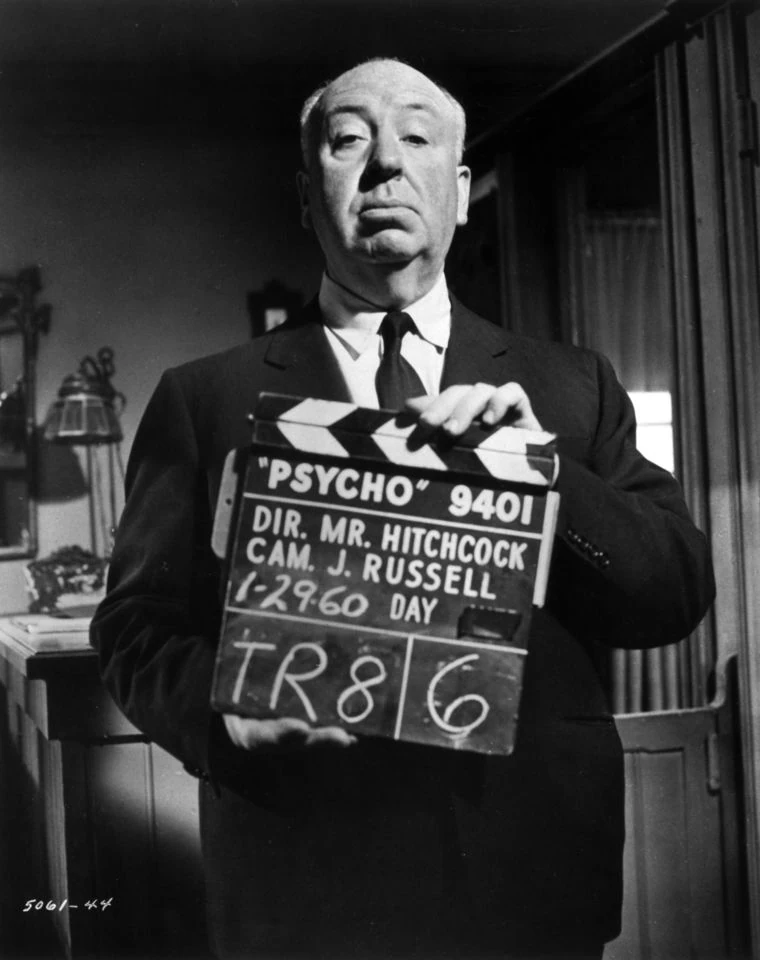
Hitchcock explored the same relationship between watching and suspicion in Psycho (1960). Made on a tight budget, in black and white, with a crew that included members of his television team, the film turned a motel into the setting for a radical shift in audience expectation. Its shower sequence uses editing, music and framing to create a sense of violence without relying on a sustained view of it. In Vertigo (1958), James Stewart plays a former police investigator whose fear of heights and growing obsession shape the film’s account of identity and desire.
The camera effect associated with Vertigo is often called a dolly zoom, or the “Vertigo effect”. The technique was developed by camera operator Irmin Roberts: the camera moves while the zoom changes in the opposite direction, distorting the apparent depth of the setting. Hitchcock’s films also made strong use of confined spaces, point-of-view shots and carefully planned compositions. Yet his work was not simply a matter of executing a fixed plan. Production records and script changes have challenged the idea that he never altered his films during filming; he adapted to changes and production needs, as other directors did.
From 1955 to 1965, Hitchcock hosted the television series Alfred Hitchcock Presents, directing 18 episodes. Its introductions, delivered with dry humour, and its distinctive profile made him recognisable beyond cinema audiences. He continued directing feature films, including North by Northwest (1959), The Birds (1963) and Frenzy (1972). The latter was made in Britain and returned to the murder-thriller territory of his earlier work. His final film was Family Plot (1976).
Recognition, controversy and remembrance
Hitchcock’s career spanned six decades and more than 50 feature films. His work received extensive recognition: he was nominated five times for the Academy Award for Best Director, though he never won it. Rebecca won Best Picture, and he received the BAFTA Fellowship in 1971 and the American Film Institute’s Life Achievement Award in 1979. He was appointed a Knight Commander of the Order of the British Empire in the 1980 New Year Honours. Too ill to travel to London, he received the papers at Universal Studios in California.
His films and his conduct towards performers require separate consideration. Tippi Hedren said that Hitchcock sexually harassed her during the making of The Birds and Marnie; accounts of the production describe her distress during the filming of the bird-attack scene. His films have also prompted sustained critical discussion of how women are represented on screen. Recognising the precision and influence of his filmmaking does not require treating those questions as incidental.
Hitchcock died at his home in Bel Air, Los Angeles, on 29 April 1980, aged 80. His wife, Alma, and daughter, Patricia, survived him. He had become a United States citizen in 1955, but his career began in London, and his British films established the methods and reputation that travelled with him to Hollywood.
Why Alfred Hitchcock deserves a place in British Legacy
Hitchcock belongs in a record of British cultural achievement because his international reputation was built on work that began in Britain. He entered the film industry in London in 1919, learning the craft through title design and production work before directing features. The Lodger, Blackmail, The 39 Steps and The Lady Vanishes show the development of his approach across the silent and sound eras. They also demonstrate that British cinema was not merely a prelude to his American career: it was where he established himself as a director and gained the recognition that brought him to Hollywood.
His legacy is specific as well as large. Hitchcock made suspense a matter of film form: what the camera reveals, what it withholds, how a cut changes a viewer’s understanding, and how a familiar space can become threatening. Rear Window turns spectatorship into the subject of a thriller; Psycho uses editing and sound to unsettle expectations; Vertigo uses a camera technique developed by Irmin Roberts to make disorientation visible. These films remain useful works for audiences and filmmakers studying how cinema creates meaning. His career also connects British filmmaking to a global screen culture, while the continuing debate about his treatment of women keeps the history of that influence open to scrutiny rather than simple celebration.
Sources
Alfred Hitchcock — revision 1378404298 · Alfred Hitchcock
Adapted in part from Alfred Hitchcock by Wikipedia contributors, under CC BY-SA 4.0. Text has been edited and combined with the existing article; this adapted text is shared under the same licence. Contributor history.