
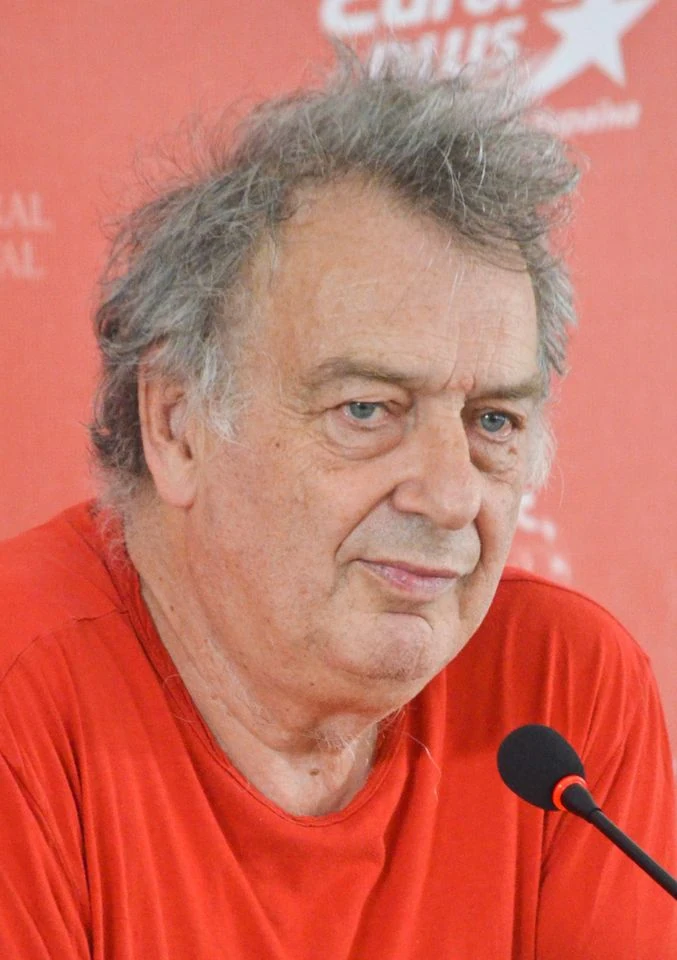
Stephen Frears has made films about an interracial romance in Britain, eighteenth-century French aristocrats and the aftermath of Princess Diana’s death. The settings and genres differ, but many of his projects are attentive to people negotiating class, power and public scrutiny. Across a career in film and television, he has moved from British television plays to internationally recognised features, returning often to stories shaped by real lives and social tensions.
From Leicester to television and film
Frears was born in Leicester on 20 June 1941. He attended Gresham’s School in Norfolk and studied law at Trinity College, Cambridge, from 1960 to 1963. At Cambridge he worked as assistant stage manager on the 1963 Footlights Revue, whose cast included Tim Brooke-Taylor, John Cleese, Bill Oddie and David Hatch. After graduating, he worked as an assistant director on films including Karel Reisz’s Morgan – A Suitable Case for Treatment and Lindsay Anderson’s if...., both released in the 1960s.
His early directing career was spent largely in television, including work on the BBC anthology series Play for Today. He also produced a series of Alan Bennett plays for London Weekend Television. His feature-film directing debut was Gumshoe (1971), a detective-story spoof. Moving between television and cinema became characteristic: Frears continued to direct for both throughout his career.
British stories and shifting settings
My Beautiful Laundrette (1985), written by Hanif Kureishi, brought Frears widespread acclaim. Its story of an interracial gay romance placed questions of identity and social belonging in a contemporary British setting. The film received an Academy Award nomination and two BAFTA nominations, and helped launch the careers of Frears and actor Daniel Day-Lewis. It established a strand of his work in which questions of class and social change are carried through individual characters rather than treated as abstractions.
Frears followed it with films taking markedly different routes. Prick Up Your Ears (1987), written with Alan Bennett, dramatised the life of playwright Joe Orton. Sammy and Rosie Get Laid (1987), based on Kureishi’s writing, turned to contemporary social and political change. In 1988, Dangerous Liaisons transported him to pre-revolutionary France. Adapted by Christopher Hampton from the eighteenth-century novel, it follows aristocrats who use seduction and manipulation as instruments of power. Its cast included Glenn Close, John Malkovich, Michelle Pfeiffer and Uma Thurman. The film received seven Academy Award nominations and ten BAFTA nominations, including one for Frears for best direction.
In 1990, Frears directed The Grifters, a neo-noir crime film starring John Cusack, Anjelica Huston and Annette Bening. It brought him his first Academy Award nomination for best director. Other projects crossed genres and national settings: the comedy-drama Hero, released in the United Kingdom as Accidental Hero; Roddy Doyle adaptations The Snapper and The Van; and the Western The Hi-Lo Country. Across them, people’s ambitions meet limits imposed by family, money or social position.
Public events, private consequences
Dirty Pretty Things (2002), a social thriller about two immigrants living in London, received an Academy Award nomination for its screenplay and won the British Independent Film Award for best independent British film. The Deal (2003), made for television, dramatised the reported political understanding between Tony Blair and Gordon Brown over the Labour leadership in 1994, with Michael Sheen playing Blair.
The Queen (2006) returned Frears to a British public moment: the death of Diana, Princess of Wales, and the responses of the monarchy and the public. Helen Mirren’s performance as Queen Elizabeth II won the Academy Award for best actress; Frears received his second Academy Award nomination for best director. The film considers not only a public institution but also the tension between private reaction, political judgement and the expectations of a watching public.
Philomena (2013), starring Judi Dench and Steve Coogan, follows an older woman’s search for the son taken from her when she was a young unmarried mother at a Catholic convent, and the journalist who helps her. Based on Martin Sixsmith’s account, the film combines the search with the developing relationship between its two central characters. It was nominated for four Academy Awards, including best picture, adapted screenplay and actress for Dench. Personal loss, institutional history and an uneasy partnership meet in a story that reflects Frears’s interest in the human stakes of larger systems.
He continued directing biographical and historical material in The Program (2015), about cyclist Lance Armstrong; Florence Foster Jenkins (2016), starring Meryl Streep as the aspiring opera singer; and Victoria & Abdul (2017), about Queen Victoria’s relationship with Abdul Karim. In television, A Very English Scandal (2018) dramatised the Jeremy Thorpe scandal. Hugh Grant played Thorpe and Ben Whishaw played Norman Scott. The three-part series brought political history into character-led television; Whishaw won a Primetime Emmy for his performance.
Recognition across two screen forms
Frears’s career has been recognised by British and international institutions. His directing work has brought two Academy Award nominations, for The Grifters and The Queen, as well as three BAFTA wins and a Primetime Emmy Award. He received the French Order of Arts and Letters in 2009 and was knighted in the 2023 Birthday Honours for services to film and television. Those distinctions reflect a career sustained across both media.
The range is apparent in the contrast between My Beautiful Laundrette, Dangerous Liaisons and Philomena, and in Frears’s returns to television for projects including The Deal and A Very English Scandal. Their subjects and forms differ. A continuing thread is attention to character under pressure: people making choices within structures of class, family, politics or public reputation.
Why Stephen Frears deserves a place in British Legacy
Frears’s place in British Legacy rests in part on his ability to make social change visible through specific lives. My Beautiful Laundrette, based on Hanif Kureishi’s screenplay, placed an interracial gay romance at the centre of a British feature. Its recognition, including an Academy Award nomination, helped bring the film to a wide audience and launched the careers of Frears and Daniel Day-Lewis. Later, Dirty Pretty Things brought the lives of immigrants in London into a social thriller. These films give their subjects a particular setting and texture without reducing British experience to a single story.
Frears has also shown how British political and historical subjects can be explored through film and television without losing their human scale. The Queen follows a constitutional and public moment through the strain between private response and public expectation; A Very English Scandal turns a political scandal into character-led television. Philomena connects an individual search with a wider institutional history. These works offer viewers ways to consider how public events and social structures affect particular people. His knighthood for services to film and television recognises a career sustained across both forms. Together, the films and dramas mark a contribution to British screen culture grounded in stories that make questions of class, politics and public life tangible through the people living within them.
Sources
Adapted in part from Stephen Frears by Wikipedia contributors, under CC BY-SA 4.0. Text has been edited and combined with the existing article; this adapted text is shared under the same licence. Contributor history.
.jpg)