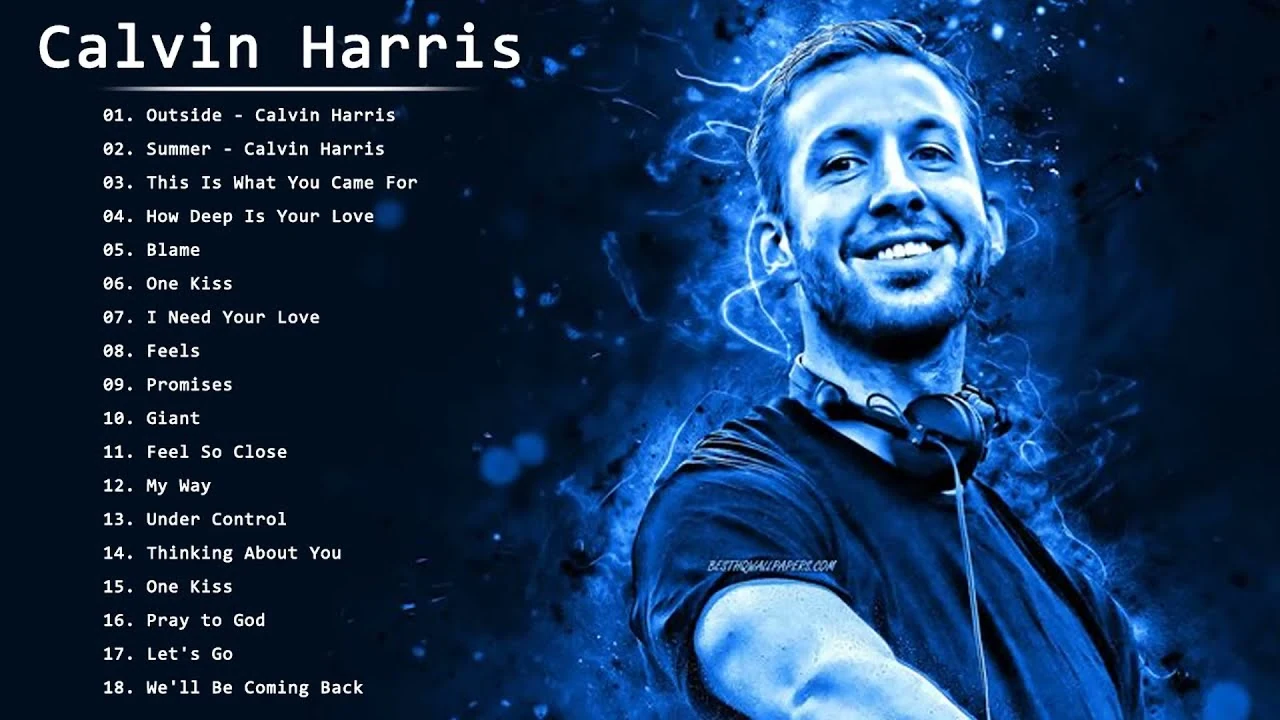
Calvin Harris’s rise began with recordings made in his bedroom in Dumfries. Born Adam Richard Wiles, he went on to write, produce and perform his own early albums, then built a career around collaborations that reached audiences well beyond the dance floor. His route from homemade demos to number-one singles also traces a change in his work: from singing on his own tracks to concentrating on production and finding other voices for the songs.
Bedroom recordings and an independent start
Wiles was born in Dumfries, Scotland, on 17 January 1984. He attended Calside Primary School and Dumfries High School. After leaving school, he stocked supermarket shelves and worked in a local fish-processing factory to buy DJ equipment. He had become interested in electronic music as a teenager and began recording demos in 1999.
At 18, he released two club singles, “Da Bongos” and “Brighter Days”, under the name Stouffer. The tracks appeared in early 2002 on the label Prima Facie. He moved to London hoping to learn from its music scene, but found few work opportunities. After returning to Dumfries, he began posting solo recordings on Myspace. The attention they attracted led talent booker Mark Gillespie to sign him as the first artist represented by his management company.
Harris signed management, publishing and recording agreements in 2006. His debut album, I Created Disco, followed in June 2007. Harris wrote, produced and performed all 14 tracks, recording them on an Amiga computer. The album drew on 1980s sounds and introduced him to a wider audience through “Acceptable in the 80s” and “The Girls”. The former reached number 10 and the latter number three on the UK Singles Chart. The album reached number eight in the UK Albums Chart and was certified gold by the British Phonographic Industry.
His early work was not confined to his own records. In 2007, he co-wrote and produced two tracks for Kylie Minogue’s album X, including “In My Arms”, which became a UK top-ten single. The following year, he produced and sang the hook on Dizzee Rascal’s “Dance wiv Me”. It spent four weeks at number one in the UK, placing Harris in a prominent collaboration between electronic production and British rap.
From the UK charts to international audiences
Harris’s second album, Ready for the Weekend, was released in August 2009 and entered the UK Albums Chart at number one. Its lead single, “I’m Not Alone”, also reached number one. Harris wrote, produced and sang on most of the album’s tracks, but his working pattern was changing. After touring with his band, he stopped doing live shows and stepped back from regularly singing on his own records, choosing to focus more on production and use guest vocalists.
That change helped define 18 Months, his third album, released in 2012. “Bounce”, with Kelis, and “Feel So Close” both reached number two in the UK. The album also included “We Found Love”, his collaboration with Rihanna. It topped charts in 27 countries and became Harris’s first US number one. Other collaborations widened the album’s reach: “Let’s Go” featured Ne-Yo, “We’ll Be Coming Back” featured Example, and “Sweet Nothing” featured Florence Welch. “Sweet Nothing” reached number one in the UK.
18 Months reached number one on the UK Albums Chart and marked a significant moment in the relationship between dance production and pop chart success. Harris became the first artist to achieve eight UK top-ten singles from one studio album, surpassing the previous record; Ed Sheeran later exceeded that total. The distinction is a record for top-ten singles, not for number-one singles as the imported text claims.
Changing sounds, continuing collaborations
Harris continued to move between solo releases and work with other artists. In 2013, he produced a remix of Florence and the Machine’s “Spectrum” that became the group’s first UK number-one single. His fourth album, Motion, arrived in 2014, with singles including “Under Control”, “Summer” and “Blame”. “Summer” and “Blame” both reached number one in the UK. The supplied Wikipedia account also records that Harris became the first British solo artist to pass one billion streams on Spotify.
He released “One Kiss” with Dua Lipa in 2018. It became a UK number-one single, and Harris won British Single of the Year at the 2019 Brit Awards for the collaboration. In 2024, he and Ellie Goulding performed “Miracle” at the Brit Awards, where Harris won British Dance Act. His recognition also includes the Ivor Novello Award for Songwriter of the Year in 2013 and a Grammy win for Best Music Video in 2013.
His albums show a career not tied to one fixed sound. After Motion, he made the funk-influenced Funk Wav Bounces Vol. 1 in 2017 and its sequel in 2022. In 2020, he released three Love Regenerator EPs under that alias, revisiting an earlier approach to production. His compilation 96 Months, released in 2024, gathered previously released singles that had not appeared on his albums.
Production, performance and public life
Harris’s work extends beyond recording albums. In 2010, he launched Fly Eye Records, a label whose releases were mostly in electronic dance music. He also took up long-term DJ residencies in Las Vegas, including a deal with the Hakkasan Group, and served as the group’s music consultant. These roles put him in a position not only to make tracks but also to shape the music programme of clubs and venues.
He has taken part in charity events and campaigns in Britain and abroad. In 2007, he performed at a Camden Town event supporting the Campaign Against Living Miserably and its work on youth suicide among men in the UK. The following year, he supported Shelter’s campaign against homelessness and poor housing in Scotland. In 2010, he performed at a War Child event in London. Later charitable contributions included AIDS-related fundraising through a music compilation and live stream, and a donation to Glasgow’s Sub Club during its pandemic-related financial difficulties.
Harris has said that Jamiroquai and Fatboy Slim inspired him to make music. His own development—from bedroom demos, to records on which he supplied every part, to collaborations with singers and producers across different styles—shows how his role in making dance music changed over time.
Why Calvin Harris deserves a place in British Legacy
Calvin Harris’s British significance rests on achievements more specific than the scale of his international profile. Born and raised in Dumfries, he began making music in Scotland, released his first club singles under an early alias and returned home when his first attempt to establish himself in London brought little work. Recordings posted online then opened a route into the industry. His early albums were notably self-contained projects: on I Created Disco, he wrote, produced and performed all 14 tracks. His later work took a different form, with guest singers and collaborators helping his productions reach a wider pop audience.
The chart history gives that development a measurable British dimension. “I’m Not Alone”, “Dance wiv Me”, “We Found Love”, “Sweet Nothing”, “Summer”, “Blame” and “One Kiss” all reached number one in the UK, while 18 Months set a UK top-ten singles record for one studio album before that total was surpassed. Collaborations with British artists, including Dizzee Rascal, Florence Welch, Ellie Goulding and Dua Lipa, connect his work to a wider musical community. British Single and British Dance Act awards recognise parts of that contribution. His support for British causes, from Shelter in Scotland to the Campaign Against Living Miserably and Glasgow’s Sub Club, adds a direct connection to organisations and places in the UK. Together, these achievements show a Dumfries-born producer whose work connected British dance music with mainstream chart audiences at home and abroad.
Sources
Calvin Harris — Wikipedia, revision 1378853534
Adapted in part from Calvin Harris by Wikipedia contributors, under CC BY-SA 4.0. Text has been edited and combined with the existing article; this adapted text is shared under the same licence. Contributor history.