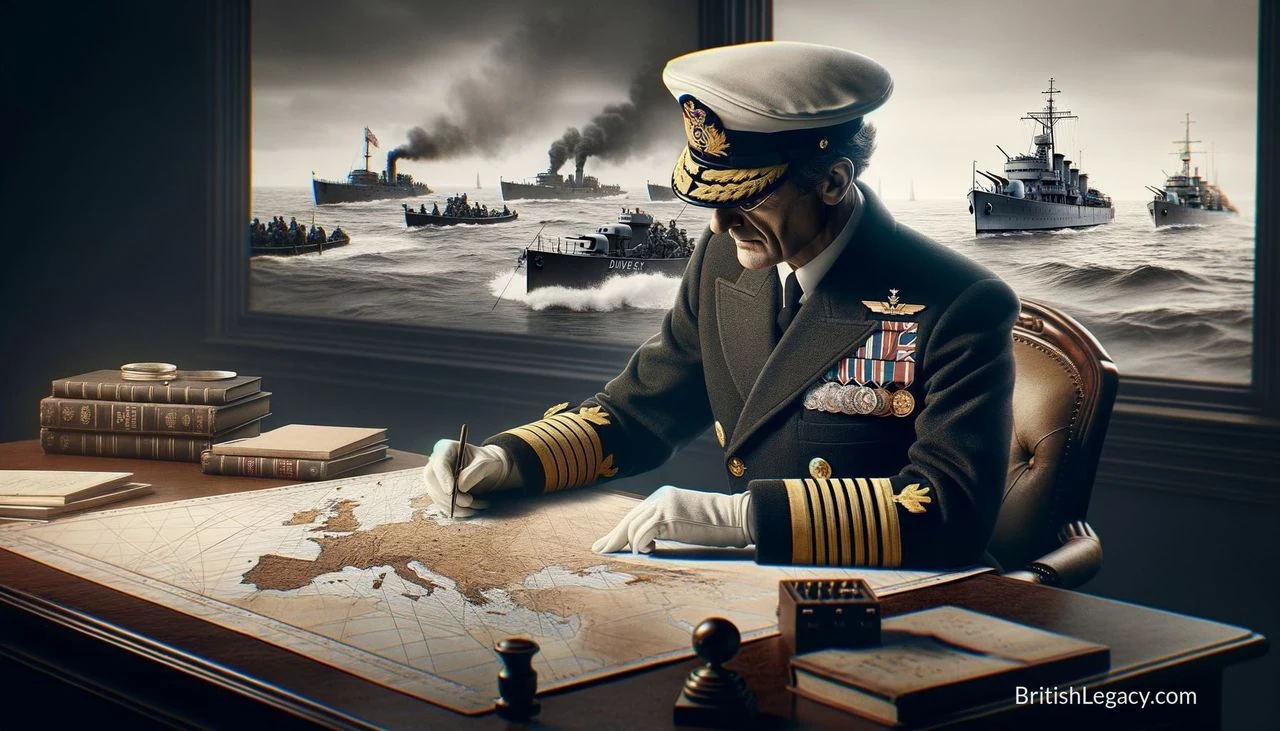
At Dover Castle, beneath its ancient defences, Bertram Ramsay and his staff worked through nine days of Operation Dynamo, the 1940 evacuation of Allied troops from Dunkirk. Four years later, he was responsible for planning and commanding the naval forces that carried the Allied invasion of Normandy across the Channel. Between those operations lay years of service, setbacks and further amphibious campaigns. Ramsay’s achievement was not simply to command ships, but to organise immense and varied forces around demanding operational aims.
A naval career shaped by war
Bertram Home Ramsay was born in Hampton Court Palace on 20 January 1883 and attended Colchester Royal Grammar School. He joined the Royal Navy in 1898, beginning a career that took him through the junior ranks and into command. In the First World War, he commanded the monitor HMS M25 from August 1915, serving with the Dover Patrol off the Belgian coast. Promoted to commander in 1916, he took command of the destroyer HMS Broke in October 1917.
On 9 May 1918, Broke took part in the Second Ostend Raid, a follow-up to the Zeebrugge Raid. Ramsay was mentioned in despatches for his service. His career between the wars was not a steady ascent: in 1935 he resigned as chief of staff to the Home Fleet commander, Sir Roger Backhouse, after Backhouse refused to delegate his authority.
Ramsay retired from the Navy in 1938. The following year, Winston Churchill persuaded him to return to service. Appointed Commander-in-Chief, Dover, on 24 August 1939, he was responsible for protecting cross-Channel military traffic, defending against possible destroyer raids and preventing submarines from passing through the Straits of Dover. The post placed him at the centre of events when the German advance in France left Allied forces in danger of being cut off.
Operation Dynamo: organising the Dunkirk evacuation
As Vice-Admiral Dover, Ramsay was responsible for Operation Dynamo, the evacuation of Allied troops from Dunkirk. He directed the operation from the tunnels beneath Dover Castle, working with his staff for nine days. The evacuation ran from 26 May to 4 June 1940. A total of 338,226 British and Allied soldiers were brought home from Dunkirk’s mole and beaches.
The evacuation drew on naval vessels and a broader collection of ships, including merchant vessels, fishing boats and privately owned craft. Ramsay’s task was to direct the effort under the pressure of an advancing enemy and to bring the troops across the Channel. After the operation, he was asked to report to King George VI and was made a Knight Commander of the Order of the Bath.
The evacuation did not end Ramsay’s responsibilities at Dover. For nearly two years he commanded forces seeking to maintain control of the surrounding waters and prepare for the threat of German invasion. In February 1942, he was in command when the German battleships Scharnhorst and Gneisenau, with their escorts, passed through the Channel. British forces had prepared for the passage under Operation Fuller but were taken by surprise and failed to stop them. Ramsay received a second Mention in Despatches.
From North Africa and Sicily to Normandy
Ramsay’s wartime work extended beyond the Channel. In 1942 he was appointed naval force commander for an invasion of Europe that was postponed; he was then transferred to serve as deputy naval commander for the Allied invasion of North Africa, Operation Torch. During the invasion of Sicily, Operation Husky, in July 1943, he was Naval Commanding Officer of the Eastern Task Force and prepared the amphibious landings.
In April 1944, Ramsay returned to the Active List and was promoted to admiral. He became Naval Commander-in-Chief of the Allied Naval Expeditionary Force for the invasion of France. The naval operation, Neptune, was part of Operation Overlord. Ramsay coordinated and commanded a fleet of almost 7,000 vessels, including the ships and landing craft required to put troops ashore and support the landings.
On D-Day, 6 June 1944, the fleet delivered more than 160,000 men to the Normandy beaches. By the end of June, more than 875,000 had been disembarked. Those figures indicate the scale of the transport and logistical task as well as the landings themselves: forces, equipment and supplies had to cross the Channel in sufficient numbers to sustain the campaign. Ramsay’s remit encompassed the naval operation that made that movement possible.
He also opposed a plan by Churchill to watch the landings from HMS Belfast, which was assigned to bombardment duties. King George VI announced that he intended to accompany the Prime Minister. Ramsay refused responsibility for either man’s safety, citing the dangers of the operation and the need for both to remain available in Britain. Churchill and the King stayed ashore.
Death and remembrance
Ramsay was killed on 2 January 1945 when his plane crashed during take-off at Toussus-le-Noble, south-west of Paris. He was travelling to a conference with Field Marshal Bernard Montgomery in Brussels. Four other people aboard also died. Ramsay was buried at Saint-Germain-en-Laye New Communal Cemetery.
His honours included appointment as a Knight Commander of the Order of the Bath and a Knight Commander of the Order of the British Empire, membership of the Royal Victorian Order, and the French Légion d’honneur, the United States Legion of Merit and the Soviet Order of Ushakov. In November 2000, a statue of Ramsay was erected at Dover Castle, near the headquarters from which he directed Operation Dynamo. His name also appears on the Colchester Royal Grammar School war memorial, and a portrait hangs at the school. The Royal Navy later named the Ramsay Building at HMS Collingwood in Fareham in his honour; it was opened by his son in March 2012.
Why Admiral Sir Bertram Ramsay deserves a place in British Legacy
Ramsay’s place in British history rests on work that was both consequential and practical. At Dunkirk, he directed an evacuation that brought 338,226 British and Allied soldiers home from France. At Normandy, he commanded the naval force that landed more than 160,000 men on D-Day and over 875,000 by the end of June. These operations required the coordination of military vessels, landing craft and supporting forces across the Channel. Remembering Ramsay helps make visible the planning and command behind events often recalled chiefly through the troops on the shore or the boats that crossed the water.
His career also connects British naval service across two world wars: from command in the Dover Patrol and the Second Ostend Raid, through the defence of Dover and the invasions of North Africa and Sicily, to Neptune. His return from retirement in 1939 and his appointment at Dover placed him in a position to lead the response to an urgent crisis; later commands drew on his experience in amphibious operations. The statue at Dover Castle, his school memorial and portrait, and the Royal Navy building named for him keep that record visible in places tied to his service. His legacy is therefore not only a reputation attached to two famous operations, but a documented contribution to the organisation of evacuation, defence and invasion on a scale that shaped the Allied campaign in Europe.
Sources
Bertram Ramsay — Wikipedia revision 1368296656 · Bertram Ramsay — Wikipedia
Adapted in part from Bertram Ramsay by Wikipedia contributors, under CC BY-SA 4.0. Text has been edited and combined with the existing article; this adapted text is shared under the same licence. Contributor history.