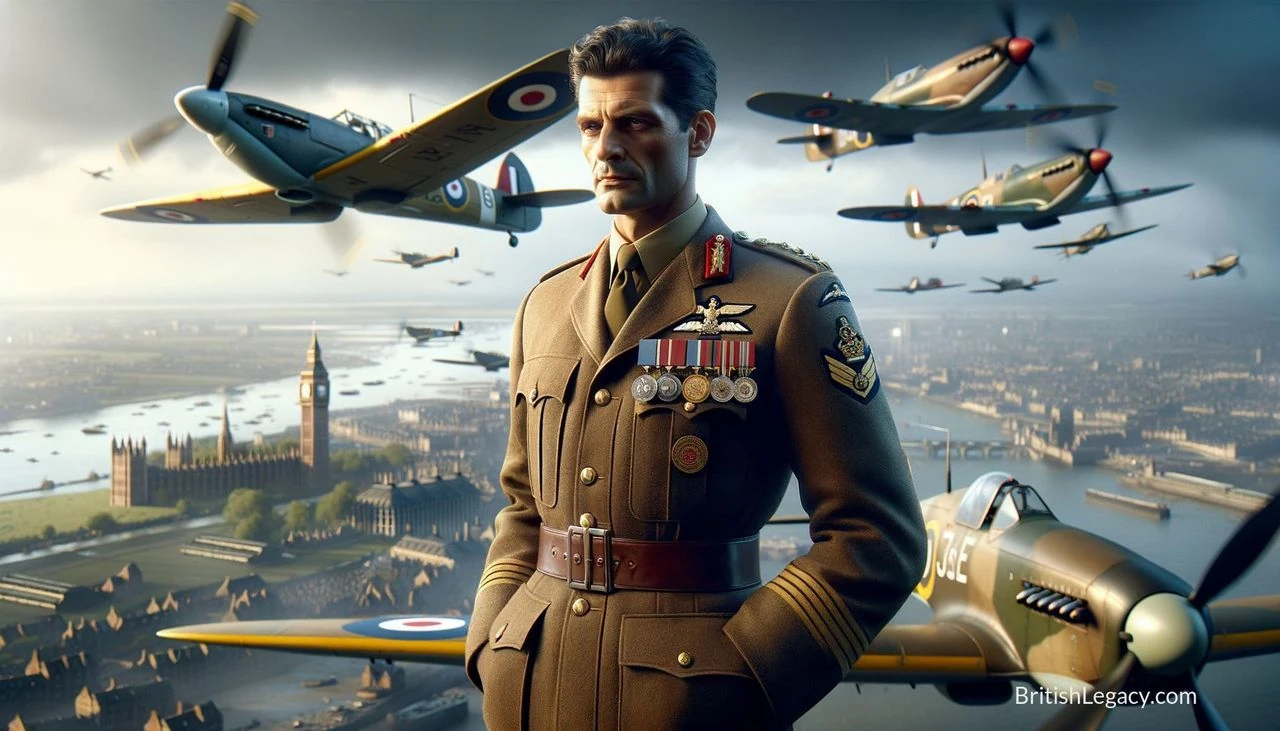
In the summer of 1940, the defence of London and south-east England depended on decisions made under pressure: which German formations posed the greatest threat, how many RAF fighters could be sent up, and when to commit them. Air Chief Marshal Sir Keith Park commanded No. 11 Group, the Fighter Command group facing the heaviest Luftwaffe assault. His work helped Britain retain control of the air over the Channel and its southern approaches. The New Zealand-born officer’s wartime career did not end with the Battle of Britain: he later directed air operations from Malta and served in senior Allied commands in the Middle East and South-East Asia.
From New Zealand artilleryman to fighter pilot
Keith Rodney Park was born in Thames, New Zealand, on 15 June 1892. His father, James Livingstone Park, was a Scottish geologist; his mother was Frances Rogers. Park attended King’s College in Auckland and Otago Boys’ High School in Dunedin. He later worked at sea as a purser for the Union Steam Ship Company and served in the New Zealand Field Artillery as a territorial soldier.
When the First World War began, Park enlisted in the New Zealand Expeditionary Force. He served with the artillery at Gallipoli, where he took part in the landing at Anzac Cove and later commanded a battery. He transferred to the British Army and continued on the Western Front. At the Battle of the Somme, in October 1916, he was wounded when a German shell threw him from his horse. During his recovery he secured a transfer to the Royal Flying Corps.
After flight training, Park became an instructor and joined No. 48 Squadron in France in 1917. Flying Bristol Fighters, he took part in patrols, reconnaissance and escort missions. He and his observers engaged German aircraft in several encounters; Park received the Military Cross and a bar to it, and was awarded the French Croix de guerre. In 1918 he took command of No. 48 Squadron. The records differ over his total aerial victories: the squadron’s figures, Air Ministry records and a later biographer do not give the same count. His wartime service nevertheless established him as a combat pilot and commander.
Building a system of air defence
Park remained in the RAF after the war. His interwar career included command and staff appointments, time at RAF Northolt and Tangmere, and a posting as air attaché in South America. In 1937 he returned to Britain and, after taking command at Tangmere, became senior air staff officer to Air Marshal Hugh Dowding, head of Fighter Command.
Park and Dowding worked on how Fighter Command should detect and respond to an air attack. The system brought together information from radio direction finding, the Observer Corps and the aircraft themselves. Park helped improve the process by which reports were assessed and displayed on plotting tables. Filtering information made the picture clearer for those deciding where to send fighters. He also worked on Fighter Command tactics, questioning whether the RAF’s traditional three-aircraft “Vic” formation suited modern monoplanes.
On 20 April 1940 Park took command of No. 11 Group, responsible for the fighter defence of London and south-east England. The group also bore major responsibility during the evacuation from Dunkirk. RAF fighters had to fly from bases in south-east England, often beyond the protection of radar, and could spend limited time over the evacuation area. Park favoured concentrated patrols over continuous coverage, which could leave the fighters too thinly spread. He flew to Dunkirk to observe conditions and visited airfields to see how his squadrons were operating.
Command at the Battle of Britain
No. 11 Group faced the main German assault during the Battle of Britain. Park had 22 fighter squadrons available, with about 350 aircraft and just over 550 pilots, while the Luftwaffe could bring a substantially larger force against the south-east. Radar gave warning, but the time between detecting an approaching raid and its arrival over the coast could be short. Park had to distinguish attacks from diversions, judge how many squadrons were ready, and direct aircraft to meet bombers before they reached their targets.
His approach relied on committing squadrons promptly rather than waiting to assemble very large formations. He sought to attack bombers and avoid being drawn into unnecessary engagements with their fighter escorts. Park also tried to keep pilots and aircraft in service: losses and inadequate training among replacements threatened the group’s capacity, while damaged airfields and the pressure on ground crews complicated operations. He regularly visited the stations under his command and kept in contact with their personnel.
On 15 September 1940, a major German daylight raid met a strong RAF response. Park committed all the fighters available to him, and aircraft from No. 12 Group also joined the defence. The German attack failed; the date became known as Battle of Britain Day. Earlier that month the Luftwaffe had shifted its attention from RAF airfields to London. That change eased some pressure on the fighter stations and allowed Park’s group time to recover, although its pilots remained heavily engaged.
Park’s command was entangled in a dispute over the “Big Wing” tactic, in which several squadrons assembled before being directed towards German aircraft. Air Vice-Marshal Trafford Leigh-Mallory, commanding No. 12 Group, advocated its use. Park argued that assembling such a force could take too long to protect targets in his group’s area, where enemy bombers might arrive quickly. He wanted No. 12 Group to provide more responsive cover for exposed airfields. The tactical disagreement fed into wider tensions between senior officers and contributed to controversy over Park’s position. He was replaced in command of No. 11 Group in December 1940 by Leigh-Mallory. The account of why Park was removed was disputed: the official explanation cited the need for rest, while Park believed the dispute over Leigh-Mallory was involved.
Malta and Allied air operations
After the Battle of Britain, Park took charge of No. 23 Group in Training Command, overseeing flying training and related establishments. In 1942 he moved to Egypt, where he was responsible for the aerial defence of the Nile Delta. In July he was sent to Malta, then under attack by German and Italian forces. There he replaced a defensive approach with forward interception: fighters aimed to meet incoming formations before they reached the island, separating the tasks of engaging escort fighters and attacking bombers. The daylight raids diminished after the new plan began, although the Axis continued to adapt and attacks resumed.
As pressure on Malta eased and supplies reached the island more regularly, RAF operations increasingly supported Allied campaigns in North Africa and the Mediterranean. Park directed attacks on shipping, ports and airfields, including operations in preparation for the invasion of Sicily. In 1944 he became air officer commanding-in-chief of RAF Middle East Command. The following year he was appointed Allied Air Commander in South-East Asia, where air supply was vital to the advance of the Fourteenth Army through Burma. Park also oversaw the air operation to repatriate Allied military and civilian internees after Japan’s surrender.
Park retired from the RAF in 1946 with the rank of air chief marshal. In New Zealand he represented aircraft manufacturer Hawker Siddeley and later served on Auckland City Council. He chaired the committee working towards an international airport at Māngere, which began international operations in 1966. Park died in Auckland on 6 February 1975, aged 82. He was given a military funeral; his ashes were scattered over Waitematā Harbour.
Recognition in Britain and New Zealand
Park received senior British honours during and after the war, including appointments as a Knight Commander of the Order of the British Empire and a Knight Grand Cross of the Order of the Bath. He was also made a Commander of the United States Legion of Merit. His name became associated with the defence of London, but recognition has been spread across the places where he served and lived.
In London, a temporary statue of Park stood on the Fourth Plinth in Trafalgar Square in 2009–10. A bronze statue was unveiled in Waterloo Place on 15 September 2010, during the 70th anniversary commemorations of the Battle of Britain. Roads near former RAF sites at Biggin Hill and Uxbridge also bear his name. In New Zealand, memorials include the Sir Keith Park Memorial Airfield in Thames and a bronze statue unveiled there in 2019. A further statue beneath a replica of his Hurricane was unveiled at Thames airfield in September 2025. His uniform and medals are displayed at the Auckland War Memorial Museum.
Why Keith Park deserves a place in British Legacy
Park’s place in British history rests on a specific responsibility at a critical moment. As commander of No. 11 Group, he directed the fighter defence of London and south-east England when the Luftwaffe concentrated its attacks there. He had to make decisions with limited aircraft, short warning times and pilots under sustained pressure. His emphasis on timely interception, clear operational information and the practical readiness of airfields and squadrons helped Fighter Command meet attacks without committing its fighters blindly. The Battle of Britain was a collective achievement, but Park’s command of the group facing the heaviest assault was a significant part of that defence.
His British legacy also includes work less often captured by the story of 1940. Before the battle, Park helped develop the information-handling and tactical practices behind Britain’s air-defence system. After it, he applied his experience to training, the defence of Egypt and the air campaign from Malta, then served in Allied command in South-East Asia. His career connects Britain’s home defence with a wider wartime effort across several theatres. Born in New Zealand and later returning there, Park was not British by birth; his connection to British Legacy is the decades he served in the RAF and the consequential command he held in Britain’s defence. The memorials in London and the continuing recognition in New Zealand reflect both sides of that history.
Sources
Keith Park — Wikipedia revision 1379812496
Adapted in part from Keith Park by Wikipedia contributors, under CC BY-SA 4.0. Text has been edited and combined with the existing article; this adapted text is shared under the same licence. Contributor history.