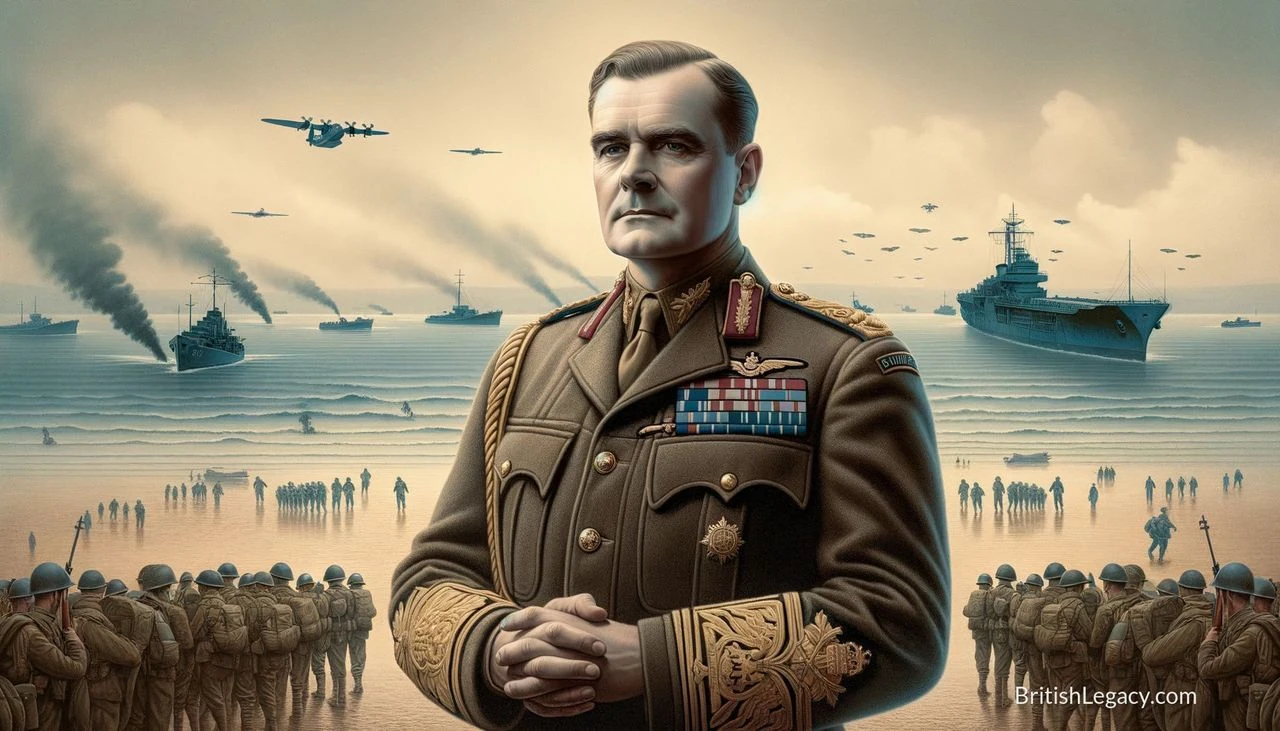
General Sir Miles Dempsey commanded the British Second Army in north-west Europe, including during the Normandy campaign and the advance across France, Belgium and into Germany. His wartime record also encompassed the retreat to Dunkirk, the invasion of Sicily and the difficult campaign in Italy. Dempsey was trusted with some of the war’s largest operations, yet shunned publicity. His story is one of a career soldier whose influence is clearest in the formations he led and the decisions he shaped.
From Sandhurst to the Western Front
Miles Christopher Dempsey was born in New Brighton, Wallasey, Cheshire, on 15 December 1896. He entered Shrewsbury School in 1911, where he played cricket and took part in the Officers’ Training Corps. In October 1914, aged 17, he left school for the Royal Military College, Sandhurst. He graduated in February 1915 and was commissioned as a second lieutenant in the Royal Berkshire Regiment.
After training, Dempsey joined the regiment’s 1st Battalion on the Western Front in June 1916. He served as a platoon commander and later led companies, including during the battles of Delville Wood and Cambrai. In March 1918, a mustard-gas attack struck his battalion. Dempsey was among the officers and soldiers gassed and evacuated to England; he later returned to the regiment. He was mentioned in despatches and awarded the Military Cross, gazetted in 1919.
His early service continued overseas after the Armistice. The 1st Battalion went to Iraq in 1919 and took part in suppressing the Iraqi revolt of 1920. In 1921 it moved to Iran, where Dempsey served during the Russian Civil War, and subsequently to India. He returned to England in 1923 for an appointment at Sandhurst. Later postings included service with his regiment in Germany and study at the Staff College, Camberley, where he graduated in 1931. Before the next war, he held staff and regimental appointments, including command of the 1st Battalion, Royal Berkshire Regiment.
Learning command in France, Sicily and Italy
When the Second World War began, Dempsey went to France with the British Expeditionary Force. In November 1939, he was promoted to acting brigadier and given command of the 13th Infantry Brigade. It fought during the retreat from the River Dyle, at the River Scarpe and at the Ypres–Comines Canal before forming part of the rearguard for the evacuation from Dunkirk. The brigade returned to England with fewer than 500 men from an original strength of nearly 3,000. Dempsey was mentioned in despatches and awarded the Distinguished Service Order for his service in France.
After Dunkirk, he served as a senior staff officer and commanded infantry and armoured formations during the training and reorganisation of the British Army in England. In December 1942, he took command of XIII Corps in the Eighth Army. He helped plan the Allied invasion of Sicily, but objected to the initial plan’s dispersed landings, arguing that the forces should be able to support one another if German resistance proved strong. Montgomery and other commanders took up objections to the plan, and the revised version was accepted by General Dwight D. Eisenhower.
XIII Corps landed in Sicily on 10 July 1943. Its first-day objectives were achieved, but progress slowed as German forces resisted. Dempsey’s corps later took part in the invasion of mainland Italy across the Strait of Messina. The landing was unopposed, but destroyed bridges and difficult terrain impeded the advance. Experience in these campaigns helped establish his reputation in combined operations and brought him the appointment that would define his wartime career.
Second Army in Normandy and beyond
Montgomery selected Dempsey to command the Second Army, the principal British Army formation in the 21st Army Group’s assault on north-west Europe. Dempsey and his staff worked with naval and air commanders to plan the landings. On D-Day, 6 June 1944, the Second Army landed on Gold, Juno and Sword beaches. Dempsey came ashore that evening and established a mobile tactical headquarters in Normandy.
The advance was hard fought. Around Caen, German resistance held up the Anglo-Canadian forces, drawing substantial German armoured strength towards the sector. Dempsey argued for an attack using three armoured divisions, supported by heavy bombing. Operation Goodwood began on 18 July and produced a costly advance of about seven miles, but did not break through the German lines. Dempsey later maintained that it achieved important strategic aims by drawing German reserves away from the American front. The campaign also exposed weaknesses in how British armour and infantry were working together; the formations were subsequently reorganised to improve cooperation between them.
After the Normandy fighting, the Second Army advanced rapidly across northern France and into Belgium. It liberated Brussels on 3 September 1944 and entered Antwerp the following day. Dempsey questioned Montgomery’s plan for Operation Market Garden, proposing instead a crossing closer to the American armies. The operation went ahead in a larger form, but stronger-than-expected German resistance prevented the Allies from reaching its final objective. Dempsey and Lieutenant-General Brian Horrocks agreed that the attempt to hold the far bank of the Nederrijn could not succeed and that the 1st Airborne Division should be withdrawn.
In March 1945, Dempsey’s army crossed the Rhine. The Second Army’s crossing began on 23 March, and he was the first British commander to cross the river. It then advanced into northern Germany. In May, his forces captured Bremen and Kiel. Dempsey sent a delegation of senior German officers seeking to surrender to Montgomery; at the same time, he negotiated the surrender of the Hamburg garrison. His wartime command had taken him from the defence and evacuation of France to the Allied advance into Germany.
Service after the European war
After the war in Europe ended, Dempsey was appointed to command the Fourteenth Army in the Far East. He took up the post in August 1945, shortly before Japan’s surrender. His responsibilities included the repatriation of prisoners of war and the reoccupation of British Malaya. In November, he became Commander-in-Chief of Allied Land Forces, South East Asia.
In April 1946, Dempsey became Commander-in-Chief, Middle East. His duties included British involvement in the Greek Civil War and the Palestine Emergency. He advised Montgomery that Britain should consider withdrawal from Mandatory Palestine if the government would not provide the resources he believed necessary. Although Montgomery wanted him to become Chief of the Imperial General Staff, Dempsey chose to retire. He left the Army in 1947.
Dempsey retained military and ceremonial connections after retirement. He served as Colonel of the Royal Berkshire Regiment and held appointments with the Royal Military Police and the Special Air Service. When the future of the SAS was in question, he lobbied for it to remain a permanent part of the Army; it achieved that status in 1950. He was also appointed Commander-in-Chief, Home Forces, in a reserve capacity, an appointment he relinquished in 1956. That year he was advanced to Knight Grand Cross of the Order of the British Empire.
His life outside the Army included a long interest in horses. He chaired the Racecourse Betting Control Board from 1947 to 1951, bred and raced horses, and later held senior roles in brewing businesses. He married Viola O’Reilly in 1948, and they settled in Berkshire. Dempsey died at his home in Yattendon on 5 June 1969, aged 72, and was buried in the churchyard there.
A commander who avoided the limelight
Dempsey was regarded as competent and unassuming, and his reluctance to seek attention contributed to his relative obscurity. His approach to command included detailed attention to maps and terrain, developed in part through studying European battlefields between the wars. In Normandy, he worked closely with air commander Harry Broadhurst after tensions between them earlier in the Italian campaign. Their relationship became a productive working partnership between the Army and the Royal Air Force.
His record was not without difficult decisions or contested results. Goodwood did not achieve a breakthrough, and Market Garden failed to secure its intended crossing. Dempsey’s contribution is better understood through the scale and range of his responsibilities than through a claim of unbroken success: he commanded formations through the retreat from France, campaigns in the Mediterranean, the liberation of Brussels and the final advance across the Rhine. In the years after the war, his advocacy also helped preserve the SAS as a permanent Army unit.
Why Miles Dempsey deserves a place in British Legacy
Miles Dempsey’s place in British Legacy rests on a substantial record of service and command, rather than on public fame. He led the Second Army through the Normandy campaign and the advance across north-west Europe, including its crossing of the Rhine in March 1945. Those operations depended on the coordination of large land forces with air and naval support. Dempsey’s role in planning the Normandy landings and in directing the subsequent campaign connects his story to the British Army’s contribution to the Allied war effort, while the difficult fighting around Caen and the contested results of Goodwood show the realities of command rather than a simplified tale of effortless victory.
His contribution also continued after the European war. In the Far East and Middle East, he held senior commands during the transition from wartime operations to post-war responsibilities. Back in Britain, his lobbying helped secure the Special Air Service’s status as a permanent part of the Army in 1950. That specific legacy—supporting the continuation of a military unit—adds a further dimension to a career otherwise most closely associated with wartime command. Dempsey was not a general who sought the limelight, and his relatively low public profile is part of the historical record. Remembering him makes British military history more complete: it recognises the commander who worked behind the headlines, led major formations across several theatres, and continued to take responsibility for the institutions of the Army after his retirement.
Sources
Miles Dempsey — revision 1379833151 · Miles Dempsey
Adapted in part from Miles Dempsey by Wikipedia contributors, under CC BY-SA 4.0. Text has been edited and combined with the existing article; this adapted text is shared under the same licence. Contributor history.