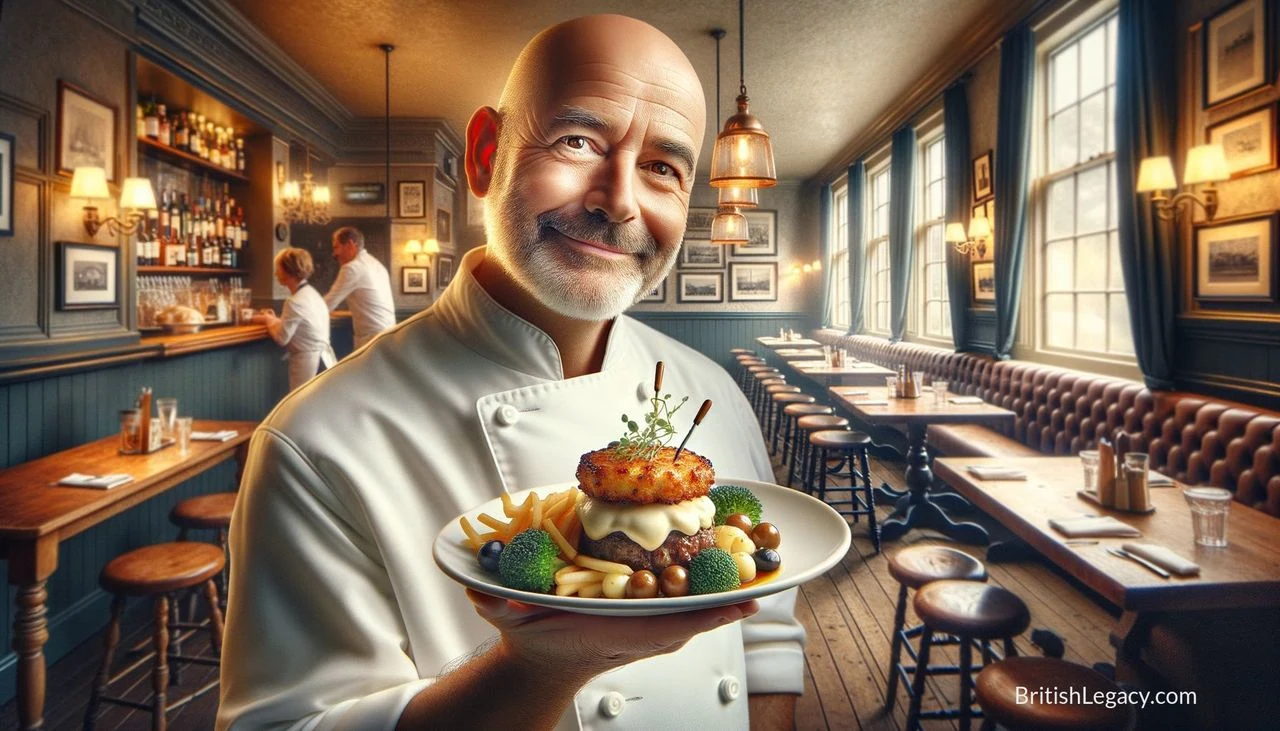
Tom Kerridge built his reputation around an idea that sounds simple but altered expectations of British pub dining: a pub could serve food ambitious enough to win Michelin stars without abandoning the character of a pub. When he and his wife, Beth Cullen-Kerridge, opened The Hand & Flowers in Marlow in 2005, the venture joined a restaurant career already shaped by some of Britain’s established kitchens. Its success made Kerridge a prominent chef; television, books and further restaurants carried his cooking well beyond Buckinghamshire.
A childhood detour into cooking
Thomas Kerridge was born in Salisbury on 27 July 1973. His family later moved around housing estates in Gloucester, where he attended Saintbridge Secondary School. The eldest of two brothers, he began cooking for himself and his younger sibling after school while their mother was at work. He enjoyed riding his bicycle and visiting Westonbirt Arboretum.
Acting briefly offered another possible direction. After three weeks at a youth theatre, he was cast in the 1991 Christmas special of the BBC television drama Miss Marple: They Do It with Mirrors, followed by several small parts. At 18, he chose cooking instead. Marco Pierre White’s cookbook White Heat helped convince him to pursue the trade, and he attended catering college in Cheltenham.
Kerridge began in a professional kitchen at Calcot Manor in Tetbury in 1991, then worked under Philip Britten at the Capital Hotel in Knightsbridge. Three years at Stephen Bull’s Marylebone restaurant followed. After moving among kitchens as a chef de partie, he joined Rhodes in the Square in 1999 as sous chef to Gary Rhodes. He later held the same role at Odettes, became head chef at Bellamys Dining Room in 2001 and then worked at Great Fosters in Surrey. A period at Monsieur Max preceded his move to Adlards in Norwich, where he was head chef.
The Hand & Flowers: a pub with Michelin ambition
Kerridge opened The Hand & Flowers in Marlow, Buckinghamshire, in 2005. The setting was a pub, but the cooking demanded the attention associated with high-end restaurants. The restaurant gained its first Michelin star in 2006. In 2012, it became the first pub to hold two Michelin stars, a distinction that brought the possibilities of British pub food into sharp focus.
Kerridge has said he did not see himself as a “Michelin-star kind of guy”; choosing a gastropub rather than a conventional fine-dining restaurant reflected that outlook. One of his signature preparations reworks a pig roast: pork belly is cooked in a bain-marie, wrapped in its skin and roasted, then served with a stuffed pig’s trotter. The combination takes a recognisable, generous British meal and applies the control and technique of a professional kitchen.
The original account also identifies slow-cooked duck breast with Savoy cabbage and duck-fat chips, and lobster with chips and Béarnaise sauce, as dishes associated with The Hand & Flowers. They convey the range of Kerridge’s approach: familiar pub forms and ingredients can accommodate both careful cooking and a touch of restaurant formality.
Building a wider restaurant group
Kerridge’s next Marlow pub, The Coach, added a more casual setting to the local restaurant scene. It received its first Michelin star in 2017. The original account places its opening in 2014, but the Wikipedia restaurant chronology gives 1 December 2015; the article follows that supplied chronology. The Coach’s dishes include “Duck and Pudding”, a contemporary take on faggots, and smoked haddock omelette.
Further ventures took Kerridge beyond Marlow. The Butcher’s Tap opened in the town in 2017. In 2018, Kerridge’s Bar & Grill opened at the Corinthia Hotel in Westminster, his first London restaurant. The Bull & Bear followed at Manchester’s Stock Exchange Hotel in 2019 and closed at the end of 2022. Kerridge’s Fish & Chips opened at Harrods in 2021 and closed in August 2025. His restaurant activity also includes The Butcher’s Tap & Grill in Chelsea, listed as opening in December 2023, and LUSH by The Hand & Flowers, a catering business launched in 2018.
Cooking on screen and in print
Television gave Kerridge a platform to explain food as well as cook it. He competed on Great British Menu in 2010 and 2011, supplying main courses for the final banquet on both occasions, and later returned as a judge. His programmes include Tom Kerridge’s Proper Pub Food, Spring Kitchen with Tom Kerridge, Food and Drink, Bake Off: Crème de la Crème and Tom Kerridge: Lose Weight for Good. He has also presented series including Tom Kerridge’s Fresh Start, Tom Kerridge’s American Feast and Saving Britain’s Pubs with Tom Kerridge.
His books extend that public-facing work into home kitchens. Among them are Tom Kerridge’s Best Ever Dishes, Tom Kerridge’s Fresh Start, The Hand & Flowers Cookbook, Pub Kitchen: The Ultimate Modern British Food Bible and Tom Kerridge Cooks Britain. In 2017, he launched Pub in the Park in Marlow; the festival expanded the following year to Bath, Tunbridge Wells and Knutsford. His work has also included creating menus for British Airways, including short-haul economy food announced in 2021.
Recognition has come from both the restaurant and hospitality industries. Kerridge received the AA Chefs’ Chef of the Year award in 2013, GQ’s Chef of the Year in 2014 and the Chef Award at the 2017 Catey Awards. These honours followed a career in which restaurant cooking, popular television and large public events have continually reinforced one another.
Why Tom Kerridge deserves a place in British Legacy
Kerridge’s place in British Legacy rests first on a specific achievement: The Hand & Flowers became the first pub to win two Michelin stars. That distinction did more than add an award to one chef’s record. It made a British institution—the local pub—a credible setting for cooking judged at the highest level. Kerridge’s own description of himself as not a “Michelin-star kind of guy” helps explain the significance of the choice. Rather than leave pub culture behind to pursue restaurant acclaim, he used the pub as the setting in which to pursue it.
His wider career has carried that idea into other forms of public life. The Coach continued the Marlow experiment in a more casual setting, while television and cookbooks brought his cooking into homes far from his restaurants. Pub in the Park took the pub-food conversation into festivals in several English towns, and his work on airline menus extended it to travellers. These activities make his British connection concrete: they are rooted in the country’s pub and food traditions, and they have helped present those traditions to diners, viewers and readers in contemporary forms. Kerridge’s achievement is not simply that he made pub food famous, but that he demonstrated how its setting and hospitality could coexist with serious culinary ambition.
Sources
Adapted in part from Tom Kerridge by Wikipedia contributors, under CC BY-SA 4.0. Text has been edited and combined with the existing article; this adapted text is shared under the same licence. Contributor history.