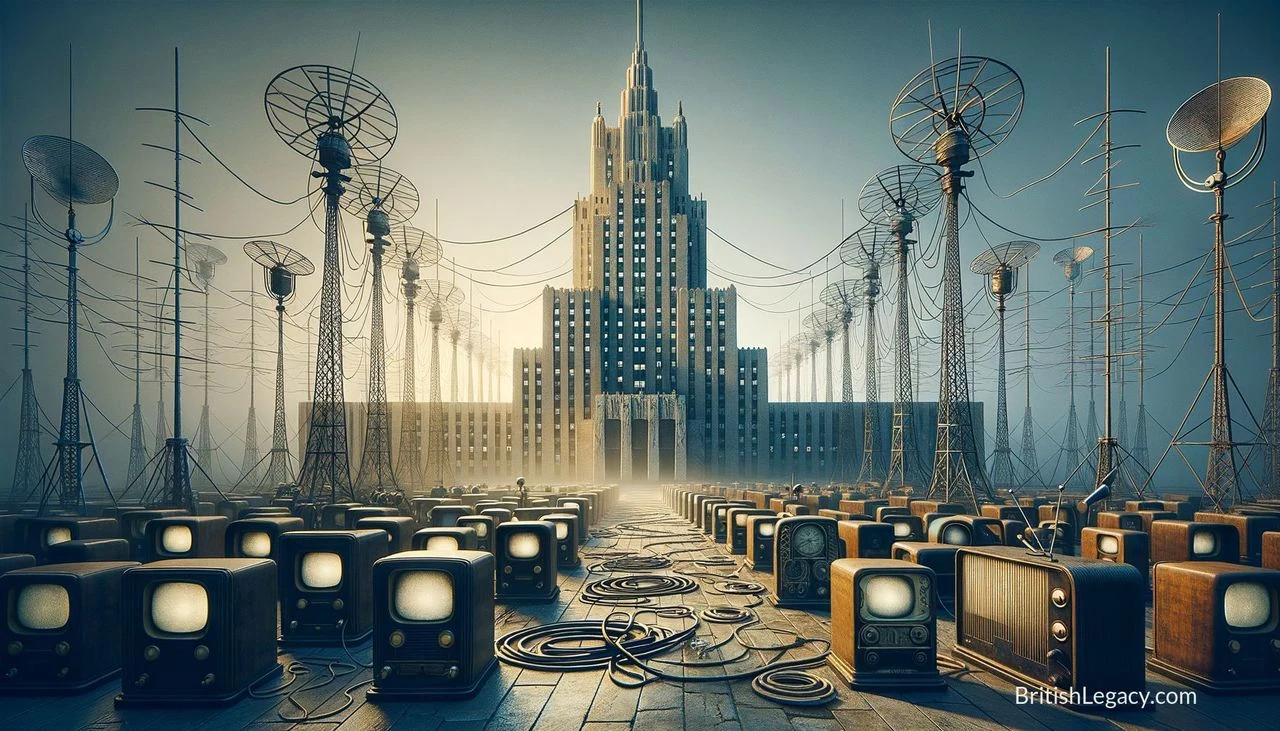
The BBC began with a practical problem: how to organise a new medium whose popularity was outrunning the arrangements for broadcasting it. Formed in 1922 by wireless manufacturers, the British Broadcasting Company soon became a national radio service. Five years later, a Royal Charter established the British Broadcasting Corporation. Since then, the BBC has helped shape how people in Britain receive news, hear music and drama, and watch television, while repeatedly adapting to new technologies and public scrutiny.
A wireless company becomes a public broadcaster
Britain’s first live public broadcast had come from the Marconi factory in Chelmsford in June 1920. Public interest in radio grew, but official concern that broadcasts might interfere with military and civil communications led to a ban on further broadcasts from Chelmsford. By 1922, the General Post Office had received nearly 100 applications for broadcasting licences. It proposed a single licence for a company jointly owned by wireless receiver manufacturers, avoiding the unregulated expansion seen in the United States.
The British Broadcasting Company Ltd. was formed on 18 October 1922. John Reith became its general manager that December. The company made its first official broadcast in November, and its early finances depended on royalties from the sale of approved wireless receivers. That arrangement proved inadequate: sales disappointed, while listeners could make receivers themselves or buy unlicensed sets. A review of broadcasting and the subsequent Crawford Committee process helped establish the case for a different model.
The change became official on 1 January 1927, when the British Broadcasting Corporation came into existence under a Royal Charter, with Reith as its first director-general. The motto adopted by the new corporation was “Nation shall speak peace unto Nation”. Reith’s approach is closely associated with the aim to “inform, educate and entertain”. In the early years, the BBC sought to serve a national audience and to distinguish itself from commercial broadcasting; its programming choices and standards were also shaped by Reith’s own moral and cultural judgements.
The corporation’s public role was not free of political pressure. During the 1926 general strike, restrictions on news bulletins were waived and the BBC became a major source of information. Reith tried to maintain the corporation’s room to operate independently while also recognising the government’s power over it. The episode helped secure a national audience, but it also exposed a lasting difficulty: a broadcaster can claim independence and impartiality while facing pressure from those in power and criticism from those who believe its coverage is not fair.
Building radio, then television
In its early decades, the BBC established radio as a shared national service. It launched Radio Times in 1923 as a guide to broadcasts. The listing magazine was one part of a system that connected audiences with programmes across the country. The corporation’s radio output ranged from music and drama to news and religious services; it also developed a tradition of broadcasting major cultural events. The BBC Proms, for example, became a BBC-supported annual festival in 1927, after music publishers Chappell and Co. withdrew their support.
Television arrived through experimentation before it became a regular service. The BBC began experimental broadcasts in 1929 using John Logie Baird’s electromechanical system. Limited regular broadcasts followed in 1932. An expanded television service opened from Alexandra Palace in November 1936, initially alternating between Baird’s mechanical system and an all-electronic system developed by EMI. The mechanical system was dropped the following year. The regular service was suspended from September 1939 until June 1946 during the Second World War.
Radio remained central during the war. The BBC moved much of its radio operation out of London, first to Bristol and then to Bedford. Its broadcasts carried major wartime speeches, including Winston Churchill’s radio addresses and Charles de Gaulle’s June 1940 appeal to the French people, made from London. In October 1940, Princesses Elizabeth and Margaret made their first BBC radio broadcast, speaking to children who had been evacuated from cities. These examples give substance to the broad description of the BBC as an important wartime source of news and morale.
When television returned after the war, it did so in a changed broadcasting landscape. Independent Television began in 1955, ending the BBC’s television monopoly. BBC2 launched in 1964, widening the corporation’s range beyond its existing service. Colour broadcasting followed: BBC2 began colour transmissions in 1967, with BBC1 following in 1969. BBC2 also made room for programming aimed at interests beyond the largest audiences, while the BBC’s broader output continued to include news, drama, entertainment, sport and documentaries.
Programmes and services across generations
The BBC’s contribution to British cultural life is visible in the range and longevity of its programmes. Its television history includes Doctor Who, EastEnders and Sherlock, alongside natural-history series such as Planet Earth and Blue Planet, narrated by Sir David Attenborough. News programmes including BBC News at Ten and Newsnight sit within a wider operation that supplies news to television, radio and online services. The corporation has also produced long-running radio programmes: Desert Island Discs began in 1942, The Archers in 1951 and Panorama on television in 1953.
Radio itself changed as competition arrived. The BBC’s national channels were reorganised in 1967: the Light Programme became Radio 1 and Radio 2, the Third Programme became Radio 3, and the Home Service became Radio 4. The corporation also began establishing local radio stations. Today, its services include national stations, services for the nations and English regions, and local radio. The World Service, launched as the BBC Empire Service in 1932, broadcasts in 43 languages as of 2026. Its international work adds another dimension to a corporation rooted in British broadcasting.
Other innovations extended the BBC’s reach beyond conventional radio and television. Ceefax, introduced in 1974, was the world’s first teletext service. It began as a way to provide subtitling and developed into a source of news and information; it closed in 2012 as the UK completed the transition to digital television. BBC Online followed in 1997, building a web presence for the corporation’s services and information. BBC iPlayer, which launched in July 2007, enabled audiences to stream television and radio programmes on demand. These developments changed not only how content was delivered, but also when audiences could access it.
The BBC has also had a commercial side. BBC Studios sells programmes and related products in Britain and overseas; it was formed in 2018 through the merger of the corporation’s production and international distribution businesses. Income from commercial activity sits alongside the licence fee, the principal means of funding the BBC’s domestic public services. The licence fee has been the subject of continuing debate, including arguments about whether it remains appropriate as viewing habits and available services change.
Public service under scrutiny
The BBC’s motto and public-service purpose describe ideals, not a guarantee that every decision has satisfied every audience. The corporation has faced sustained criticism over impartiality, independence and funding. Accusations of political bias have come from both the left and the right. Disputes over coverage and editorial decisions have sometimes prompted resignations by senior executives; controversies around the Hutton Inquiry in 2004, for example, led to the departure of senior managers, including director-general Greg Dyke.
Funding is part of the same public argument. The licence fee supports radio, television and online services for audiences across the UK, but critics have challenged the obligation to pay it and questioned how the system works in an era of multiple channels and streaming. Commercial income, including the international sale of programmes, provides another source of revenue. The balance between public funding, commercial activity and a universal service remains a recurring question for the institution.
Those debates are not incidental to the BBC’s history. Its scale and public responsibilities make its claims to impartiality and independence consequential, and the same reach that allows it to serve large audiences brings close attention to how it operates. A measured account of the BBC must therefore recognise both the services it has built and the continuing arguments over how it is governed, funded and trusted.
Why the BBC deserves a place in British Legacy
The BBC deserves a place in British Legacy because its development is closely bound to the history of broadcasting in Britain. Formed in 1922 by wireless manufacturers, it helped turn radio from a developing technology into a national service. Its change into a chartered corporation in 1927 established a distinct public-service model, while its television service, launched in 1936, carried broadcasting into a new medium. Later shifts—from the introduction of BBC2 and colour television to Ceefax, BBC Online and iPlayer—show an institution repeatedly changing how people encounter programmes and information.
That history has tangible cultural and public consequences. The BBC has supported institutions such as the Proms, created programmes that have lasted across generations, and developed services for the UK’s nations and regions as well as an international World Service. Its output spans news, drama, education, sport, music and natural history. These contributions help explain why the BBC is more than a familiar broadcaster: it has helped shape common reference points and the practical infrastructure of public communication. Its place in British Legacy should not depend on unqualified praise. Arguments over the licence fee, impartiality and independence are part of the story too. The BBC’s legacy lies in the breadth of the service it has built, its influence on British broadcasting, and the continuing public debate over what a national broadcaster should be.
Sources
Adapted in part from BBC by Wikipedia contributors, under CC BY-SA 4.0. Text has been edited and combined with the existing article; this adapted text is shared under the same licence. Contributor history.