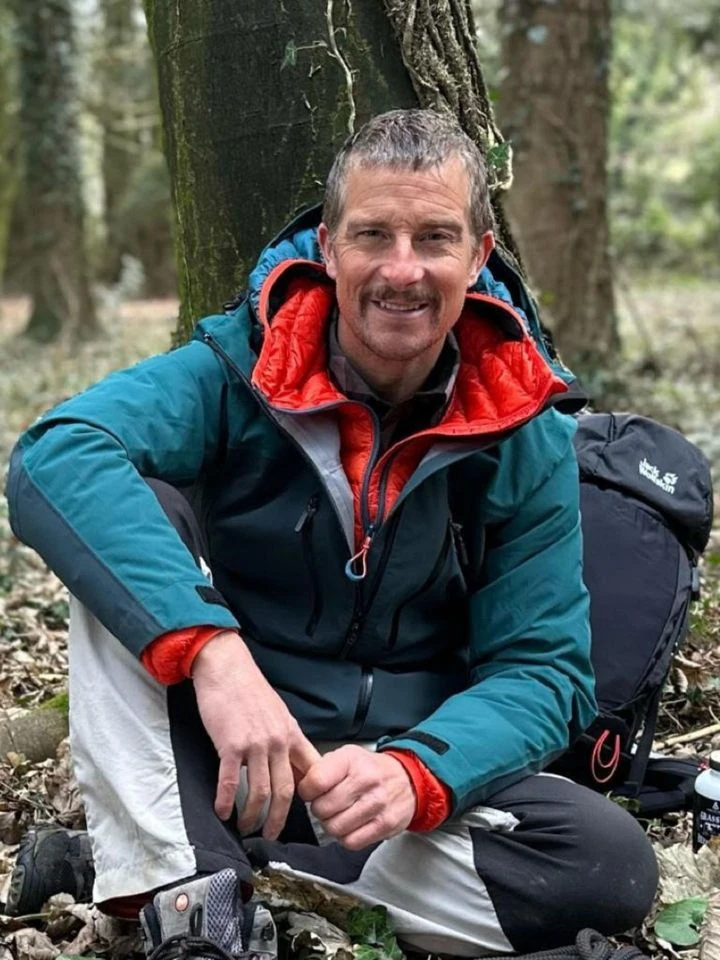
Bear Grylls turned expeditions into television and television into a platform for outdoor adventure. His career has ranged from climbing Everest after a serious parachuting accident to presenting survival programmes for international audiences. In Britain, one of his most lasting public roles was as Chief Scout, a post he held from 2009 to 2024.
From Donaghadee to the mountains
Edward Michael Grylls was born in Donaghadee, County Down, on 7 June 1974. When he was four, his family moved to Bembridge on the Isle of Wight. He learnt to climb and sail with his father, and later attended Eton College, where he helped establish the school’s first mountaineering club. After school, he studied Spanish and German at the University of the West of England and Birkbeck College, graduating in Hispanic studies in 2002.
Between 1994 and 1997, Grylls served as a trooper with 21 SAS (Reserve) in the Territorial Army. In 1996, a free-fall parachuting accident in Zambia left him with three broken vertebrae and ended his service. Eighteen months later, on 16 May 1998, he reached the summit of Mount Everest, aged 23. At the time he was among the youngest people to climb it. The claim that he was the youngest Briton is disputed: the account of his ascent notes an earlier climber with British and Australian citizenship, and subsequent British climbers reached the summit at younger ages.
Grylls continued to take on expeditions, often with a fundraising or public-awareness purpose. In 2000, he led a jet-ski circumnavigation of the British Isles that raised money for the Royal National Lifeboat Institution. In 2003, he led a team across the North Atlantic in an open rigid-inflatable boat, travelling from Halifax, Nova Scotia, to John o’ Groats. The crossing faced strong gales, waves and icebergs.
Other projects pushed into less familiar territory. In 2005, Grylls and two colleagues held an open-air formal dinner at 7,600 metres beneath a hot-air balloon, raising funds for The Duke of Edinburgh’s Award and The King’s Trust. In 2007, he set a paramotor altitude record in the Himalayas, reaching 9,000 metres; the expedition was filmed, and he did not fly over Everest itself. The following year, a planned Antarctic expedition ended early after he broke his shoulder kite-skiing. In 2010, he led a team through the Northwest Passage in an ice-breaking rigid-inflatable boat, an expedition intended to raise awareness of global warming and funds for Global Angels.
Survival on screen
Grylls became widely known through Born Survivor: Bear Grylls, broadcast in Britain, and the series’ international versions, including Man vs. Wild and Ultimate Survival. First shown in 2006, the programme placed him in difficult environments and presented practical demonstrations of survival. Its stunts and physical challenges became central to its appeal, while the format carried his expeditions to audiences well beyond Britain.
The programme also attracted criticism over how some scenes were presented. A consultant disclosed that Grylls had stayed in hotels on some nights and that certain scenes had been staged. Grylls apologised to viewers who felt misled. This episode is part of the programme’s history as well as a reminder that the television image of survival was, at times, shaped for the camera.
His later television work included The Island with Bear Grylls, which began on Channel 4 in 2014, and Running Wild with Bear Grylls, in which celebrities joined him on wilderness trips. He also presented series including Escape to the Legion, Get Out Alive and ITV’s Bear Grylls: Mission Survive. In 2020, he presented World’s Toughest Race: Eco-Challenge Fiji. Alongside broadcasting, he has worked as a motivational speaker and written books about expeditions, outdoor skills and survival, as well as children’s adventure fiction.
Chief Scout and charitable work
In July 2009, aged 35, Grylls became Chief Scout of the Scout Association, succeeding Peter Duncan. He was the youngest person to hold the position since it was created. His term lasted until 2024, when Dwayne Fields succeeded him. The role made a clear connection between his public profile and a British youth movement built around shared activities, outdoor skills and community participation. In 2018, the World Organization of the Scout Movement appointed him its first Chief Ambassador.
Grylls’s fundraising work has supported several organisations. His Everest climb raised funds for SSAFA Forces Help, while the jet-ski journey around Britain supported the RNLI. Global Angels benefited from expeditions including the 2007 paramotor achievement and the 2010 Northwest Passage journey. He has also served as an ambassador for The King’s Trust and Care for Children. In 2014, he designed one of the Scouts-themed Paddington Bear statues displayed in London; it was auctioned to raise money for the NSPCC.
In 2019, Grylls was appointed an Officer of the Order of the British Empire for services to young people, the media and charity. The honour recognised work spanning youth organisations, broadcasting and fundraising rather than a single expedition.
Why Bear Grylls deserves a place in British Legacy
Grylls’s place in British Legacy rests on the connection he made between adventure and public life. His ascent of Everest in 1998 followed a major injury and came when he was 23; it became the starting point for a career in which expeditions were also broadcast, written about and used to draw attention to charitable causes. His achievements include a British Isles circumnavigation for the RNLI, a North Atlantic crossing and a record-setting paramotor flight in the Himalayas. These episodes show the varied forms his work took, from endurance challenges to fundraising and environmental awareness.
His years as Chief Scout give that adventurous reputation a specifically British institutional dimension. From 2009 to 2024, Grylls represented a long-established youth movement to a wide public, while his later appointment as the first Chief Ambassador of World Scouting extended that association internationally. His work with organisations such as The King’s Trust, the RNLI, Global Angels and the NSPCC connects public attention with practical support for young people, children and safety at sea. The television record is not without complication: criticism of staged scenes in Man vs. Wild matters to an honest account of how survival was presented. Taken together, the expeditions, broadcasting, charitable fundraising and sustained Scout leadership form a distinctive contribution to contemporary British public life.
Sources
Bear Grylls — Wikipedia, revision 1372673364
Adapted in part from Bear Grylls by Wikipedia contributors, under CC BY-SA 4.0. Text has been edited and combined with the existing article; this adapted text is shared under the same licence. Contributor history.