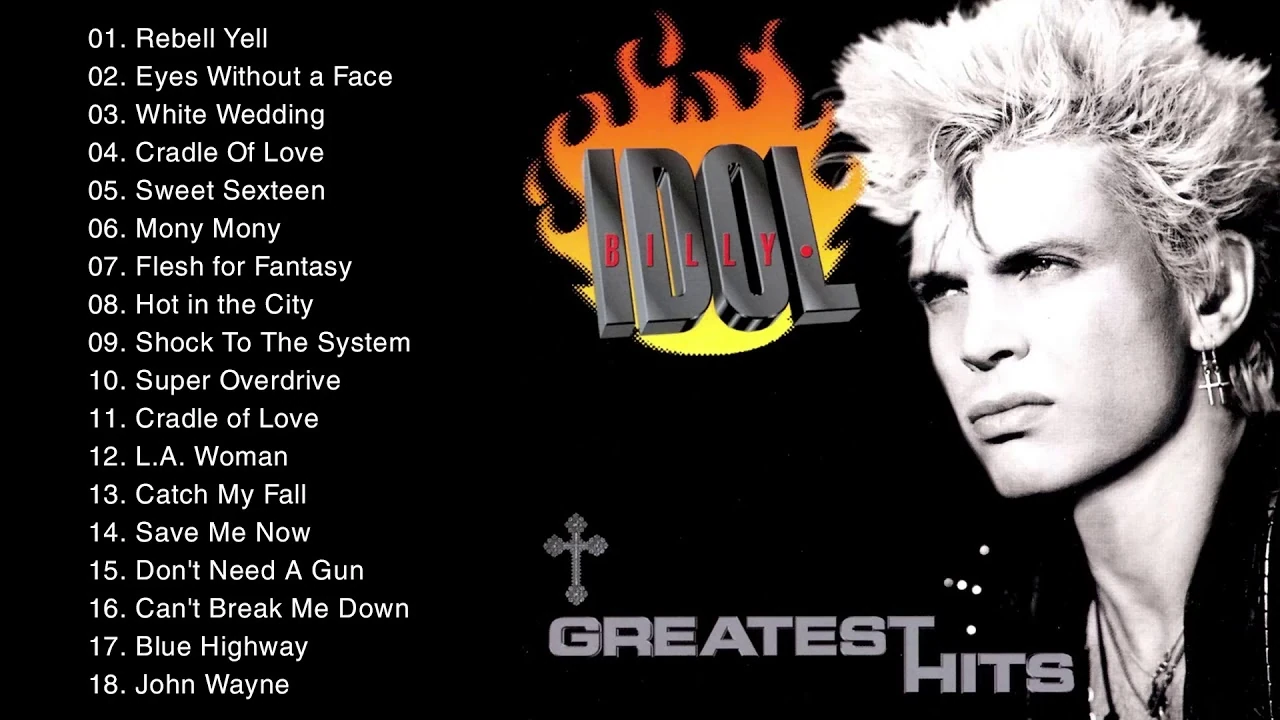
Billy Idol’s career began in the London punk scene and grew into an international solo success. Born William Michael Albert Broad in Stanmore on 30 November 1955, he first found an audience as the singer of Generation X. After moving to New York in 1981, he worked with guitarist Steve Stevens on a solo sound that brought punk attitude together with rock, pop and dance influences. The songs “White Wedding”, “Dancing with Myself” and “Rebel Yell” became central to that transformation, as music videos helped make Idol a familiar presence on MTV.
From Bromley to Generation X
Broad’s early life crossed the Atlantic and several parts of south-east England. Born in Stanmore, Middlesex, he moved to the United States with his family in 1958, aged two. They returned to England four years later and settled in Dorking. In 1971 the family moved to Bromley, where he attended Ravensbourne School for Boys; he later went to Worthing High School for Boys after another family move, to Goring-by-Sea. He began a philosophy with literature degree at the University of Sussex in 1975 but left after his first year.
By then, music had begun to draw him towards London. He joined the Bromley Contingent, a loosely organised group of Sex Pistols fans who travelled to see the band. In late 1976, he joined Chelsea as a guitarist. He and Chelsea bassist Tony James soon left to form Generation X, with Broad becoming its singer and frontman. His stage name, Billy Idol, was inspired by a school report: chemistry teacher Bill Price had described him as “idle”.
Generation X stood apart from some of punk’s more confrontational currents. The band drew on mid-1960s British pop as well as punk, and Idol later described its position as different from that of the Clash and the Sex Pistols. It was among the first punk bands to appear on the BBC music programme Top of the Pops. The group signed to Chrysalis Records, released three studio albums and disbanded after appearing in the 1980 film D.O.A.: A Rite of Passage.
The path from Chelsea to Generation X is clearer than the brief origin story sometimes given to Idol’s career. He joined Chelsea for a few weeks, then co-founded Generation X with James; the group’s early single “Your Generation” appeared in 1977. “Ready Steady Go” belongs to the Generation X catalogue, but the supplied reference does not identify it as a hit single from the band’s 1978 debut album. That distinction matters: the band’s story was longer than one album and one song, and its influences were not limited to punk alone.
A solo career built for a new audience
In 1981, Idol moved to New York City to pursue a solo career. He worked with guitarist Steve Stevens, whose playing helped shape the forceful, polished sound of the records that followed. The transition did not mean abandoning his earlier work: “Dancing with Myself” had been recorded for Generation X’s final album, Kiss Me Deadly, and was included on Idol’s 1981 solo EP Don’t Stop. His self-titled solo album followed in 1982.
“Dancing with Myself” and “White Wedding” helped establish him as a regular presence on MTV, a then-new music television channel. The video for “White Wedding”, directed by British film-maker David Mallet, received frequent airplay. In the United States, “Dancing with Myself” was also promoted with a video directed by Tobe Hooper. Idol’s visual presentation—blond hair, leather and a confrontational expression—made the songs’ punk lineage visible even as their sound reached into mainstream rock.
MTV gave Idol a route to American audiences at a moment when British performers were making a conspicuous impact on the channel. He became part of what was called the “Second British Invasion” in the United States. The label describes a wider movement, not a solo achievement, but Idol’s combination of a British punk background, memorable choruses and strongly visual performance made him one of its recognisable figures.
His next album, Rebel Yell, appeared in 1983 and became a major commercial success. Its title song reached number six on the UK singles chart, while “Eyes Without a Face” and “Flesh for Fantasy” became other prominent tracks. “Eyes Without a Face” reached number four on the US Billboard Hot 100. The album established Idol more firmly in the United States as well as expanding his audience elsewhere. The title track’s chorus—“With a rebel yell, she cried, ‘More, more, more’”—became one of the songs most closely associated with his name.
Reinvention, interruption and return
Idol followed Rebel Yell with Whiplash Smile in 1986. Its singles included “To Be a Lover”, “Don’t Need a Gun” and “Sweet Sixteen”. A remix collection, Vital Idol, followed in 1987; its live version of Tommy James’s “Mony Mony” reached the top of the US chart. The compilation Idol Songs: 11 of the Best, released in 1988, reached number two in the UK and later went platinum there.
In 1990, Idol broke his leg in a motorcycle accident. The injury interrupted plans beyond music: he had been cast in Oliver Stone’s The Doors, but his part was reduced, and an accident also prevented him from taking a larger role in Terminator 2: Judgment Day. His album Charmed Life was released that year. Unable to walk during the making of the “Cradle of Love” video, he was filmed from the waist up; the video won an MTV Video Music Award for Best Video from a Film. “Cradle of Love” also brought him his third Grammy nomination for Best Male Rock Vocal Performance.
Idol’s 1993 album Cyberpunk marked a sharp change in approach. Made in a home studio using computer-based recording tools, it drew on electronic and industrial elements. It performed less strongly in the United States than his earlier albums, though it achieved moderate chart success in parts of Europe. After a quieter period, he returned with Devil’s Playground in 2005, his first new studio album in nearly 12 years. That year he appeared at Donington Park’s Download Festival and received Classic Rock’s Comeback of the Year award.
He continued recording and touring. Later albums included Kings & Queens of the Underground (2014) and Dream Into It (2025). His 2014 memoir, Dancing with Myself, accompanied a renewed look at his life and career. In 2018, he and James joined former Sex Pistols members Steve Jones and Paul Cook for performances as Generation Sex, combining material from their former bands. Idol’s return to active recording and performance has not erased the breaks and stylistic turns in his career; it has made them part of its shape.
Songs, image and recognition
Idol’s catalogue moves between styles rather than following a single formula. Generation X drew on British pop as well as punk. His solo records combined punk attitude and pop hooks with hard rock, new wave and dance beats. Cyberpunk explored electronic sounds, while Devil’s Playground returned to a more hard-rock-oriented approach. The result is a body of work in which the brisk, recognisable force of songs such as “Rebel Yell” sits alongside experiments and reinventions.
His visual identity was also part of the way the music travelled. The videos for “White Wedding” and “Dancing with Myself” gave television audiences a vivid performer as well as a song. Idol’s blond hair, leather clothing and familiar snarl became closely associated with his public image in the 1980s. Rather than treating that look as separate from the music, the videos made it a vehicle for the same blend of punk defiance and pop accessibility that marked the records.
Idol received three Grammy nominations in the now-defunct Best Male Rock Vocal Performance category: for “Rebel Yell” in 1985, “To Be a Lover” in 1987 and “Cradle of Love” in 1991. His video for “Cradle of Love” won at the 1990 MTV Video Music Awards. These recognitions chart different aspects of his success: songs that travelled across radio and charts, and visual work that helped turn music television into an important part of his public career.
His life and work have also extended beyond records. Idol has appeared in films and on television, and in 2023 received a star on the Hollywood Walk of Fame. A full-length documentary about him, Billy Idol Should Be Dead, premiered at the Tribeca Festival in 2025. His career has been neither an uninterrupted climb nor a simple continuation of his first punk band. It has involved changes of sound, accidents, periods away from recording and renewed work with Stevens and other collaborators.
Why Billy Idol deserves a place in British Legacy
Billy Idol deserves a place in British Legacy because his career grew from a particular British setting: the London punk scene of the 1970s. He moved from Chelsea to Generation X, the band he formed with Tony James, and fronted a group that drew on British pop as well as punk. Their appearances on television and their records placed Idol within the cultural moment that reshaped British popular music. His later move to New York did not erase that beginning. Instead, he carried its attitude into a solo career that found a much wider audience.
That journey matters in its own right. Idol’s work with Steve Stevens helped turn the energy of his punk beginnings into songs with broader rock and pop reach. “White Wedding”, “Dancing with Myself” and “Rebel Yell” became enduring reference points, while their music videos demonstrated how image and television could amplify a performer’s work. His later recordings, including the electronically minded Cyberpunk and the return to hard rock on Devil’s Playground, show a career that continued to change rather than resting on its early successes. His British legacy is therefore not a claim that every part of his career took place in Britain, but a specific account of what he carried abroad: a musical identity formed in British punk and adapted for a global rock audience.
Sources
Billy Idol — Wikipedia, revision 1378211396
Adapted in part from Billy Idol by Wikipedia contributors, under CC BY-SA 4.0. Text has been edited and combined with the existing article; this adapted text is shared under the same licence. Contributor history.