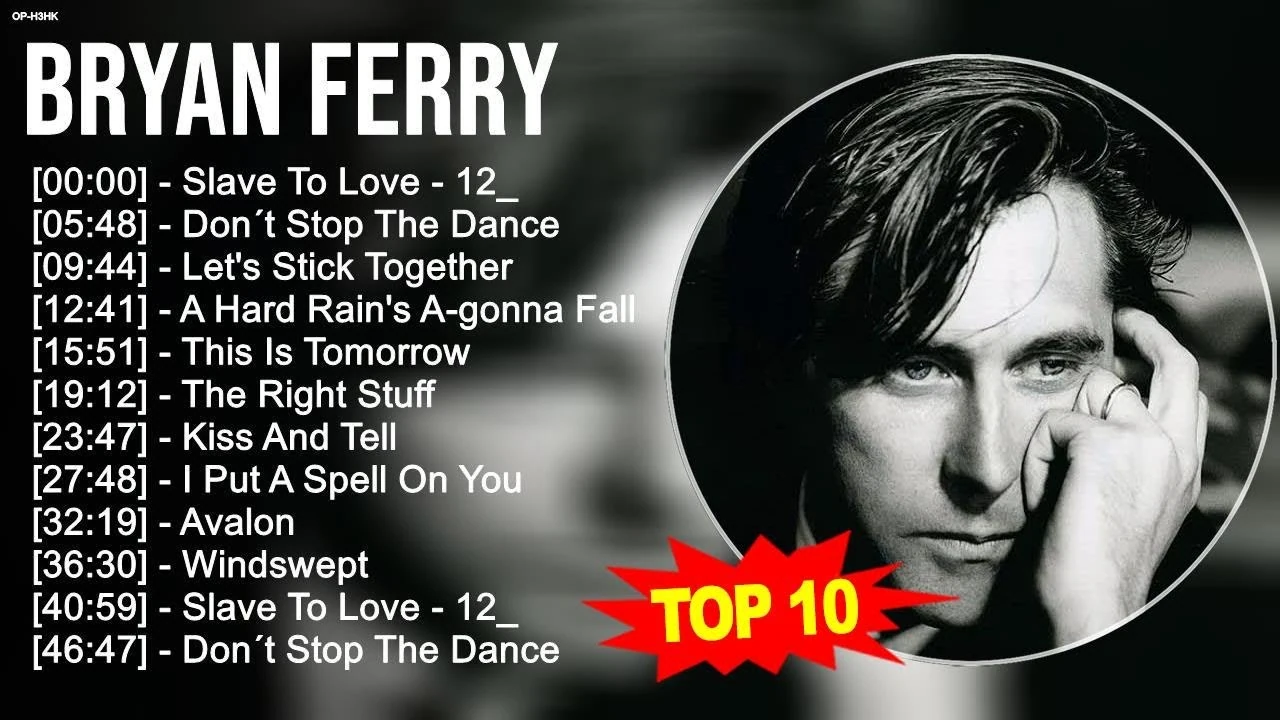
Bryan Ferry’s career has been built on contrast. With Roxy Music, he helped turn art-school experimentation into striking pop; as a solo artist, he moved between original songs and carefully chosen covers. His elegant singing and carefully constructed public image became part of the music, but the work behind them was equally varied: Ferry studied fine art, taught at a secondary school and, from 1970, began assembling the band that would make his name.
From Washington to art school
Ferry was born on 26 September 1945 in Washington, County Durham, to Mary Ann and Frederick Charles Ferry. His working-class father was a farm labourer who also looked after pit ponies. Ferry attended Washington Grammar-Technical School and, as a boy, earned money as a paperboy. He spent some of it on jazz magazines; the whistling he developed on his rounds would later feature in his recording of John Lennon’s “Jealous Guy”.
He spent a year at Durham University before studying fine art at Newcastle University from 1964 to 1968. The artist Richard Hamilton taught him for a year. Ferry’s contemporaries included Tim Head and Nick de Ville, and some of his paintings were displayed at the Tate Gallery in 1970. While at university, he played in bands including the Banshees, City Blues and the Gas Board. These experiences put music alongside visual art in his early creative life, rather than setting the two apart.
In 1968 Ferry moved to London and taught art and pottery at Holland Park School while pursuing music. In 1970 he began putting together Roxy Music with friends and acquaintances, initially including bassist Graham Simpson. The group’s developing line-up brought together saxophonist and oboist Andy Mackay, Brian Eno, drummer Paul Thompson and guitarist Phil Manzanera, among others. Ferry became its lead singer and principal songwriter.
Roxy Music: sound and spectacle
Roxy Music’s self-titled debut album appeared in June 1972 and reached number 10 in the UK album chart. Its mix of musical styles announced a band interested in pushing beyond familiar pop conventions. The non-album single “Virginia Plain” became an early hit. That summer the group performed it on Top of the Pops, in what the supplied account describes as one of the first electronic music performances on a mainstream television programme.
The band’s visual identity was not an afterthought. Ferry took an active role in the art direction of its album covers, working with designer Antony Price and others. The debut sleeve, featuring model Kari-Ann Moller in a dress designed by Price, helped make the record’s presentation part of the group’s impact. The 1973 album For Your Pleasure developed a darker mood and strengthened the band’s distinctive sound and image.
Roxy Music’s personnel and music continued to change. Brian Eno left after the first two albums, and violinist and keyboard player Eddie Jobson joined. Stranded (1973) became the group’s first UK number-one album. Its accompanying tour saw Ferry step out from behind the keyboard and take centre stage in a white dinner jacket. By the time of Siren (1975), the band had broadened its international following; the album included “Love Is the Drug”. Its members temporarily went their separate ways in 1976.
Ferry brought Roxy Music back together in 1978. The band’s later albums included Manifesto (1979), Flesh + Blood (1980) and Avalon (1982), each of the last two reaching number one in the UK album chart. In 1981, “Jealous Guy”, Ferry’s tribute to Lennon, became Roxy Music’s only UK number-one single. After touring Avalon, Ferry disbanded the group in 1983 to concentrate on his solo career.
A parallel solo career
Ferry began recording solo while Roxy Music was still active. His 1973 debut, These Foolish Things, consisted of cover versions of older songs, a marked change of direction from the band. His next album, Another Time, Another Place (1974), also reached the UK top five. The success of these records helped establish a pattern in his solo work: original songwriting sat alongside reinterpretations, including standards from the Great American Songbook.
After Roxy Music’s temporary break, Ferry released Let’s Stick Together (1976), In Your Mind (1977) and The Bride Stripped Bare (1978). “Let’s Stick Together” and “The Price of Love” both reached the UK top ten. Later solo albums continued to shift the emphasis. Boys and Girls (1985), his first and only solo studio album to top the UK chart, included “Slave to Love” and “Don’t Stop the Dance”. The album remained in the chart for 44 weeks.
His work after the mid-1980s took in further originals and covers. Bête Noire (1987) and Taxi (1993) both reached the UK top ten; the latter was a covers album. As Time Goes By (1999) revisited songs of the 1930s and was nominated for a Grammy Award. He also recorded Bob Dylan songs on Dylanesque (2007), and continued to release new material with albums including Frantic (2002), Olympia (2010), Avonmore (2014) and Bitter-Sweet (2018).
Reunions, performances and later recordings
Ferry, Manzanera, Mackay and Thompson reunited as Roxy Music in 2001 and toured, though the group did not record new material during that reunion. The band performed together again in 2011 before going on an indefinite hiatus. In 2022, the four musicians toured to mark Roxy Music’s 50th anniversary, returning to the group’s history without requiring Ferry’s solo career to stand still in the meantime.
His later projects continued to connect different musical settings. The Jazz Age (2012), recorded with the Bryan Ferry Orchestra, recast songs from his solo and Roxy Music catalogue as 1920s-style jazz. After director Baz Luhrmann used “Love Is the Drug” from the album for his 2013 film The Great Gatsby, Ferry and the orchestra contributed further jazz pieces to the film project. Ferry also toured with the orchestra.
In 2014 he released Avonmore, followed by a UK tour and his first solo live album, Live 2015. Among his other recorded and performance work were a 2020 album drawn from his first solo tour, Live at the Royal Albert Hall, 1974, and Royal Albert Hall 2020, recorded at the venue in March 2020. Proceeds from the latter went to support his touring band and crew. In 2025 he released the studio album Loose Talk.
Image, influence and recognition
Ferry’s approach to presentation linked his musical and visual interests. He art-directed Roxy Music’s album covers, while his own stage clothing became a recognisable part of his performances. During the band’s early years he appeared in sharply tailored clothes; later, costumes ranged from a gaucho outfit to military uniforms. The style changed, but the performance remained deliberately composed.
That attention to image was matched by a flexible musical identity. Roxy Music’s shifts from art-rock experimentation to the polished sound of Avalon were accompanied by Ferry’s ventures into standards, Dylan covers, jazz arrangements and original solo material. The 2019 induction of Roxy Music into the Rock and Roll Hall of Fame recognised the group’s work; Ferry was made a CBE in 2011 for his contribution to the British music industry. Newcastle University awarded him an honorary Doctor of Music in 2014.
Why Bryan Ferry deserves a place in British Legacy
Ferry’s place in British musical history rests on more than his role as the frontman of Roxy Music. He helped build a group whose records treated sound, songwriting and visual presentation as parts of the same artistic proposition. From the debut album and “Virginia Plain” to the UK chart-topping Avalon, Roxy Music repeatedly altered its approach without losing its identity. Ferry’s contribution as lead singer and main songwriter connected those changes, while his involvement in the group’s cover art made the band’s visual character an integral part of its public presence.
His parallel solo career shows a different kind of continuity: a willingness to move between original songs and interpretations of other writers’ work. These Foolish Things, “Slave to Love”, Dylanesque and The Jazz Age belong to different moments and musical settings, yet each reflects Ferry’s interest in reshaping material rather than repeating a single formula. The reach of that work is evidenced by sustained chart success, extensive touring and the return of Roxy Music’s original quartet for its 50th-anniversary tour. His career connects a northern English upbringing and art education to British popular music with an international audience. That combination of musical reinvention, visual authorship and enduring collaboration makes Ferry a substantial subject for British Legacy.
Sources
Bryan Ferry — revision 1378018539 · Bryan Ferry
Adapted in part from Bryan Ferry by Wikipedia contributors, under CC BY-SA 4.0. Text has been edited and combined with the existing article; this adapted text is shared under the same licence. Contributor history.