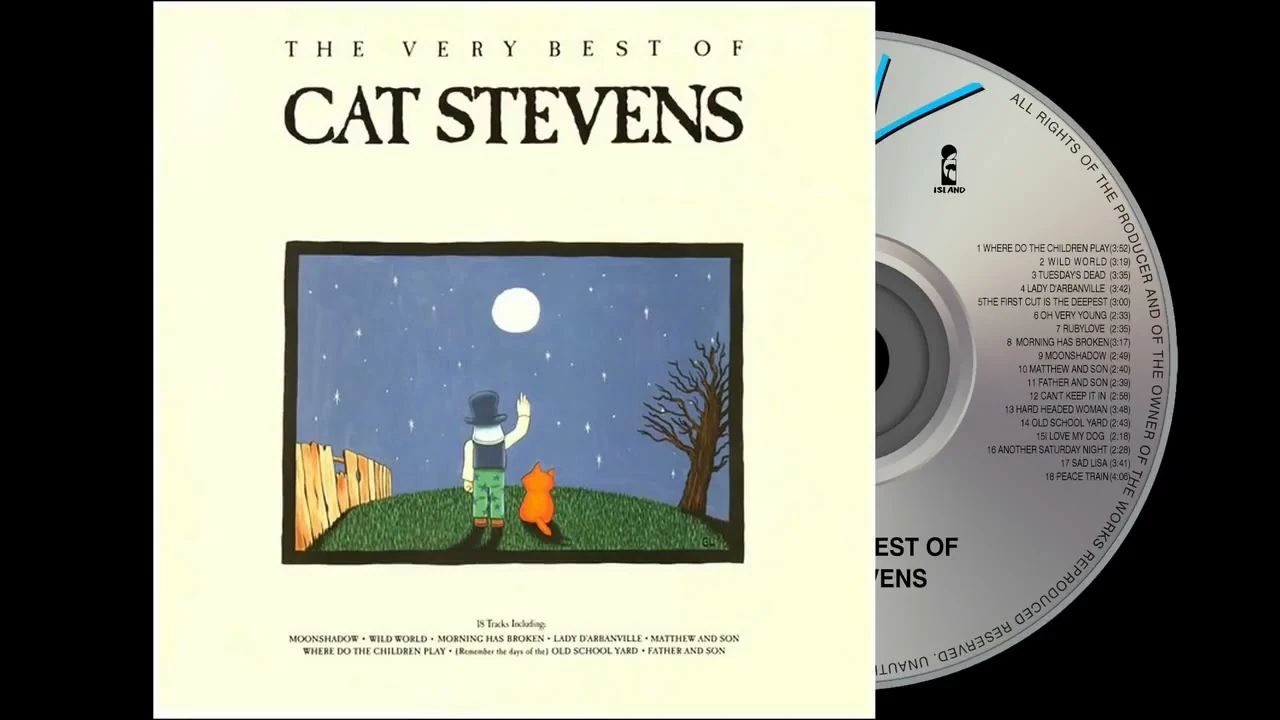
Cat Stevens’s songs made intimate subjects expansive: a father and son at odds, a parting from a lover, the search for direction, and the hope of peace. Born Steven Demetre Georgiou in Marylebone, London, he became one of the most recognisable British singer-songwriters of the early 1970s. His career then took an unusual turn. After embracing Islam and taking the name Yusuf Islam, he withdrew from the pop business, devoted himself to religious, educational and charitable work, and eventually returned to recording and performance under several forms of his name.
A London childhood and an early start
Georgiou was born on 21 July 1948, the youngest child of a Greek Cypriot father and a Swedish mother. His parents ran the Moulin Rouge restaurant, where the family lived above the business and worked. He attended St Joseph Roman Catholic Primary School and later other schools in the West End. A move with his mother to Gävle, Sweden, brought a period at primary school there before they returned to England.
Music and art developed side by side. Georgiou became interested in the piano as a child and took up the guitar at 15, inspired in part by the Beatles. He studied at Hammersmith School of Art, initially considering a career as a cartoonist, but began performing as Steve Adams in 1965. The stage name Cat Stevens followed: he later explained that it was easier to remember than his full birth name, and that a girlfriend had remarked on his cat-like eyes.
In 1966, manager and producer Mike Hurst heard Stevens perform “I Love My Dog”. Decca signed him after Hurst arranged a demo, and the single reached number 28 in the UK. “Matthew and Son”, the title track of his 1967 debut album, reached number two; the album itself reached number seven. Early success brought further chart singles, but the next album, New Masters, did not chart in the UK. It did contain “The First Cut Is the Deepest”, which Stevens sold to P. P. Arnold and which later became a hit for several other performers.
Finding a sound that travelled
Stevens’s first records had been shaped by pop production. After illness and a difficult period with his record company, he sought greater control over the music. He signed with Island Records and worked with producer Paul Samwell-Smith, alongside guitarist Alun Davies. Their collaboration helped establish the more acoustic folk-rock sound associated with his best-known work.
Mona Bone Jakon, released in 1970, marked the change. Its single “Lady D’Arbanville”, written about Patti D’Arbanville, reached number eight in the UK. The album also included “Katmandu”, featuring Peter Gabriel on flute. Stevens’s next record, Tea for the Tillerman, brought international success. Its songs took everyday relationships and choices as their starting point while making room for questions of belief and purpose.
“Father and Son” sets the perspective of a young man against that of his father; “Wild World” is a song of parting. The album’s reach helped bring Stevens’s writing to a much wider audience. In 1971, Teaser and the Firecat continued that success, with “Peace Train”, “Morning Has Broken” and “Moonshadow”. The following year, Catch Bull at Four reached number one on the US Billboard 200. The sequence established him as a songwriter whose songs could move between personal feeling, accessible melody and spiritual reflection.
He did not settle into one sound. Foreigner (1973) was a departure: Stevens wrote the album himself and made it with less involvement from his established collaborators. Its reception was poor, but the next records returned more closely to the acoustic style that had brought him success. Buddha and the Chocolate Box reached the top three in both the UK and the US. In 1977, Izitso used synthesiser and pop-rock arrangements, while “(Remember the Days of the) Old Schoolyard”, a duet with Elkie Brooks, became his last chart hit under the Cat Stevens name.
Faith, withdrawal and a different musical life
A serious bout of tuberculosis in 1968 had already interrupted Stevens’s career and prompted questions about his life and beliefs. Later, in 1976, he nearly drowned off the coast of Malibu. He said that the experience intensified his search for spiritual truth. His brother David gave him a copy of the Qur’an, and on 23 December 1977 Stevens formally embraced Islam at Regent’s Park Mosque in London. The following year he took the name Yusuf Islam.
His conversion was not the result of a single event alone. In accounts included in the supplied reference, Islam described a gradual change and a combination of reasons for leaving the pop business, including his understanding of religious guidance and a feeling that the demands of the music industry had become uninspiring. His last original album as Cat Stevens, Back to Earth, appeared in 1978. In November 1979, he headlined a Wembley Stadium charity concert for UNICEF’s International Year of the Child; it became his final pop performance for many years.
Islam’s musical activity did not disappear entirely, but it changed form. From the 1990s he recorded material with Islamic themes, initially using percussion rather than the instrumentation of his earlier records. He also made recordings for children, including A Is for Allah, and established Mountain of Light Productions and the Jamal record label. In 2001, following the attacks of 11 September, he condemned the violence and performed “Peace Train” publicly for the first time in more than two decades, in an a cappella version.
In 2006, he released An Other Cup, his first new album of pop songs in 28 years. He was credited as Yusuf, with the album sleeve identifying him as the artist formerly known as Cat Stevens. He resumed touring and performing, later returning to the Cat Stevens name as part of “Yusuf / Cat Stevens”. His subsequent albums included Roadsinger, The Laughing Apple, Tea for the Tillerman 2 and King of a Land. In 2023, he made his first appearance at Glastonbury Festival, playing the Pyramid Stage.
Education, charity and recognition
Islam’s work beyond music has included education and organised relief. He founded Islamia Primary School in north-west London in 1983; it later moved to Queen’s Park. He went on to establish Muslim secondary schools and, in 1992, set up the Association of Muslim Schools to bring schools across the UK together. He also founded Small Kindness, a charity whose work has included support for orphans and families in the Balkans, Indonesia and Iraq. These activities give concrete form to the educational and humanitarian commitments described in the original account, while the available evidence does not justify a general claim about their overall impact.
His awards span songwriting, music and humanitarian work. The Ivor Novello Award for Outstanding Song Collection came in 2007, rather than 2006 as stated in the original article. He was inducted into the Rock and Roll Hall of Fame in 2014 and the Songwriters Hall of Fame in 2019. Other recognition included a 2005 honorary doctorate from the University of Gloucestershire for services to education and humanitarian relief, a 2007 honorary doctorate from the University of Exeter, and the BBC Radio 2 Folk Awards’ Lifetime Achievement Award in 2015.
Why Cat Stevens deserves a place in British Legacy
Cat Stevens belongs in a British cultural story first because his rise was rooted in London. Born in Marylebone and signed to Decca as a young performer, he moved from early chart-pop success to a distinctively British folk-rock career that reached an international audience. The records made with Paul Samwell-Smith and Alun Davies established a body of work that remains identifiable through its songs: “Father and Son” turns a generational divide into a musical conversation; “Wild World” gives a relationship’s ending a memorable, direct voice; and “Peace Train” carries an appeal to harmony. Their range helps explain why his work is more than a collection of hits: it links private experience with questions of choice, belief and hope.
His place in this history also reflects a life that did not follow a conventional pop trajectory. After taking the name Yusuf Islam, he left the music business for years and put substantial effort into Muslim education and charitable work, including schools and the Association of Muslim Schools in Britain. His eventual return to recording and performance brought his earlier songs and later work into the same career, without erasing the religious commitments that had changed its direction. For British Legacy, the significance lies in that combination: a London-born songwriter who helped shape the international reach of British folk-rock, and a public figure whose subsequent work connected music with education, faith and humanitarian concern.
Sources
Adapted in part from Cat Stevens by Wikipedia contributors, under CC BY-SA 4.0. Text has been edited and combined with the existing article; this adapted text is shared under the same licence. Contributor history.