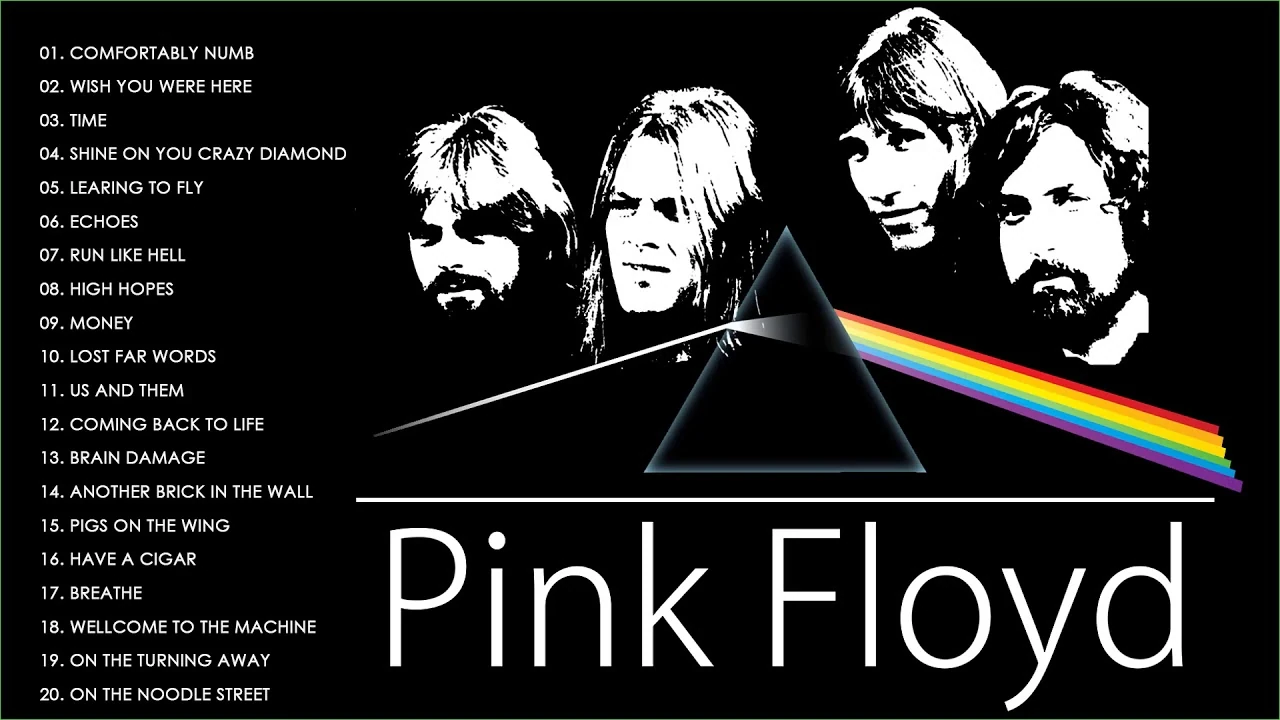
Pink Floyd began in London in 1965 as a group of students and friends experimenting with music, sound and performance. They became famous for more than their songs. Their records made the album feel like a connected world, while their concerts combined music with lighting, projected images and elaborate stage design. From Syd Barrett’s early psychedelic writing to the long compositions and conceptual albums that followed, the band repeatedly asked what popular music could do—and found listeners on a remarkable scale.
The familiar images—the prism on The Dark Side of the Moon, the pig above Battersea Power Station, the wall built between musicians and audience—were part of that ambition, not substitutes for it. Pink Floyd joined musical invention to ideas about time, money, war, absence and alienation. Their history also included disagreement and changing line-ups: the band that began with Barrett was not the same creative partnership that made its best-known records, and its later work continued after Roger Waters’s departure.
Student groups and the London underground
Roger Waters and Nick Mason met in 1962 while studying architecture at Regent Street Polytechnic in London. They first played together in a student group that also included Richard Wright, who joined later that year. The group changed its line-up and name several times; among its early identities were Sigma 6 and the Tea Set. Syd Barrett, a childhood friend of Waters, joined the musicians in London in 1964. After guitarist Bob Klose left in 1965, Barrett took over lead guitar.
The band eventually took its name from blues musicians Pink Anderson and Floyd Council, whose records Barrett owned. In 1966, Pink Floyd became part of London’s underground scene, playing venues including the Marquee and UFO Club. Their early live sets included extended instrumental passages, feedback and sound effects. Coloured projections and lighting helped turn performances into immersive events, rather than conventional sets of songs. In 1967 they also used an early quadraphonic sound system, which could move amplified sound around a venue.
Barrett was the principal songwriter on the group’s first album, The Piper at the Gates of Dawn, released in 1967. Its songs combined psychedelic experimentation with an individual, often whimsical voice. The band also reached the singles charts with Barrett’s “Arnold Layne” and “See Emily Play”. Their early success did not make the group’s future straightforward. Barrett’s mental health deteriorated, and in December 1967 David Gilmour joined as a fifth member. The band found it increasingly difficult to work with Barrett, who left in 1968. It was a major change: Pink Floyd had to develop a musical identity without the songwriter who had helped establish it.
Finding a new shape
The first album after Barrett’s departure, A Saucerful of Secrets (1968), retained one of his songs, “Jugband Blues”, while making room for the other members’ writing. Pink Floyd’s next records show a group testing different forms rather than following a settled formula. Ummagumma (1969) paired live performances with individual experimental pieces by band members. Atom Heart Mother (1970), made with composer Ron Geesin and performed with choir, became their first UK number-one album. The band later expressed reservations about that record, but it marked a significant commercial milestone.
Meddle (1971) offered a clearer sense of what Pink Floyd could do with a long composition. Its closing track, “Echoes”, unfolds across an album side, developing through changes in texture, melody and pace. The group also composed music for films, including More and La Vallée; the latter’s soundtrack appeared as Obscured by Clouds in 1972. These projects gave the band further opportunities to explore how music could create atmosphere and carry a listener through a larger structure.
Their breakthrough into a defining run of albums came with The Dark Side of the Moon, released in 1973. Recorded at Abbey Road between 1972 and early 1973, it made themes of mortality, work, money and mental strain part of a carefully connected musical sequence. The ticking clocks that open “Time”, the register-like effects in “Money” and Clare Torry’s wordless vocal on “The Great Gig in the Sky” are among its most recognisable details. Crossfades bind the tracks together, so that the record’s shape matters as much as any one song.
The album also brought together the band’s different strengths. Waters increasingly directed the themes and lyrics; Gilmour’s guitar and voice brought melodic clarity and emotional lift; Wright’s keyboards supplied harmonic colour and space; and Mason’s drumming helped shape the music’s movement. Their roles were not interchangeable, and the group’s achievement depended on the way distinct contributions met in the finished arrangements. The Dark Side of the Moon reached number two in the UK and had a long chart life there. Its success made Pink Floyd international stars without requiring them to abandon the album-length forms they had been developing.
Albums with ideas built into the music
Wish You Were Here, released in 1975, returned to the subject of Barrett, but its concerns reach beyond a portrait of an absent friend. The title track and “Shine On You Crazy Diamond” give a musical form to loss and distance; other material, including “Have a Cigar”, turns towards the music business and the demands surrounding commercial success. Barrett visited the studio during the album’s making, an encounter that affected the band. The record reached number one in both the UK and the United States.
On Animals (1977), Waters drew on George Orwell’s Animal Farm for a harsher account of social divisions. Its dogs, pigs and sheep represent different positions within a world shaped by power and exploitation. The cover placed an inflatable pig above Battersea Power Station, joining the record’s imagery to a recognisable London landmark. The album’s musical and political character differed from the more flowing atmosphere of Wish You Were Here, but both made their subject matter central to the listener’s experience.
The Wall (1979) turned isolation into a rock narrative. Its central character, Pink, withdraws behind a metaphorical barrier, with the story drawing on ideas about childhood, war, fame and authoritarianism. The album included “Another Brick in the Wall (Part 2)”, which became a UK and US chart-topping single, and “Comfortably Numb”. The music was designed as part of a larger dramatic sequence rather than a collection of unrelated songs. In the subsequent stage show, a wall of cardboard bricks was built between the band and the audience; animation and giant figures extended the story into the visual space of the concert.
These albums are often described as concept records, but their ideas were not simply themes placed over conventional songs. Recurring sounds and motifs, transitions between tracks and changes in scale made the concepts part of the music’s architecture. The Wall was adapted into the 1982 film Pink Floyd – The Wall, which won two BAFTA awards. The band also continued to work with film, having made several soundtracks earlier in their career. Their wider practice treated recording, cover design and performance as related parts of an artistic project.
Design, engineering and the live experience
Pink Floyd’s visual identity developed in close conversation with their music. Their collaborations with the design group Hipgnosis produced covers that became widely recognised in their own right: the refracting prism on The Dark Side of the Moon, the image of Battersea Power Station for Animals, and the stark wall associated with The Wall. The images gave listeners another way into the records, while the albums’ sound and subject matter supplied the context that made the designs memorable.
The same relationship between idea and presentation shaped the stage shows. Early performances in London used slides, lighting and projected shapes alongside extended music. The band later adopted a large circular screen and, for the Animals tour, an inflatable pig. The The Wall performances made the barrier in the story physically present, separating the musicians from the audience. These productions required more than visual decoration: sound systems, lighting, projections and stage devices all helped determine how the music was heard and seen.
In 2017, the Victoria and Albert Museum in London presented Pink Floyd: Their Mortal Remains. Its attention to objects, instruments, posters, stage equipment, projections and cover designs reflected the breadth of the band’s work. Pink Floyd were not only musicians with a recognisable visual style; their concerts and records prompted questions about how sound, design and space could operate together in popular culture.
Disagreement, continuation and a long afterlife
The band’s creative partnership was not without strain. Richard Wright left during the making of The Wall, later returning as a paid musician for its tour. Waters departed in 1985 after internal disputes and his belief that Pink Floyd had run its course. Gilmour and Mason continued using the band’s name, and Wright rejoined them. They released A Momentary Lapse of Reason in 1987 and The Division Bell in 1994, both followed by major tours. The later albums came from a different working arrangement from the classic Waters-led period, but their existence shows that Pink Floyd’s history did not end with one member’s departure.
At Live 8 in Hyde Park in 2005, Waters, Gilmour, Mason and Wright performed together for the first time in more than 24 years. It was a one-off reunion, not the start of a new touring line-up. In 2014, Gilmour and Mason revisited recordings made with Wright during the The Division Bell sessions to create The Endless River, released as the band’s last studio album. Wright’s playing, central to the group’s sound, also shaped the album’s purpose as a tribute.
Pink Floyd’s institutional recognition includes induction into the Rock and Roll Hall of Fame in 1996 and the UK Music Hall of Fame in 2005. They received the Polar Music Prize in 2008 for their contribution to the fusion of art and music and the development of popular culture. Their catalogue has also continued to reach UK chart audiences: the soundtrack to the restored Live at Pompeii film was released in 2025 and became the band’s seventh UK number-one album.
Why Pink Floyd deserve a place in British Legacy
Pink Floyd deserve a place in British Legacy because their work grew from a recognisable British setting and then travelled far beyond it. Their beginnings lay in London student groups, Regent Street Polytechnic, the capital’s underground clubs and a culture in which art, music and new forms of performance overlapped. Those beginnings produced more than a successful band. Pink Floyd helped bring extended composition, sonic experiment and album-length thinking into popular music, while keeping melody and emotional force at the centre of the listening experience.
Their contribution also crossed disciplines. Studio techniques became part of composition; album covers became enduring cultural images; and concerts used sound, light and physical structures to create an environment around the music. Records such as The Dark Side of the Moon, Wish You Were Here, Animals and The Wall gave shape to subjects including pressure, absence, exploitation and isolation. Their continued chart presence, museum exhibition and major awards show that this achievement is not confined to the memory of one era. Pink Floyd’s British legacy lies in the possibilities they opened up: popular music could be technically adventurous, conceptually ambitious and widely heard at once. Their example remains valuable not because every artist should imitate their scale, but because they showed how patience, craft and imagination can enlarge what a record or a live performance can mean.
Sources
Adapted in part from Pink Floyd by Wikipedia contributors, under CC BY-SA 4.0. Text has been edited and combined with the existing article; this adapted text is shared under the same licence. Contributor history.