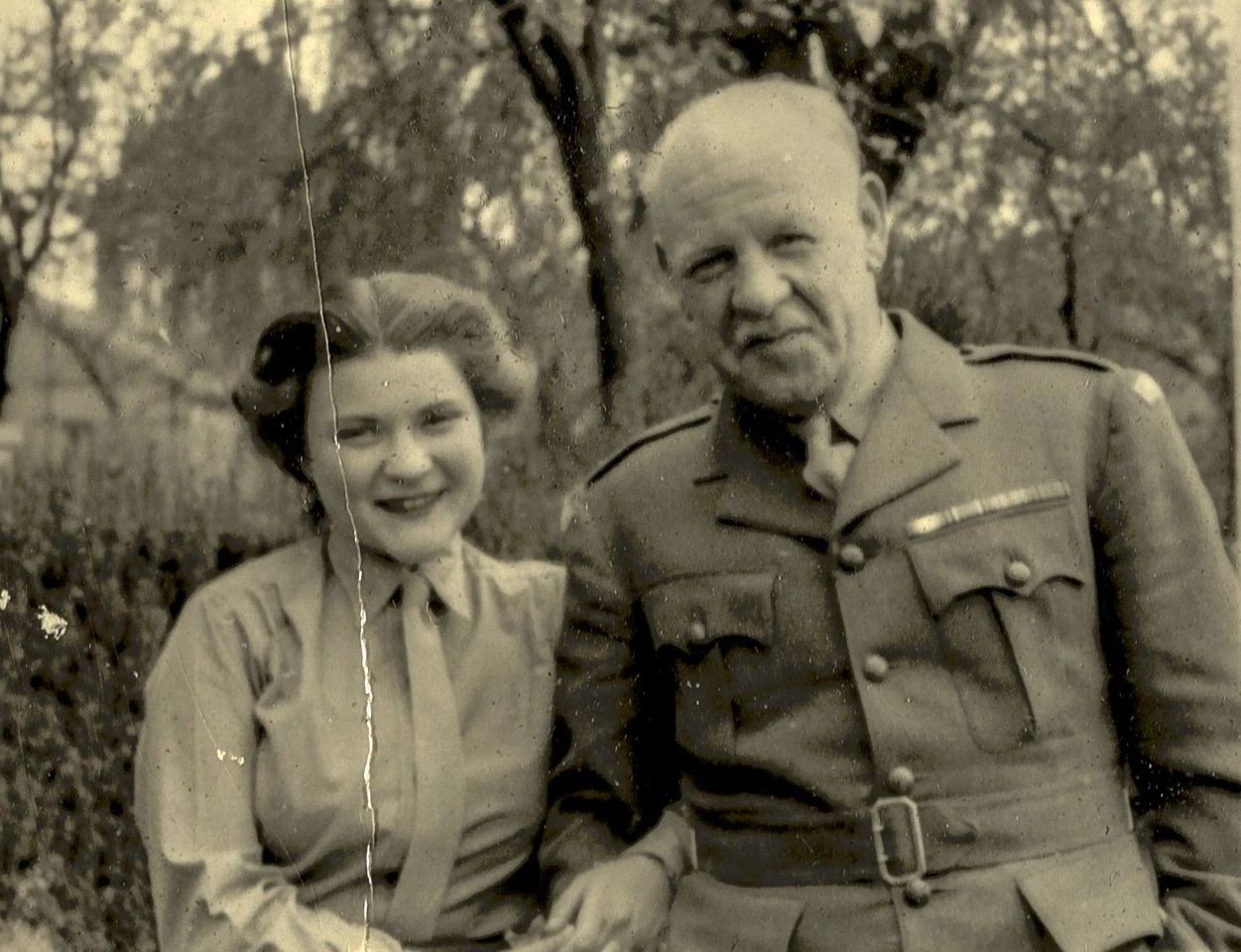
Helen Bamber’s work began with a task that was both practical and moral: helping survivors of the Nazi concentration camps recover, while receiving and bearing witness to what they had endured. In 1945, aged 20, she joined a Jewish Relief Unit team at Bergen-Belsen. She arrived months after the camp’s liberation, but the suffering she encountered shaped a lifetime of work with people affected by torture, persecution and violence. In Britain, she helped establish Amnesty International’s first British group, founded a service for torture survivors and, at 80, created the Helen Bamber Foundation.
A young organiser at Bergen-Belsen
Born Helen Balmuth in London on 1 May 1925, she grew up in a Jewish family in north-east London. Her father, Louis, was an accountant as well as a writer and mathematician; his strong beliefs in human rights helped shape the outlook of the family. As a teenager, Helen joined protests against Oswald Mosley’s British Union of Fascists. During the Second World War she was evacuated to Suffolk.
Towards the end of the war, Bamber answered an appeal for volunteers to help Jewish survivors of the Nazi camps. She joined one of the first rehabilitation teams sent to Bergen-Belsen with the Jewish Relief Unit. She was not there at the moment of liberation: she arrived some months later, after the first camp had been burned because of typhus and disease. Survivors were living in former German army barracks, many crowded into rooms without basic facilities. Bamber later described seeing people who were emaciated, injured and gravely ill.
She came to understand that care meant more than treating visible injuries. Survivors needed to tell what had happened to them, often repeatedly; she saw her role as listening and bearing witness. Bamber remained in Germany for two and a half years. Among her work was negotiating the evacuation to Switzerland of a group of young survivors with tuberculosis. The combination of sustained attention to individual people and organised practical help would recur throughout her career.
Building services for children and survivors
Bamber returned to England in 1947 and worked with the Jewish Refugee Committee and the Committee for the Care of Young Children from Concentration Camps. Over the following eight years she trained to work with disturbed children and young adults, liaising with the Anna Freud Clinic, and studied social science part-time at the London School of Economics. In 1958 she became an almoner at St George-in-the-East Hospital and later worked at the Middlesex Hospital.
Her concern for children in hospital led her to become a founding member of the National Association for the Welfare of Children in Hospital. The organisation established in Britain the practice of allowing a mother to remain with her young child in hospital. This work is an important part of Bamber’s history: her contribution was not confined to campaigning on abuses abroad, but also included changing how care was organised in British institutions.
In 1961 Bamber joined Amnesty International and became chair of its first British group. She later helped establish its Medical Group in 1974 and served as its secretary. The group’s work prompted the British Medical Association to establish a Working Party on Torture. Bamber led research into government torture in Chile, the Soviet Union, South Africa and Northern Ireland.
In 1980, she resigned from Amnesty’s Executive Council alongside other members of the Medical Group. Five years later, they left the organisation and established the Medical Foundation for the Care of Victims of Torture in London. The foundation set out to offer long-term physical and psychological care to people whose injuries required specialist help. It moved to Kentish Town in 1987 and treated as many as 3,000 patients a year from more than 90 countries. Bamber continued as its director until 2002, then stepped back from that role to concentrate on her work with patients.
A foundation shaped around complex needs
In 2005, aged 80, Bamber established the Helen Bamber Foundation in response to changing patterns of violence and what the account of her work describes as an increasingly hostile political landscape. The new organisation extended her rehabilitative work with survivors of torture. Its clients included refugees and asylum seekers who had experienced state-sponsored torture, political or religious persecution, human trafficking, forced labour, sexual exploitation and gender-based violence.
The foundation’s work addressed needs that could not be separated neatly into medical, psychological, legal or practical categories. Survivors might face serious physical injuries and psychological conditions alongside homelessness, destitution, isolation or the risk of further exploitation and persecution. The organisation brought therapists, doctors and legal specialists together to provide therapeutic care, medical consultation, legal protection and practical support. That integrated approach continued a principle evident in Bamber’s earlier work: recovery requires attention to the person’s circumstances as well as to the account of what happened.
In 2013, Bamber stepped back from the day-to-day running of the foundation and became its director emeritus, having previously been clinical director. She died in London on 21 August 2014, aged 89, and was buried at Highgate Cemetery. Her work had taken her beyond Britain, including to Gaza, Kosovo, Uganda, Turkey and Northern Ireland, while the organisations she helped establish developed long-term services for survivors.
Recognition and a lasting practice
Bamber’s honours included the OBE in 1997, the European Woman of Achievement award in 1993 and a Beacon Fellowship Prize in 2006. In 2009 she received the Eileen Skellern Lifetime Achievement Award, the Times/Sternberg Active Life Award and the Dag Hammarskjold Inspiration Award. Her recognition reflected several strands of work: direct care, campaigning, research and the creation of services able to continue beyond one person’s working life.
She also received honorary degrees from institutions including the universities of Hull, Dundee, Glasgow and Ulster, as well as the Open University, Oxford Brookes University, Kingston University and the University of Essex. These honours sit alongside the less ceremonial measure of her work: the structures she helped establish, from hospital practice for children to specialist care for survivors of torture.
Why Helen Bamber deserves a place in British Legacy
Helen Bamber’s place in British history rests on specific work, not on any general claim that one person represents a whole nation. She helped establish the first British group of Amnesty International, later supported its Medical Group and led research into torture across several countries, including Northern Ireland. Her work also reached into British hospitals: as a founding member of the National Association for the Welfare of Children in Hospital, she contributed to a change that allowed mothers to stay with their young children. Together, those efforts show how campaigning, professional care and institutional reform can reinforce one another.
Her most enduring achievement may be the services she helped build around survivors’ needs. The Medical Foundation for the Care of Victims of Torture provided long-term specialist support, while the Helen Bamber Foundation extended that work for refugees and asylum seekers facing complex medical, psychological, legal and practical difficulties. Bamber’s understanding of listening as a form of care connected her early work at Bergen-Belsen with these later institutions. Her British legacy is therefore both human and organisational: a practice of taking testimony seriously, and services designed to help people live with the consequences of violence. That combination made her work more durable than a campaign or an award alone.
Sources
Helen Bamber (revision 1372195972)
Adapted in part from Helen Bamber by Wikipedia contributors, under CC BY-SA 4.0. Text has been edited and combined with the existing article; this adapted text is shared under the same licence. Contributor history.