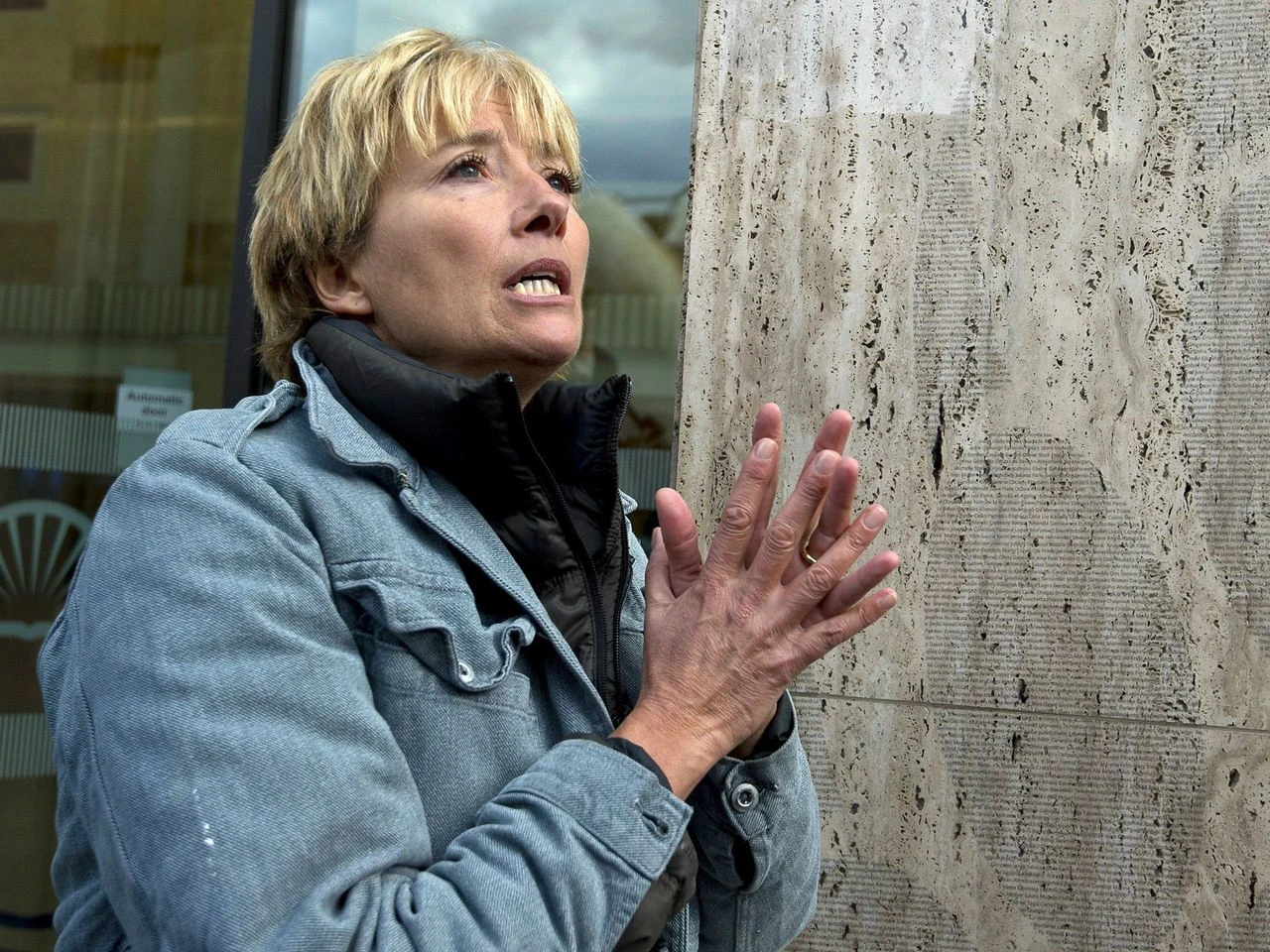
Emma Thompson’s career has moved between comic performance, literary adaptation and film roles seen by audiences around the world. She has won Academy Awards as both an actor and a screenwriter, while her public work has included human-rights campaigning and environmental activism. Her British cultural connections run through the stages and institutions where she began, the literature she has adapted and a long succession of British screen productions.
Cambridge, comedy and a stage breakthrough
Thompson was born in Hammersmith, London, on 15 April 1959. Her father, Eric Thompson, was an actor and writer best known for writing the children’s television series The Magic Roundabout; her mother, Scottish actress Phyllida Law, also worked in theatre and film. Thompson attended Camden School for Girls before studying English at Newnham College, Cambridge, where she joined the university’s Footlights comedy troupe.
Footlights gave Thompson a setting in which to develop as a comic performer and writer. She became the troupe’s vice-president in 1980 and co-directed its first all-female revue, Woman’s Hour. The following year, her Footlights team won the Perrier Award at the Edinburgh Festival Fringe for The Cellar Tapes. She graduated with an upper second-class degree. In the early 1980s, she also studied clowning under Philippe Gaulier.
Thompson began professional work in 1982, touring in a stage version of Not the Nine O’Clock News. Television followed: she appeared with fellow Footlights performers Hugh Laurie and Stephen Fry in comedy programmes including Alfresco, which ran from 1983 to 1984. In 1985, she took the role of Sally Smith in the West End revival of the musical Me and My Girl. The production ran for 15 months and brought her a significant stage breakthrough.
Two television dramas consolidated that progress. In 1987 she starred in Fortunes of War and Tutti Frutti, winning the BAFTA Television Award for Best Actress for her performances. Shakespearean work added another strand: she played Princess Katherine in Kenneth Branagh’s film of Henry V in 1989. These early projects established a range that encompassed comedy, drama and classical performance.
Film recognition and the work of writing
Thompson’s international profile grew with Howards End (1992), the Merchant Ivory adaptation of E. M. Forster’s novel. She played Margaret Schlegel, an independent-minded woman drawn into the lives of a privileged family. The role earned her the Academy Award, BAFTA and Golden Globe for Best Actress. In 1993, she received two Academy Award nominations in the same year: Best Actress for The Remains of the Day and Best Supporting Actress for In the Name of the Father.
Her achievement as a screenwriter became equally distinctive. Thompson adapted Jane Austen’s Sense and Sensibility for the screen, spending five years developing the script. Released in 1995, the film was directed by Ang Lee and starred Thompson as Elinor Dashwood alongside Kate Winslet. Thompson won the Academy Award for Best Adapted Screenplay and a BAFTA for the script, as well as an Academy Award nomination for her performance. She is the only person to have won Oscars for both acting and screenwriting.
Rather than settle into one kind of role, Thompson moved between period drama, comedy and contemporary stories. Her work includes Primary Colors (1998), Wit (2001), Love Actually (2003) and the Harry Potter films, in which she played Professor Sybill Trelawney. She also wrote and starred in Nanny McPhee (2005), a children’s film developed over nine years from a story she had read in childhood, and returned to the character in its 2010 sequel.
Later screen roles extended that variety. Thompson played P. L. Travers in Saving Mr. Banks (2013), appeared as Mrs Potts in the 2017 live-action Beauty and the Beast, and played the Baroness in Cruella (2021). Her work has continued on stage, too: in 2014 she played Mrs Lovett in a Lincoln Center production of Stephen Sondheim’s Sweeney Todd, her first stage appearance in 24 years. Alongside acting and screenwriting, she wrote three authorised Peter Rabbit children’s books, published between 2012 and 2014.
Human rights and environmental campaigning
Thompson’s activism has included sustained work with organisations supporting people affected by persecution and displacement. She is chair of the Helen Bamber Foundation, which works with survivors of torture and other forms of human-rights abuse, and a patron of the Refugee Council. The foundation has a therapy room in her office for traumatised refugees. In 2017, Thompson marched in support of Nazanin Zaghari-Ratcliffe, the Iranian-British charity worker held in Iran.
Her public advocacy has also addressed AIDS. Thompson is a patron of the Elton John AIDS Foundation, and Time named her a “European Hero” in 2009 in recognition of her work drawing attention to the plight of people affected by AIDS in Africa. These activities sit alongside her refugee work as distinct parts of her public engagement, rather than as a single undifferentiated campaign.
Environmental campaigning is another part of that work. Thompson has supported Greenpeace and, in January 2009, joined three other members in buying land near Sipson, close to Heathrow, to deter the building of a proposed third runway. In 2014, she and her daughter took part in a Greenpeace “Save the Arctic” expedition intended to raise awareness of the dangers of oil drilling. She narrated the 2016 short documentary The Doubt Machine: Inside the Koch Brothers’ War on Climate Science and supported the 2019 Extinction Rebellion rally in London. The campaigns differed in their aims and methods, but each made her involvement public and specific.
Honours and a continuing career
Thompson’s awards recognise achievements across acting and writing. In addition to the Academy Awards for Howards End and Sense and Sensibility, she has received three BAFTA Awards, two Golden Globe Awards and a Primetime Emmy Award. In 2018, she was appointed Dame Commander of the Order of the British Empire for services to drama. She was elected a Fellow of the Royal Society of Literature in 2021.
Her work has continued across film and television. In 2019, she appeared in the BBC and HBO drama Years and Years and starred in Late Night. In 2022, she appeared in Good Luck to You, Leo Grande, played Miss Trunchbull in Matilda the Musical, and starred in What’s Love Got to Do with It? In 2025, she began appearing as Zoë Boehm in the television series Down Cemetery Road. She has remained active as a performer while taking on work as a screenwriter and producer.
Why Emma Thompson deserves a place in British Legacy
Emma Thompson’s place in British Legacy rests on a rare combination of achievements. She developed as a performer through British institutions including Cambridge Footlights, the Edinburgh Festival Fringe and the West End, then earned international recognition in film. Her Academy Awards for Howards End and Sense and Sensibility mark two different kinds of accomplishment: an acting performance and a screenplay adapted from a major British novel. The latter award recognises her work shaping the story for the screen, not simply interpreting it as an actor. Her writing for Nanny McPhee and the Peter Rabbit books extended that creative work to family audiences.
Her legacy also includes public engagement expressed through particular roles and campaigns. As chair of the Helen Bamber Foundation and a patron of the Refugee Council, she has lent her public standing to work with refugees and survivors of human-rights abuses. Her AIDS advocacy and environmental campaigning have taken different forms, from support for organisations to participation in specific campaigns, including opposition to a third Heathrow runway and Greenpeace’s Arctic expedition. Those activities do not make her a substitute for the organisations or people doing the work; they show how a prominent British actor has used her platform to bring attention to it. Taken together, her performances, writing and advocacy form a legacy grounded in identifiable contributions to British cultural life and public debate.
Sources
Emma Thompson — Wikipedia revision 1379702148
Adapted in part from Emma Thompson by Wikipedia contributors, under CC BY-SA 4.0. Text has been edited and combined with the existing article; this adapted text is shared under the same licence. Contributor history.