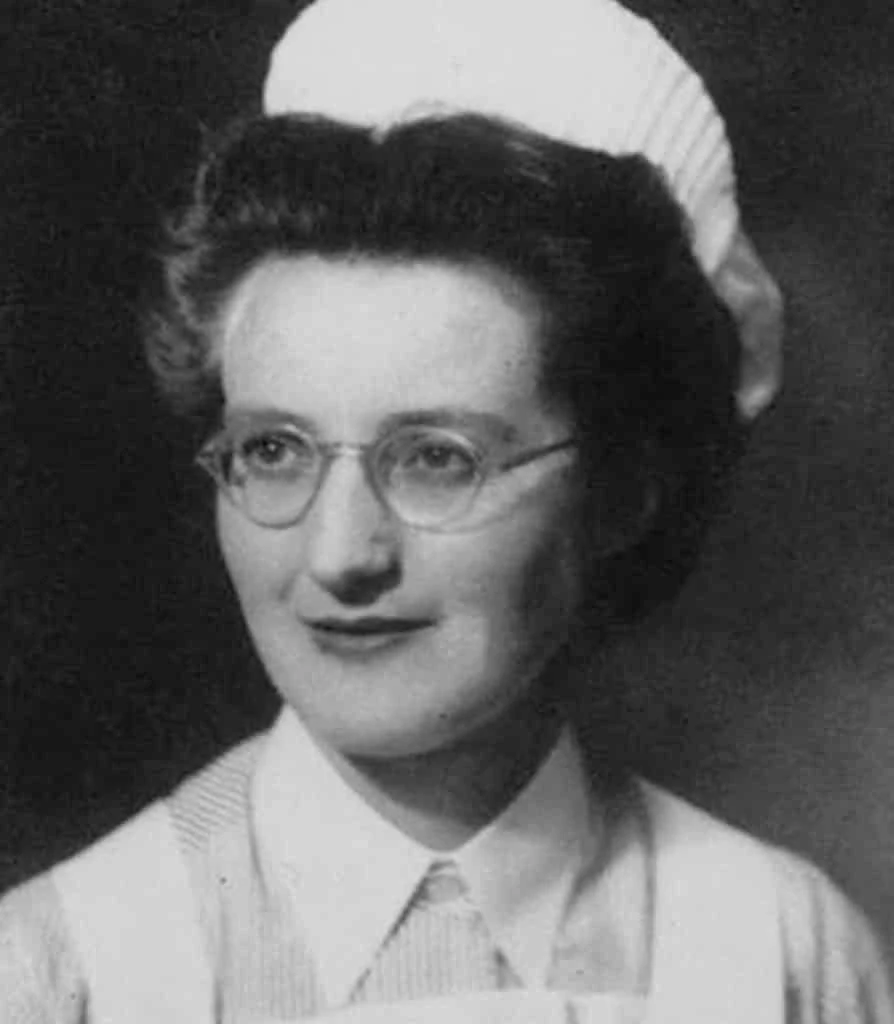
Cicely Saunders set out to change what care could mean for people nearing the end of life. A nurse, social worker and physician, she brought clinical research and skilled pain relief together with attention to patients’ emotional, social and spiritual needs. In 1967, the hospice she helped establish in south London became the world’s first purpose-built hospice. Its approach helped shape palliative care as a specialist field, with an enduring principle at its centre: a person’s worth does not diminish as life draws to a close.
A route through nursing, social work and medicine
Saunders was born in Barnet, Hertfordshire, on 22 June 1918. She attended Roedean School before beginning a degree in politics, philosophy and economics at St Anne’s College, Oxford, in 1938. During the Second World War she decided to become a nurse, training at the Nightingale School of Nursing at St Thomas’s Hospital from 1940 to 1944. A back injury interrupted that path. She returned to Oxford, completed a BA in 1945 and qualified as a medical social worker in 1947.
Her work brought her close to people living with serious illness. In 1948 she met David Tasma, a Polish-Jewish refugee who was dying of cancer. He left her £500, saying it was to be “a window in your home”. The gift later became associated with the idea of a hospice; a plain sheet of glass at St Christopher’s entrance commemorates it. Saunders also worked part-time at St Luke’s Home for the Dying Poor in Bayswater. In 1951 she began medical studies at St Thomas’s Hospital Medical School, qualifying as a doctor in 1957.
She had already spent time at St Joseph’s Hospice in Hackney, where she researched pain control. There she developed the practical and intellectual foundations of her work: the relief of pain and other symptoms had to be joined to an understanding of the whole person. Saunders described this wider experience of suffering as “total pain”, encompassing physical, emotional, social and spiritual distress.
Building St Christopher’s
Saunders spent years planning a hospice that would combine care with teaching and clinical research. St Christopher’s Hospice was established in Sydenham, south London, in 1967. It was the world’s first purpose-built hospice, designed around specialist relief of pain and other symptoms as well as patients’ social, psychological and spiritual needs. Its concern extended to families and friends, too.
The idea was not simply to create a different building, but to organise care differently. St Christopher’s was conceived as a place where people could live as fully as possible while dying, rather than being treated only as cases of disease. Its environment and everyday activities mattered alongside medical treatment. Saunders served as its medical director from its opening, became chair in 1985 and was appointed president in 2000.
Her work helped establish palliative care as a medical specialty that could be adapted to different settings. Saunders argued for expert symptom relief and for care that recognised the individual, at a time when death was often difficult to discuss. Her guiding words—“you matter because you are you, you matter to the last moment of your life”—expressed the purpose of that approach: care should continue to affirm a person’s dignity, not merely attempt to treat an illness.
Ideas, ethics and a wider reach
Saunders also contributed to discussion of medical ethics in Britain. She advised Andrew Mephem on a report that led to the formation of the London Medical Group, a forerunner of organisations concerned with medical ethics. Her lecture on pain developed into “The Nature and Management of Terminal Pain”, and her talks on care for dying patients circulated through medical groups around the country. The subject was not separate from her hospice work: careful discussion of pain and dignity helped make the practical questions of end-of-life care part of wider medical debate.
She opposed the legalisation of voluntary euthanasia. Her position reflected her Christian faith and her belief that effective pain control could prevent unnecessary suffering. She also recognised common ground in the desire to avoid needless pain and preserve personal dignity. Including this aspect of her work makes clear that her influence extended to contested questions about how society and medicine should respond to death.
St Christopher’s model influenced hospice and palliative care beyond Britain. Saunders’s work was recognised internationally, including through the 2001 Conrad N. Hilton Humanitarian Prize, awarded to St Christopher’s. In 2002 she co-founded Cicely Saunders International, a charity established to promote research into care for people with progressive illness and wider access to high-quality palliative care. The charity helped create the Cicely Saunders Institute, described as the world’s first purpose-built institute of palliative care.
Recognition and later life
Saunders was appointed an Officer of the Order of the British Empire in 1965 and a Dame Commander of the Order of the British Empire in 1979. Other honours included the Templeton Prize in 1981 and appointment to the Order of Merit in 1989. She was a Fellow of the Royal College of Surgeons, the Royal College of Physicians and the Royal College of Nursing. In 1977 she received an honorary Lambeth doctorate, and in 2005 a portrait of her was unveiled at the National Portrait Gallery.
In 1980 she married Marian Bohusz-Szyszko, a Polish émigré artist whose paintings she had come to know and support. A substantial amount of his work is displayed at St Christopher’s. Saunders continued working after developing breast cancer. She died at the hospice in 2005, aged 87.
Why Cicely Saunders deserves a place in British Legacy
Cicely Saunders deserves a place in British Legacy because she helped turn a neglected area of care into a lasting part of medicine. At St Christopher’s, pain relief, clinical research and teaching were brought together with attention to the social, emotional and spiritual dimensions of illness. Her idea of “total pain” gave practitioners a way to recognise suffering beyond physical symptoms; the hospice’s approach made that understanding part of organised, specialist care. The result was not only a new institution in south London, but a model that could be adapted elsewhere.
Her British legacy is also visible in the way she changed professional discussion. Through her lectures and involvement in the London Medical Group, she helped bring pain, dying and medical ethics into debate among health professionals. Later, Cicely Saunders International and the institute bearing her name continued the links between research and care. These achievements connect a distinctly British institution-building story with a wider human benefit: more considered support for patients and their families during serious illness. Saunders’s work did not promise to remove the fact of death. It insisted that, until the end, people deserved skilled care, attention and respect.
Sources
Cicely Saunders · Cicely Saunders
Adapted in part from Cicely Saunders by Wikipedia contributors, under CC BY-SA 4.0. Text has been edited and combined with the existing article; this adapted text is shared under the same licence. Contributor history.