Emma Thompson’s career has moved between comedy, Shakespeare, literary adaptation and popular film without settling into a single register. She first found an audience through Cambridge Footlights and British television, then became an international film star. Her work as a screenwriter has been just as distinctive: for Sense and Sensibility, she adapted Jane Austen and played Elinor Dashwood, winning an Academy Award for the screenplay as well as acclaim for her performance. Two Oscars, for acting and writing, mark an unusual achievement; the range of work behind them is the fuller story.
Cambridge comedy and an early breakthrough
Thompson was born on 15 April 1959 in Hammersmith, London. Her parents, Eric Thompson and Scottish actress Phyllida Law, both worked in the performing arts. Her father was also known for writing the children’s television series The Magic Roundabout. Thompson grew up in West Hampstead and attended Camden School for Girls. She later studied English at Newnham College, Cambridge, where she joined the Footlights comedy troupe.
Footlights gave her a foundation in sketch comedy and a circle of fellow performers, including Stephen Fry and Hugh Laurie. In 1980 she became the troupe’s vice-president and co-directed its first all-female revue, Woman’s Hour. The following year, the Footlights team won the Perrier Award at the Edinburgh Festival Fringe for The Cellar Tapes. Thompson graduated with an upper second-class degree. Her early training also included studying clowning under Philippe Gaulier.
Her first professional stage work came in 1982, touring with a stage version of Not the Nine O’Clock News. Television followed, including the sketch series Alfresco, in which she appeared with fellow Cambridge performers Fry and Laurie. In 1985, she joined the West End revival of Me and My Girl, playing Sally Smith for 15 months. The production was a breakthrough, though the demanding run left her exhausted. Two years later, leading roles in the BBC series Tutti Frutti and Fortunes of War brought wider attention and a BAFTA Television Award for Best Actress. The latter also began her professional collaboration with Kenneth Branagh.
From Shakespeare to Howards End
Thompson’s early screen career included Shakespeare. She played Princess Katherine in Branagh’s film of Henry V in 1989, followed by Beatrice in his Much Ado About Nothing in 1993. Their shared work also included Dead Again and a stage revival of Look Back in Anger. These projects established her as a performer able to move between classical material and contemporary comedy.
A decisive change in scale came with James Ivory’s Howards End (1992), adapted from E. M. Forster’s novel. Thompson played Margaret Schlegel, an idealistic woman drawn into the lives of a privileged family. The film explores the Edwardian British class system; Thompson’s performance earned her the Academy Award, BAFTA and Golden Globe for Best Actress. Its international success brought her to a much wider audience.
In 1993, she received two Academy Award nominations: Best Actress for The Remains of the Day and Best Supporting Actress for In the Name of the Father. In the first, another adaptation of a major literary work, she played housekeeper Miss Kenton opposite Anthony Hopkins. Her ability to convey feeling through restraint became a defining strength, but she continued to work in comedy and contemporary drama as well as period films.
Writing Jane Austen and creating Nanny McPhee
Thompson’s adaptation of Sense and Sensibility shows how her acting and writing inform one another. A lifelong admirer of Austen, she spent five years developing the screenplay, translating the novel’s social observation and wit for the screen. Directed by Ang Lee, the 1995 film starred Thompson as Elinor Dashwood alongside Kate Winslet. It earned widespread acclaim and won Thompson the Academy Award for Best Adapted Screenplay, as well as a BAFTA for her performance. She is the only person to have won Academy Awards for both acting and screenwriting.
Writing became an important part of her work beyond Austen. Thompson wrote and starred in Nanny McPhee (2005), a children’s film inspired by the Nurse Matilda stories she had read as a child. The project took nine years to reach the screen, and the film topped the UK box office. She returned to the character and wrote its 2010 sequel, setting the story in Britain during the Second World War. She also wrote the screenplay for Effie Gray and co-wrote Bridget Jones’s Baby.
In 2012, publishers commissioned Thompson to write The Further Tale of Peter Rabbit, the first authorised Peter Rabbit story since 1930 that was not written by Beatrix Potter. She followed it with The Christmas Tale of Peter Rabbit and The Spectacular Tale of Peter Rabbit. The books extended her writing into children’s literature, reaching readers well beyond the audience for her film work.
Her acting has ranged from the emotionally controlled wife in Love Actually to P. L. Travers in Saving Mr. Banks, and from Professor Trelawney in the Harry Potter films to Mrs Potts in Beauty and the Beast. In 2014, she played Mrs Lovett in a Lincoln Center production of Stephen Sondheim’s Sweeney Todd: The Demon Barber of Fleet Street. Later screen roles included Late Night, Good Luck to You, Leo Grande and Miss Trunchbull in Matilda the Musical. Across those parts, she has continued to move between independent work, literary adaptation, comedy and large-scale popular entertainment.
Public work and recognition
Thompson’s public work has included human-rights and environmental campaigning. She is chair of the Helen Bamber Foundation, which supports victims of torture, and a patron of the Refugee Council and the Elton John AIDS Foundation. In 2009, Time magazine named her a European Hero in recognition of her work highlighting the plight of people with AIDS in Africa. In 2017, she marched in support of Nazanin Zaghari-Ratcliffe, who was being held in Iran.
She has also campaigned on climate change. In 2009, she and three other Greenpeace members bought land near Sipson, a village affected by proposals for a third runway at Heathrow Airport, as part of their opposition to the expansion. In 2014, she and her daughter joined a Greenpeace expedition to raise awareness of the risks of Arctic oil drilling. These activities sit alongside her work in film and television: her public profile has given her a platform, while her roles with named organisations and participation in specific campaigns give that advocacy a practical focus.
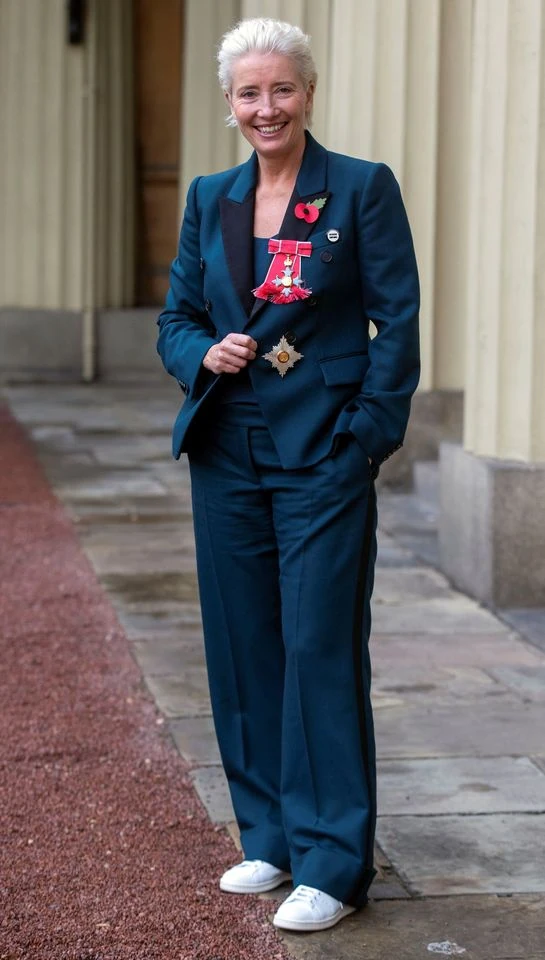
Thompson was appointed Dame Commander of the Order of the British Empire in the 2018 Birthday Honours for services to drama. She was elected a Fellow of the Royal Society of Literature in 2021. The honours recognise an artist whose career has crossed performance and authorship, from university comedy to award-winning film writing and children’s books.
Wrap-Up
Thompson’s career has taken her from a Cambridge sketch troupe to the West End, television, cinema and children’s publishing. The breadth is evident in the contrast between her early comedy, her performances in Forster and Ishiguro adaptations, and her work in popular films and family entertainment. Her screenplays have also given her a hand in shaping the stories she performs, rather than limiting her contribution to interpretation on stage or screen.
That combination of acting and writing is central to the account of her work: her Austen adaptation secured a second kind of recognition, while Nanny McPhee and the Peter Rabbit books brought her authorship to younger audiences. Alongside those achievements, her named commitments to refugee support, human rights and environmental campaigning form part of her public life.
Why Emma Thompson deserves a place in British Legacy
Emma Thompson’s place in British cultural life rests on more than a list of prominent roles. Her work has helped bring British literature to new audiences: Sense and Sensibility translated Austen’s social observation into a film that could stand on its own, and Thompson’s screenplay earned the rare distinction of an Academy Award for writing alongside her earlier acting Oscar. Her performances in Howards End and The Remains of the Day also carried stories shaped by British class and history to international viewers without reducing them to period decoration.
Her career connects several parts of that cultural tradition. Footlights and the Edinburgh Fringe gave her a grounding in comedy; the West End, Shakespeare and television broadened her performance range; screenwriting allowed her to reshape literary and children’s stories for cinema. The success of Nanny McPhee and her Peter Rabbit books shows that her writing has reached younger audiences as well as adult filmgoers. Beyond the arts, her roles with refugee, human-rights and AIDS organisations, and her campaigning with Greenpeace, give substance to her public advocacy. Thompson’s British legacy is not a general claim about national character: it is the record of a performer and writer whose work has travelled widely while remaining closely connected to British theatre, literature and screen culture.
Sources
Adapted in part from Emma Thompson by Wikipedia contributors, under CC BY-SA 4.0. Text has been edited and combined with the existing article; this adapted text is shared under the same licence. Contributor history.