Christopher Nolan’s career began with films made on a small scale and with limited resources. His first feature, Following (1998), was shot with friends over weekends on a budget of about £3,000. Two years later, Memento brought international attention with a story told in reverse. Nolan went on to direct major studio productions while retaining an interest in unusual narrative structures, practical effects and the possibilities of large-format film.
Learning to make films in London
Nolan was born in Westminster, London, on 30 July 1970. His father, Brendan, was a British advertising executive; his mother, Christina, was American and had worked as a flight attendant and English teacher. He grew up between London and Evanston, Illinois, and holds British and American citizenship. He began making films as a child, borrowing his father’s Super 8 camera to film his action figures. In his teens, he made short films with his brother Jonathan and filmmaker Roko Belic.
After attending Haileybury and Imperial Service College in Hertfordshire, Nolan studied English literature at University College London (UCL), graduating in 1993. He chose the university in part for its film-making facilities and became president of its Film Society. With fellow student Emma Thomas, he screened 35 mm features and used the proceeds to make 16 mm films during the summer. The combination of literary study and practical production became an early part of his working life: he learned to shape stories while also working with the material means of making them.
Before his feature debut, Nolan worked as a script reader, camera operator and director of corporate and industrial films. He made the short Doodlebug in 1997. His first feature, Following, grew from a small circle of collaborators and a tightly controlled production. Nolan wrote, directed, photographed and edited it; its cast and crew were largely friends, and filming took place at weekends over a year. The film follows a young man who trails strangers through London and becomes entangled in crime. Its festival success opened a route to the next project.
Memento and the move into studio filmmaking
Memento (2000) made Nolan’s interest in fractured chronology central to the viewing experience. Its protagonist, played by Guy Pearce, has anterograde amnesia and uses notes and tattoos while trying to find his wife’s killer. Nolan developed the screenplay from an idea by his brother Jonathan, whose short story appeared after the film’s release. The story’s reverse structure made the limits of memory part of the film’s form, rather than simply a subject for its characters to discuss.
After Memento, Nolan directed Insomnia (2002), a studio-backed thriller starring Al Pacino, Robin Williams and Hilary Swank. He then brought a comparatively grounded approach to Batman Begins (2005), restarting the film series with Christian Bale as Bruce Wayne. Its two sequels, The Dark Knight (2008) and The Dark Knight Rises (2012), completed a trilogy that joined the superhero story to crime drama and the workings of a city. The Dark Knight used high-resolution IMAX cameras, an example of Nolan’s interest in combining technical experimentation with mainstream production.
Between the Batman films, Nolan directed The Prestige (2006), about rival nineteenth-century magicians, and Inception (2010), a science-fiction thriller structured around dreams and the architecture of the mind. Inception developed an idea he had considered for years and paired an intricate premise with the scale of a major commercial release. He returned to science fiction with Interstellar (2014), whose story of astronauts searching for a new home drew on scientific theories developed with physicist Kip Thorne. Across these films, Nolan repeatedly made questions of time, identity and perception part of the plot’s machinery.
Large-format filmmaking and preservation
Nolan has repeatedly favoured celluloid photography, practical effects and large-format cameras. These choices are not a rejection of spectacle: they shape how spectacle is made, with physical sets, miniatures and in-camera effects playing an important role in films that also use computer-generated imagery. His interest in the technology of cinema extends beyond his own productions to the survival and presentation of films made by others.
In 2015, Nolan directed Quay, a short documentary about the animators Stephen and Timothy Quay, and organised theatrical screenings of their work. He also helped convene discussions on the future of film at the Getty Museum, followed by events at Tate Modern in London and other international venues. In 2018, he supervised a new 70 mm print of Stanley Kubrick’s 2001: A Space Odyssey, made from the original camera negative, and presented it at Cannes. These activities connected his interest in analogue filmmaking with the practical work of keeping older films available to audiences.
His 2017 film Dunkirk brought that approach to a story set during the 1940 evacuation of Allied soldiers from France. Nolan described its structure as a triptych and sought to make the film work through image, sound and suspense, with little dialogue. It received widespread critical recognition and earned him his first Academy Award nomination for directing. His later film Tenet (2020), made after the pandemic disrupted its release plans, returned to the manipulation of time, though its reception was more divided.
Oppenheimer, recognition and an evolving career
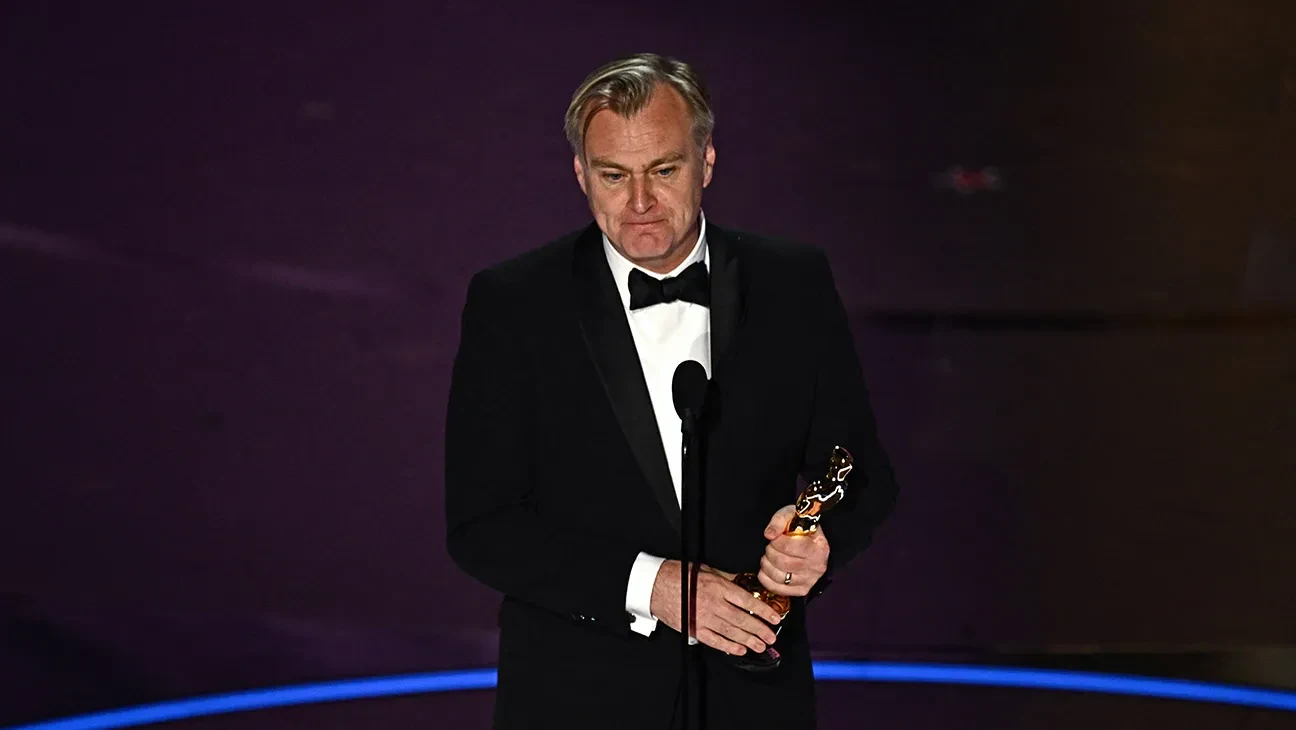
For Oppenheimer (2023), Nolan dramatised the life of physicist J. Robert Oppenheimer and his role in developing the atomic bomb. The film was financed and distributed by Universal Pictures, marking a break with Warner Bros., the studio behind many of his previous features. Nolan had disagreed with Warner Bros.’ decision to release films simultaneously in cinemas and on its streaming service. Oppenheimer became a major commercial success and won Nolan Academy Awards for both directing and best picture.
Nolan’s honours include appointment as a Commander of the Order of the British Empire in 2019 for services to film, followed by a knighthood in March 2024 for his contributions to film. He received the British Film Institute Fellowship in 2024. At UCL, where he first developed his film-making practice, he was named an honorary fellow in 2006 and received an honorary doctorate in 2017. Emma Thomas, his wife and a producer on his films, was made a dame in 2024.
Alongside directing, Nolan has worked to support film preservation and has served on bodies concerned with the medium, including the board of the Film Foundation. He and Thomas founded the production company Syncopy, which they run together. In 2025, Nolan became president of the Directors Guild of America. His career thus combines creative work with involvement in the institutions and practices that shape how films are made, distributed and preserved.
Why Sir Christopher Nolan deserves a place in British Legacy
Nolan’s connection to British cultural life is grounded in his London birth, his education at UCL and the start of his career as a filmmaker working with modest means. Following was not a large studio production: Nolan made it with a small group of collaborators, over weekends, and turned it into a feature that helped secure the opportunity to make Memento. That path matters because it shows a British beginning to a career that later operated on an international scale. His UCL years also joined study in English literature to hands-on film production, while his subsequent honorary recognition there reflects a continuing institutional connection.
His wider contribution lies in showing that a popular film can take formal and intellectual risks without abandoning the reach of mainstream cinema. From the reverse chronology of Memento to the large-scale storytelling of Inception, Dunkirk and Oppenheimer, Nolan has made questions of memory, time and responsibility part of films designed for broad audiences. His work with analogue formats and film preservation adds a practical dimension: it supports not only his own preferred methods but also the continued circulation of older cinema. Together, these achievements make his legacy relevant to British film culture as both a director’s body of work and an ongoing engagement with how films are made and kept alive.
Sources
Adapted in part from Christopher Nolan by Wikipedia contributors, under CC BY-SA 4.0. Text has been edited and combined with the existing article; this adapted text is shared under the same licence. Contributor history.