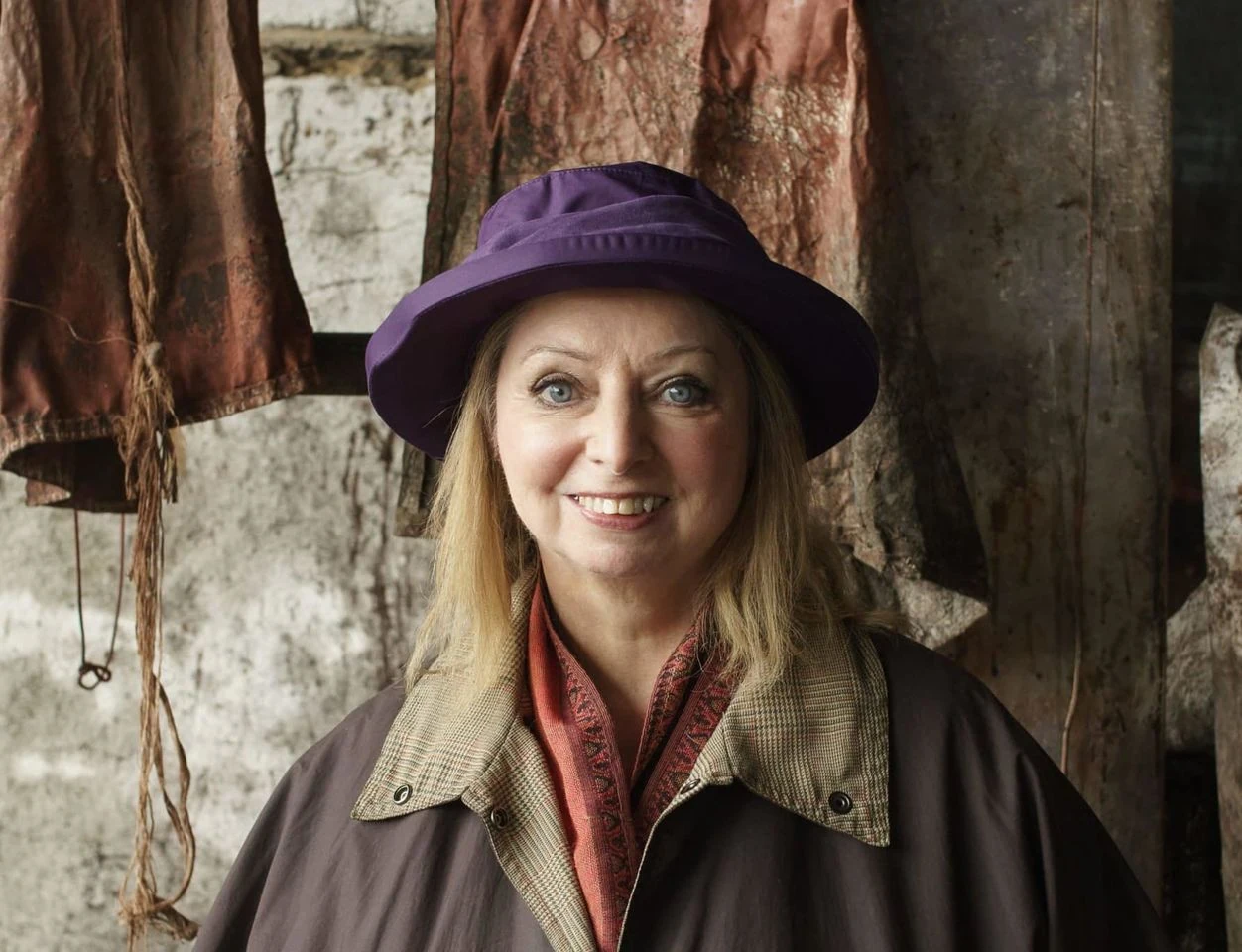
Hilary Mantel made the past feel close without pretending it was simple. In novels ranging from a French Revolution epic to the Tudor court of Henry VIII, she treated history not as a settled procession of famous names but as a world experienced by people whose motives and futures remained uncertain. Her Thomas Cromwell trilogy brought that approach to a wide readership: its first two volumes won the Booker Prize, while its final novel completed one of the defining literary projects of her career.
From Glossop to a life in writing
Mantel was born Hilary Mary Thompson in Glossop, Derbyshire, on 6 July 1952. She grew up in the mill village of Hadfield and attended Harrytown Convent School in Romiley, Cheshire. In 1970 she began studying law at the London School of Economics, later transferring to the University of Sheffield, where she graduated in 1973 with a degree in jurisprudence. After university she worked in a hospital social work department and as a sales assistant in Manchester.
She married geologist Gerald McEwen in 1973. The couple moved to Botswana in 1977 and later lived in Jeddah, Saudi Arabia. Those years abroad supplied material for fiction and memoir: her novel Eight Months on Ghazzah Street draws on life in Saudi Arabia, and she later wrote about the experience in essays. She also began a novel about the French Revolution in 1974. Unable to find a publisher at the time, she returned to the project years later; A Place of Greater Safety, following Danton, Robespierre and Camille Desmoulins, appeared in 1992.
Mantel’s first published novel, Every Day Is Mother's Day, came out in 1985, followed by Vacant Possession in 1986. After returning to England, she worked as film critic for The Spectator from 1987 to 1991 and reviewed books and other subjects for publications in Britain and the United States. Her early work ranged widely: Fludd (1989), set in a northern village and its Catholic community, won the Winifred Holtby Memorial Prize; A Change of Climate (1994) explored family life and charitable work; and An Experiment in Love (1995) followed three young women at university in London.
History beyond the Tudor court
Historical fiction was central to Mantel’s reputation, but it was not confined to the world of Henry VIII. The Giant, O’Brien (1998) reworked the story of Charles Byrne, an Irish giant who came to London in the eighteenth century, setting him against surgeon John Hunter. Her fiction repeatedly put private lives under pressure from social and political forces, while changing setting and period rather than settling on one historical formula.
She also wrote short stories, essays, reviews and memoir. Giving Up the Ghost, published in 2003, won the MIND Book of the Year award; the same year she published the short-story collection Learning to Talk. Beyond Black (2005), a novel about a professional medium, was shortlisted for the Orange Prize and longlisted for the Booker Prize. In 2014 she published The Assassination of Margaret Thatcher, a collection whose title story imagined an attempt on the former prime minister. Mantel’s writing for newspapers and literary journals, and her later BBC Reith Lectures on historical fiction, made her a public commentator as well as a novelist.
The Cromwell novels and the Booker
Wolf Hall, published in 2009, follows Thomas Cromwell’s rise in the court of Henry VIII. Mantel places the reader close to Cromwell’s shifting perspective, making the political workings of the Tudor court legible through calculation, memory and uncertainty. The novel won the 2009 Booker Prize and the 2010 Walter Scott Prize. Its sequel, Bring Up the Bodies, appeared in 2012 and won the Booker Prize that year as well as the Costa Book of the Year.
Those awards made Mantel the first woman to win the Booker Prize twice and the first author to win it for a sequel. The books’ success was not simply a matter of placing a familiar king and his advisers on the page. Mantel’s Cromwell is not treated as a ready-made villain or hero: he is a capable, watchful political operator whose loyalties and vulnerabilities emerge through the narrative. That characterisation gave readers a way into Tudor power while leaving its violence and instability intact.
The trilogy concluded with The Mirror & the Light in 2020. Longlisted for the Booker Prize, it returned to Cromwell’s final years. By then, the three novels had become an extended account of how an individual can gain influence within a court where status, religion and survival are entangled. The Royal Shakespeare Company adapted the novels for the stage, and the BBC made them into a television miniseries, carrying Mantel’s interpretation of Tudor history into other forms.
Public work, honours and final years
Mantel’s career included recognition beyond individual novels. She received the David Cohen Prize in 2013 and the British Academy President’s Medal in 2016; in 2020 the Royal Society of Literature named her a Companion of Literature. She was appointed CBE in 2006 and made a Dame Commander of the Order of the British Empire in the 2014 Birthday Honours for services to literature. She also received honorary degrees from universities including Sheffield Hallam, Exeter, Cambridge and Oxford.
She and McEwen remarried in 1982 and lived in Budleigh Salterton, Devon. Mantel died in Exeter on 22 September 2022, aged 70, following a stroke. At the time of her death she was working on a new novel. A posthumously published non-fiction work, The Woman Who Died of Robespierre, returned to the revolutionary history that had occupied her early ambitions as a novelist.
Why Hilary Mantel deserves a place in British Legacy
Mantel’s place in British literary history rests on the scale and achievement of her writing, not simply on the honours attached to it. She built a career across novels, short fiction, memoir, criticism and lectures, moving from contemporary family stories to the French Revolution and the Tudor court. The Booker-winning Cromwell novels show how she made historical fiction intellectually demanding and widely readable at once. They invite readers into the calculations of political life without reducing the past to a parade of familiar rulers or a simple contest between good and evil.
Her British legacy is also visible in the journey her work made from page to stage and screen. The Royal Shakespeare Company’s adaptations and the BBC miniseries brought her retelling of Tudor history to audiences beyond the readership of the novels. Her achievements were recognised through major literary prizes and a DBE for services to literature, but the books remain the clearest measure of her contribution: distinctive works that changed how many readers imagined Thomas Cromwell and his age. Across a career that included the French Revolution, modern Britain and the unsettling worlds of Beyond Black, Mantel demonstrated that historical imagination could be both rigorous and inventive. Her novels continue to give British readers and international audiences a compelling way to encounter the past as lived experience.
Sources
Hilary Mantel — Wikipedia revision 1379596792
Adapted in part from Hilary Mantel by Wikipedia contributors, under CC BY-SA 4.0. Text has been edited and combined with the existing article; this adapted text is shared under the same licence. Contributor history.