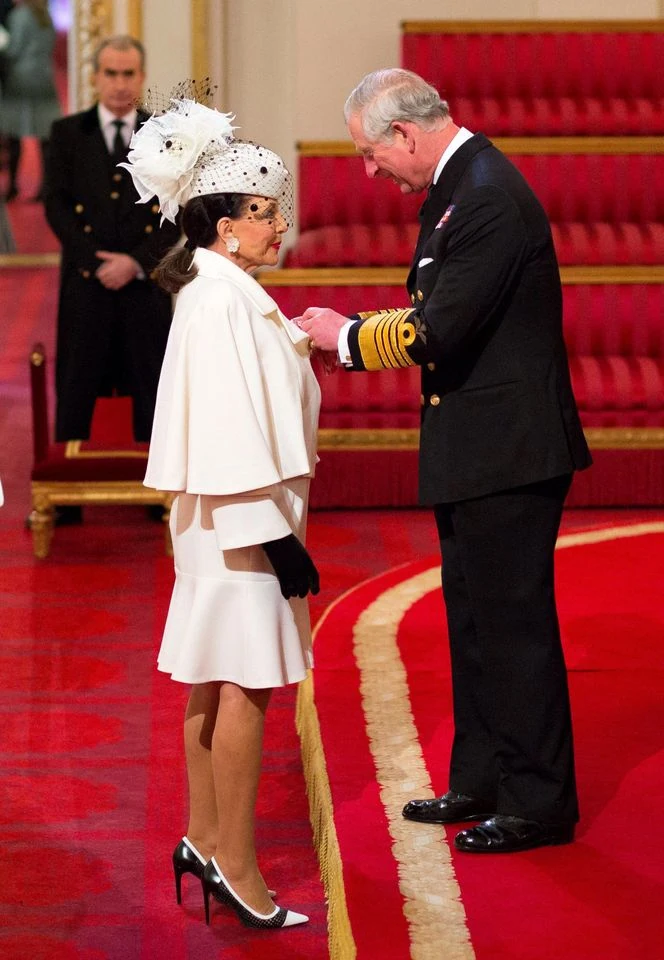
Joan Collins’s career has moved between British film studios, Hollywood, television and the stage. She was still a teenager when she trained at the Royal Academy of Dramatic Art and signed with the Rank Organisation; decades later, her performance as Alexis Colby in the American series Dynasty made her an international star. Alongside acting, she has written novels, memoirs and lifestyle books, and supported charities, particularly those concerned with children.
Training and a start in British films
Born in London on 23 May 1933, Joan Henrietta Collins was the daughter of Elsa Collins, a dance teacher, and Joseph William Collins, a talent agent. Her younger sister Jackie became a novelist. Joan attended the Francis Holland School in London and made her stage debut in A Doll’s House at the age of nine. At 16, she began training at RADA; at 17, she signed with Rank, a British film studio.
Her screen career began with small parts in Lady Godiva Rides Again (1951) and The Woman’s Angle (1952), followed by a more substantial role in Judgment Deferred. The early 1950s brought a run of British films, among them I Believe in You, Cosh Boy, Turn the Key Softly and The Square Ring, all released in 1953. She also returned to the stage, appearing in London productions including The Seventh Veil and Jassy.
A turning point came when American director Howard Hawks cast her as Princess Nellifer in Land of the Pharaohs (1955). The film led to a contract with 20th Century Fox. That year, she appeared in The Virgin Queen and took the leading role of Evelyn Nesbit in The Girl in the Red Velvet Swing. Her subsequent films included The Opposite Sex, Sea Wife, Island in the Sun and The Wayward Bus. In 1958, she appeared opposite Paul Newman in Rally ’Round the Flag, Boys!.
Across film, television and the stage
Collins continued to work in the United States and Britain through the 1960s, appearing in films including Esther and the King (1960), The Road to Hong Kong (1962) and Warning Shot (1967). Her television work included the role of Edith Keeler in the Star Trek episode “The City on the Edge of Forever” (1967). In the 1970s, she appeared in British productions such as Revenge, Tales from the Crypt and Fear in the Night, as well as in American television series and films.
Two films based on novels by Jackie Collins brought her renewed prominence in Britain. Joan starred in The Stud (1978), then its sequel, The Bitch (1979). She also returned to the West End in The Last of Mrs. Cheyney. These roles preceded the part most closely associated with her: Alexis Colby in the American television series Dynasty, which she joined in 1981.
Collins played Alexis through the series’ run, which ended in 1989. The role brought her a Golden Globe Award for best actress in a television drama series in 1983, following several nominations. It also earned her a Primetime Emmy nomination. In 1983, she received a star on the Hollywood Walk of Fame. The character’s forceful presence became a defining element of the show, and Collins’s performance helped turn a struggling soap opera into a major international success.
After Dynasty, she continued to move between screen and stage. She made her Broadway debut in Private Lives in 1990 and later played the role in London. Other work included a series of Noël Coward plays for BBC Television, a return to the screen in Dynasty: The Reunion, and roles in films and television productions in the following decades. Her British television appearances included Footballers’ Wives, Hotel Babylon and Benidorm. She also appeared in the British comedy-drama The Time of Their Lives (2017) and the short film Gerry (2018).
Books, public work and honours
Writing has been a substantial part of Collins’s working life. Her books include memoirs such as Past Imperfect, novels including Prime Time, and lifestyle titles such as The Joan Collins Beauty Book. The supplied account describes her books as bestselling and says they have sold more than 50 million copies and been translated into 30 languages. She has also written columns and contributed regularly to British publications.
Collins has publicly supported charitable causes over several decades, with particular involvement in work relating to children. The supplied account records her support for the International Foundation for Children with Learning Disabilities and her patronage of Shooting Star Chase Children’s Hospice and Fight for Sight. It also describes her support for foster children in India. In 1982, she spoke before the United States Congress about funding for neurological research. These activities sit alongside her work as an actor and writer, rather than being confined to a single campaign.
Her honours distinguish between recognition for acting and recognition for charity. Collins was appointed OBE in the 1997 New Year Honours for services to drama. In the 2015 New Year Honours she was made a Dame Commander of the Order of the British Empire for services to charity. The distinction matters: the damehood was not, as the earlier article stated, awarded for drama and charity together.
Why Joan Collins deserves a place in British Legacy
Joan Collins’s British legacy begins with a clear route through British institutions and productions: a London upbringing, training at RADA, an early contract with Rank and a succession of roles in British films and theatre. That foundation did not limit her to one national industry. She carried a career that began in Britain into American cinema and television, then continued to return to British stages and screens. Her part as Alexis Colby became globally recognised, but it followed years of work across genres and media. The story is not simply one of sudden fame; it is a long professional life built through film, television and live performance.
Her contribution also extends beyond acting. Collins has published fiction, memoir and lifestyle writing, bringing a sustained public writing career alongside her screen work. Her charitable activity, particularly her support for children’s causes, is reflected in the 2015 DBE for services to charity. Together, these strands explain her place in a British cultural history: she trained and began her career in Britain, became an international performer, and remained connected to British theatre, television and charitable organisations. The combination of longevity, range and visible public service gives her story substance beyond glamour or celebrity, and makes her career a useful record of how British performers have worked across national borders and different forms of popular culture.
Sources
Joan Collins (revision 1379248946)
Adapted in part from Joan Collins by Wikipedia contributors, under CC BY-SA 4.0. Text has been edited and combined with the existing article; this adapted text is shared under the same licence. Contributor history.