
Judi Dench’s career has never belonged to one medium. She began professionally with the Old Vic Company in 1957, became one of the Royal Shakespeare Company’s leading performers and later reached a worldwide audience as M in the James Bond films. Her work ranges from Shakespeare and musical theatre to television comedy and cinema; the thread running through it is a performer able to move between sharply different forms without leaving the stage behind.
A York childhood and London training
Judith Olivia Dench was born in Heworth, York, on 9 December 1934. Her father, Reginald, was a doctor; her mother, Olave, worked as wardrobe mistress at York Theatre Royal. The theatre was part of family life: actors stayed in the Dench home, and Dench took part in the modern revival of the York Mystery Plays as a young performer, playing the Virgin Mary in 1957.
She attended the Mount School in York and became a Quaker. Although she first trained as a set designer, seeing Peggy Ashcroft play Cleopatra helped direct her towards acting. Dench studied at the Central School of Speech and Drama in London, where she won four acting prizes, including its Gold Medal as Outstanding Student.
Her professional stage debut came in September 1957, as Ophelia in Hamlet with the Old Vic Company. She played Juliet in Romeo and Juliet and Katherine in Henry V during four seasons with the company, and toured in North America and elsewhere. After joining the Royal Shakespeare Company in 1961, she continued to work in repertory theatre, including seasons in Nottingham and Oxford. Her first film, The Third Secret, followed in 1964; her early screen work also included the television drama Talking to a Stranger, for which she won a BAFTA for Best Actress.
Building a reputation on stage and television
Dench’s career broadened without displacing her theatre work. In 1968 she took the role of Sally Bowles in the London production of Cabaret. The part, and the musical’s demands, were a departure from her established classical roles. She returned to the RSC and spent nearly two decades performing with the company in Stratford-upon-Avon and London. Among her acclaimed work there was Lady Macbeth in Trevor Nunn’s 1976 production of Macbeth, staged at the small, intimate Other Place before transferring to London. She also directed for the first time in 1988, staging Much Ado About Nothing for the Renaissance Theatre Company’s Shakespeare season.
Television brought a different kind of recognition. Dench starred with her husband, Michael Williams, in the romantic comedy A Fine Romance (1981–84), and later in As Time Goes By (1992–2005). Her screen work included supporting roles in films such as A Room with a View, but for years the theatre remained central to her public reputation. She also took on Cleopatra for the National Theatre in 1987, adding another major Shakespearean role to a career already marked by work across the principal British stages.
From Queen Victoria to M
International film audiences came to know Dench through two very different roles. In Mrs Brown (1997), she played Queen Victoria in a drama about the monarch’s relationship with her servant John Brown. The performance drew wide acclaim and earned her an Academy Award nomination. The following year she played Queen Elizabeth I in Shakespeare in Love. Although her screen time was brief, the role won her the Academy Award for Best Supporting Actress.
In 1995, Dench took over as M in GoldenEye, becoming the first woman to play James Bond’s superior. The part brought a new visibility to her film career, but did not replace her work in theatre, television or other films. She appeared in eight Bond films, ending with a cameo in Spectre (2015). Between them were roles in films including Chocolat, Iris, Notes on a Scandal and Philomena. She also continued to take on stage parts: her performance in A Little Night Music won an Olivier Award, and she won a Tony Award for her 1999 Broadway appearance in Amy’s View.
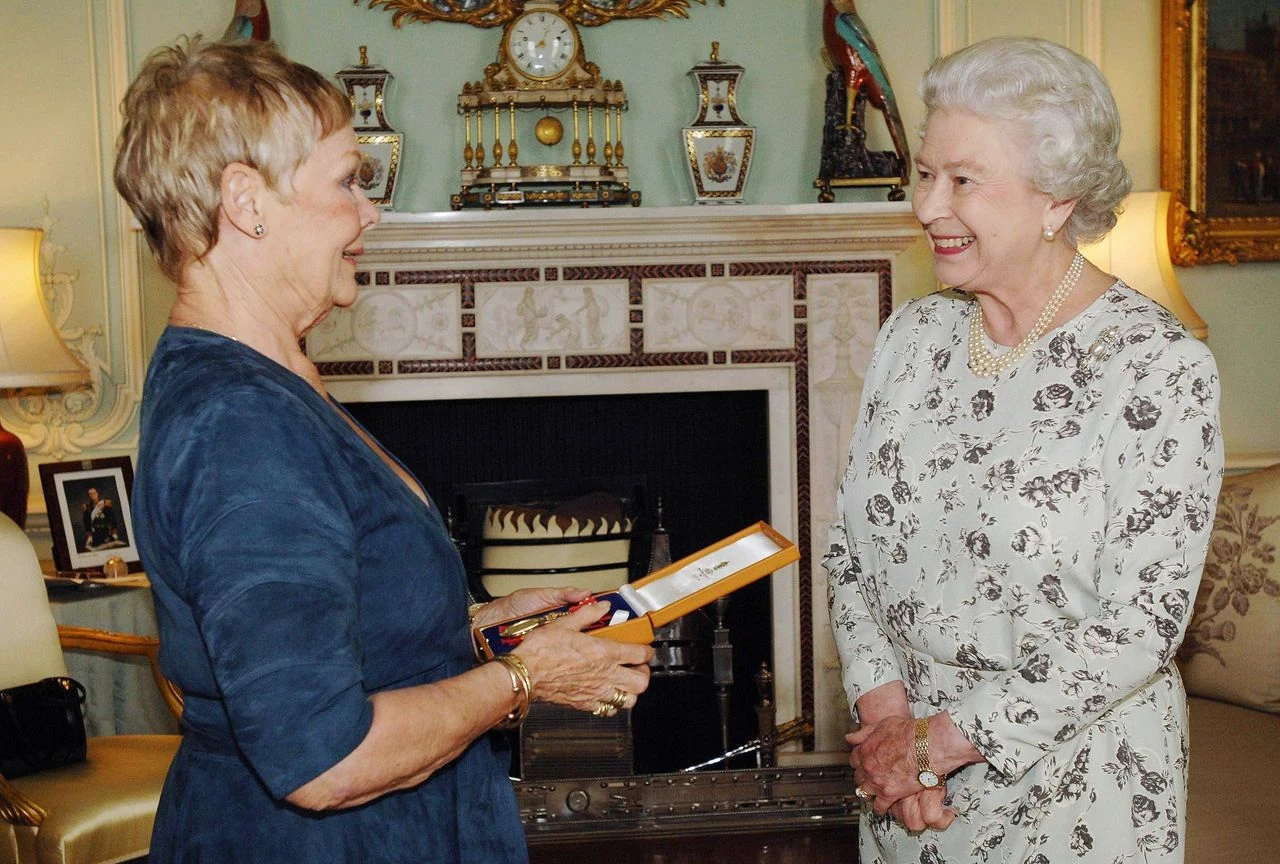
Her later screen roles include Queen Victoria again in Victoria & Abdul (2017), as well as performances in Belfast (2021) and Allelujah (2022). Across seven decades of work, Dench has received an Academy Award, a Tony Award, two Golden Globe Awards, six BAFTA Film Awards, four BAFTA Television Awards and seven Olivier Awards. She was appointed OBE in 1970, Dame Commander of the Order of the British Empire in 1988, and a Member of the Order of the Companions of Honour in 2005.
Work beyond the roles
Dench’s connection with Shakespeare has extended beyond her performances. She has supported organisations and projects that enable young people to encounter his plays, including the Shakespeare Schools Festival and York Youth Mysteries. She is also a patron of Shakespeare North, a cultural and educational venue in Prescot, and of the Festival Players Theatre Company. These commitments sit alongside a career in which Shakespeare has remained a working presence, not simply an early credential.
Her public interests include wildlife conservation. Dench has served as vice-president of Fauna and Flora International and taken part in Sketch for Survival, a conservation fundraiser. She presented the ITV series Judi Dench’s Wild Borneo Adventure in 2019, travelling with her partner, David Mills, to explore the island’s wildlife and conservation work. Her support for theatre, education and conservation provides a broader context for a career often represented through a handful of celebrated screen roles.
Why Judi Dench deserves a place in British Legacy
Judi Dench deserves a place in British Legacy because her career demonstrates the reach and resilience of British performance across its central institutions. Her first professional work was with the Old Vic Company; she became a defining performer for the Royal Shakespeare Company and worked with the National Theatre, while also building a substantial television and film career. Her Shakespearean roles, including Ophelia, Juliet and Lady Macbeth, connect her to a living performance tradition. Her later achievements, from Queen Victoria to M, show how an actor formed in repertory theatre could also command an international screen audience.
The importance of that career lies not only in awards or fame, but in the range of work those honours recognise. Dench has moved between tragedy, comedy, musical theatre and film without abandoning live performance. Her support for Shakespeare education and youth theatre extends that tradition to new participants, while her conservation advocacy connects her public standing to causes beyond the arts. The combination matters: she has been both an accomplished performer and a visible supporter of institutions and projects that keep performance accessible and active. Her British legacy is therefore not a single iconic character, but a sustained contribution to theatre, television, cinema and the cultural life around them.
Sources
Adapted in part from Judi Dench by Wikipedia contributors, under CC BY-SA 4.0. Text has been edited and combined with the existing article; this adapted text is shared under the same licence. Contributor history.
.jpg)