
Maggie Smith could move from Shakespearean tragedy to sharp comedy without losing the precision that made each performance her own. She began on the stage in Oxford, became a leading actor in Laurence Olivier’s National Theatre Company, won two Academy Awards and reached new audiences as Professor Minerva McGonagall and Violet Crawley. Her career connected British theatre and screen acting with an international public, while remaining rooted in the work of a performer who kept returning to the stage.
From Ilford to the Oxford Playhouse
Margaret Natalie Smith was born in Ilford, Essex, on 28 December 1934. Her mother, Margaret Hutton, was a Scottish secretary from Glasgow; her father, Nathaniel Smith, was a public-health pathologist from Newcastle upon Tyne who worked at the University of Oxford. The family moved to Oxford when Maggie was four. She attended Oxford High School until she was 16, then left to study acting at the Oxford Playhouse.
In 1952, aged 17, she appeared as Viola in Twelfth Night at the Oxford Playhouse under the auspices of the Oxford University Dramatic Society. Further Oxford productions included Cinderella, Rookery Nook and The Government Inspector. She made her professional debut on Broadway in the revue New Faces of ’56, appearing in several roles. The contrast between her early work in Oxford and that first professional engagement abroad foreshadowed a career that would be both distinctly British and international in reach.
Smith’s early stage work brought her to the attention of Laurence Olivier. After seeing her in The Double Dealer at the Old Vic, he invited her to join the National Theatre Company, formed there in 1962. She became one of its prominent actors, appearing alongside performers including Derek Jacobi and Michael Gambon. In Shakespeare’s Othello, she played Desdemona opposite Olivier; the film adaptation later brought her an Academy Award nomination for supporting actress. Her National Theatre years established a central strand of her career: rigorous classical work, performed with an independence that could match the company’s formidable leading figures.
Stage craft and screen recognition
Smith’s theatre career was never confined to one company or tradition. She performed in works by Shakespeare, Ibsen, Noël Coward, Edward Albee and Peter Shaffer, among others. At Stratford, Ontario, she played roles including Cleopatra, Titania, Rosalind and Lady Macbeth. On Broadway, she earned Tony nominations for Private Lives and Night and Day, then won the Tony Award for Best Actress in a Play for Lettice and Lovage in 1990. Shaffer wrote that play specifically for her. Her later stage appearances included The Importance of Being Earnest, Three Tall Women and, after an 11-year absence from theatre, A German Life at London’s Bridge Theatre in 2019.
Film made Smith’s work visible to audiences well beyond the theatre. Her title performance in The Prime of Miss Jean Brodie (1969) won the Academy Award for Best Actress and a BAFTA Film Award. She won a second Oscar, for supporting actress, for California Suite (1978). Other screen performances included A Room with a View, which brought another Oscar nomination and a BAFTA, and Gosford Park, for which she was nominated for a supporting-actress Oscar. Her film work encompassed drama, comedy and ensemble casts, including Death on the Nile, A Private Function, Sister Act, The Secret Garden and The Lady in the Van.
From 2001 to 2011, Smith played Professor Minerva McGonagall in seven of the eight Harry Potter films. The role placed her classical authority inside a global fantasy series and introduced her to another generation of viewers. She brought a different kind of command to television as Violet Crawley, the Dowager Countess of Grantham, in the British period drama Downton Abbey. The series ran from 2010 to 2015; Smith won three Primetime Emmy Awards for the role, as well as a Golden Globe and Screen Actors Guild Awards. The character’s dry wit became one of the show’s defining features.
A career that kept changing shape
Smith’s success in major film and television roles did not displace her theatre work. She returned to the West End as Brunhilde Pomsel in A German Life, a one-woman play based on the life of a woman who worked as a secretary for Joseph Goebbels. Smith’s performance was widely praised and earned her a record sixth Evening Standard Award for Best Actress. The role demanded sustained attention to the distance between a young woman’s experience and the knowledge of later events, a challenge quite different from the wit and social precision associated with many of her better-known comic parts.
Her later screen work included The Best Exotic Marigold Hotel and its sequel, Quartet, A Boy Called Christmas and The Miracle Club. She returned as Violet Crawley in the Downton Abbey films, including Downton Abbey: A New Era (2022), and reprised McGonagall’s voice in the video game Harry Potter: Hogwarts Mystery. In 2018, she appeared in the documentary Nothing Like a Dame, in conversation with Judi Dench, Eileen Atkins and Joan Plowright about their lives and work.
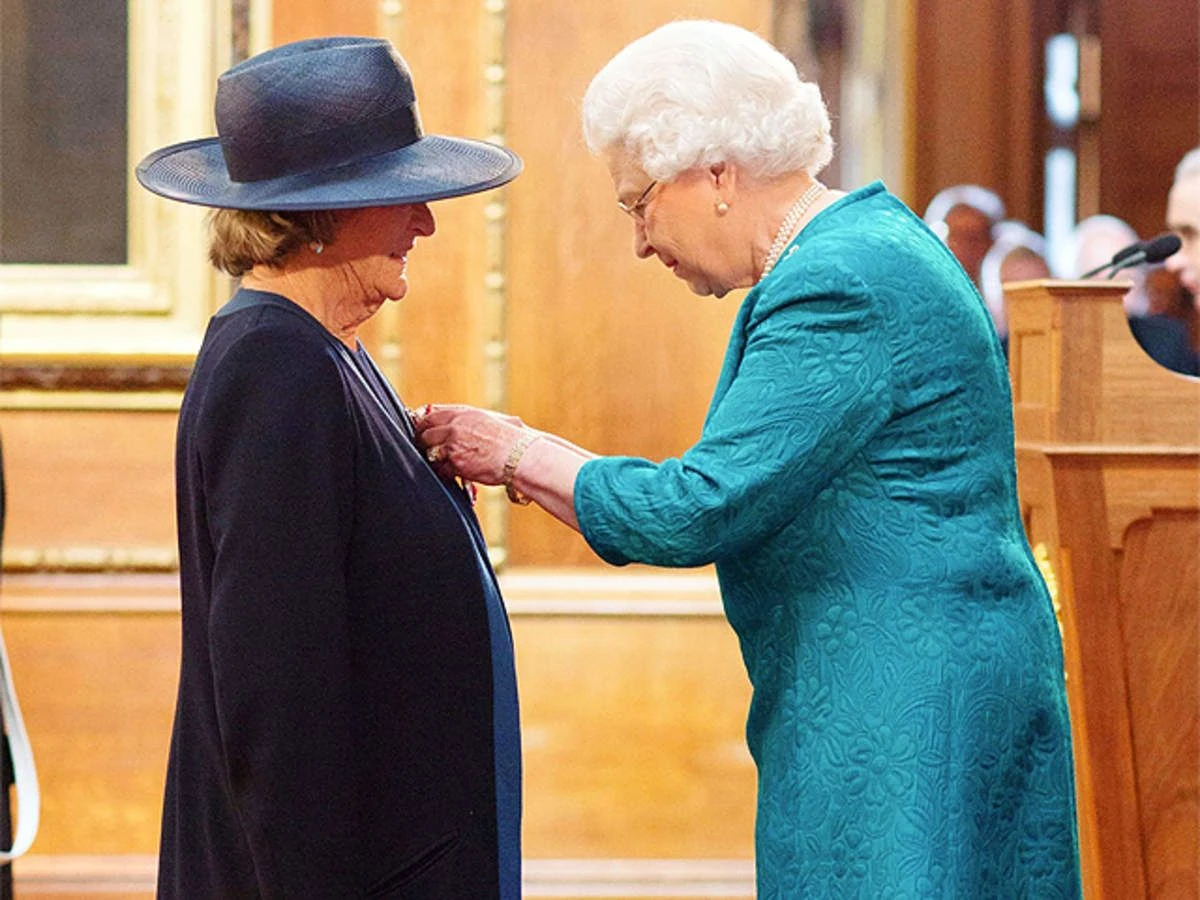
Smith’s honours reflected both stage and screen achievement. She was appointed a Commander of the Order of the British Empire in 1970 and promoted to Dame Commander in 1990. In 2014 she was appointed a Member of the Order of the Companions of Honour for services to drama. Her other recognitions included the BAFTA Fellowship, the British Film Institute Fellowship and the Society of London Theatre Special Award. She received four Primetime Emmy Awards, three Golden Globes, five BAFTA Film Awards and a Tony Award, alongside two Academy Awards. These were not simply a tally of popular success: they recognised a body of work spanning different forms, audiences and generations.
Smith supported institutions and causes connected to performance and public life. She was a patron of the Oxford Playhouse, where her career began, and of the International Glaucoma Association, and held roles with the Royal Theatrical Fund and Chichester Cinema at New Park. She also took part in fundraising events, including those supporting Christchurch’s Court Theatre after the 2011 earthquake and the Royal Theatrical Fund. These activities sat alongside, rather than replacing, the central evidence of her contribution: decades of performances on stage and screen.
Death and remembrance
Maggie Smith died in Chelsea, London, on 27 September 2024, aged 89. Tributes came from across the worlds of theatre, film and television. King Charles III described her as a national treasure and recalled the warmth and wit that shone through her performances. At theatres in London’s West End, the lights were dimmed for two minutes in her memory; Broadway theatres also marked her death. Her funeral was held in a private service at Mortlake Crematorium on 4 November.
Her long career is also a record of how an actor can remain compelling while the medium and audience change around her. The Oxford student who played Viola went on to work at the National Theatre, on Broadway and in films watched around the world. Smith could be a Shakespearean actor, a film star, a television icon or the sharpest voice in an ensemble, without those identities cancelling one another out.
Why Maggie Smith deserves a place in British Legacy
Maggie Smith deserves a place in British Legacy because her work demonstrates the reach and durability of British acting across theatre, film and television. Her early career grew from the Oxford Playhouse and the National Theatre Company, where she became part of a major chapter in post-war British theatre. She then carried that stage training into films including The Prime of Miss Jean Brodie and A Room with a View, winning international recognition without leaving British performance traditions behind. Her awards record reflects that breadth: two Academy Awards, a Tony, four Primetime Emmys and five BAFTA Film Awards among other honours.
Her cultural presence also crossed generations. McGonagall brought Smith’s distinctive authority to the Harry Potter films; Violet Crawley made her a defining presence in Downton Abbey. Both roles brought a British actor’s craft to worldwide audiences, while her continued theatre work showed that screen fame did not exhaust her ambitions. Her support for the Oxford Playhouse, the Royal Theatrical Fund and other organisations linked her public life to the institutions and people who sustain performance. Remembering Smith is therefore not only a matter of celebrating familiar characters. It is a way to recognise an artist whose work strengthened British theatre and screen culture, reached audiences across the world and remained active across eight decades.
Sources
Maggie Smith — Wikipedia revision 1379009608
Adapted in part from Maggie Smith by Wikipedia contributors, under CC BY-SA 4.0. Text has been edited and combined with the existing article; this adapted text is shared under the same licence. Contributor history.
.jpg)