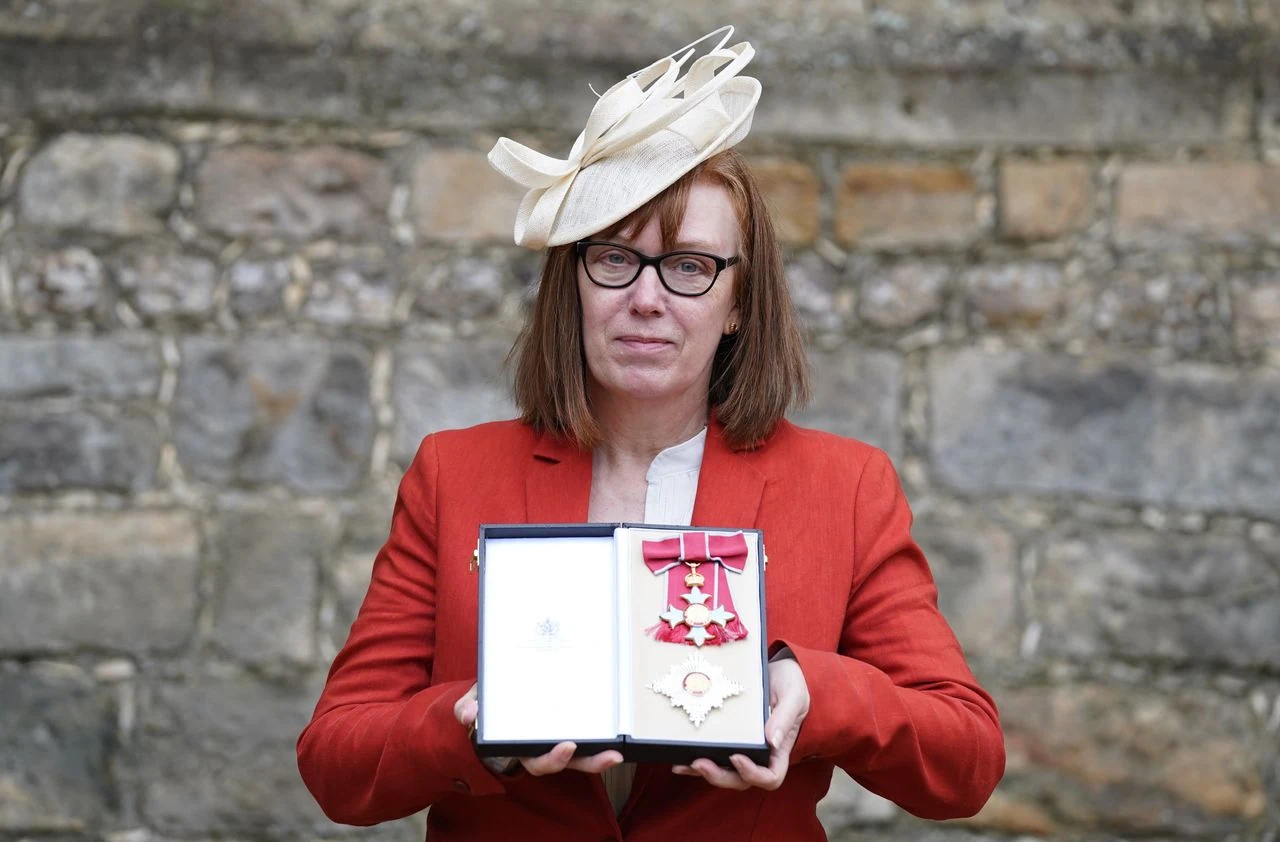
Dame Sarah Gilbert’s work on vaccines began long before COVID-19. At Oxford, she developed research into viral vaccines for diseases including influenza and malaria. That experience shaped her contribution to the Oxford–AstraZeneca COVID-19 vaccine: a project designed and tested in the first months of the pandemic, then approved for use in the UK on 30 December 2020. Gilbert’s story is not only one of a vaccine developed at speed. It is also a record of the scientific work, institutional collaboration and earlier research that made such a response possible.
From Kettering to vaccine research
Sarah Catherine Gilbert was born in Kettering, Northamptonshire, in April 1962. She attended Kettering High School for Girls and later studied biological sciences at the University of East Anglia, graduating in 1983. She went on to the University of Hull, where her doctoral research examined the genetics and biochemistry of the yeast Rhodosporidium toruloides. She received her PhD in 1986.
Gilbert’s first research posts were in industry. She worked at the Brewing Industry Research Foundation and the Leicester Biocentre before joining Delta Biotechnology, a Nottingham biopharmaceutical company, in 1990. In 1994 she returned to academic research, joining Adrian Hill’s laboratory at Oxford. Her early work there included research into host–parasite interactions in malaria.
She became a university lecturer in 1999 and a Reader in Vaccinology in 2004. In 2010 she became a professor at Oxford’s Jenner Institute. Her research focused on viral vaccines: approaches in which a safe virus carries a protein from a disease-causing pathogen, prompting an immune response. The work included vaccines intended to stimulate T cells, a part of the immune system, and investigations into malaria and influenza.
Research before the pandemic
Gilbert was involved in developing and testing a universal flu vaccine. Unlike conventional flu vaccines that focus on proteins on the virus’s outer surface, this approach used core influenza proteins and aimed to prompt a T-cell response. Early clinical trials began in 2008. A later trial, in 2011, formed part of the testing of the vaccine. The research provided experience in developing viral-vectored vaccines and taking candidates into clinical studies.
Her group also investigated the ChAdOx1 viral vector for other diseases. Research described in the scientific record included work on Middle East respiratory syndrome (MERS), Nipah and Rift Valley fever. The outcomes differed: the evidence cited for these candidates included animal studies and, for MERS, an immune response in people. These projects should not be confused with proven human vaccines for every disease; they show the range of pathogens for which the platform was being explored.
Designing a vaccine for COVID-19
In January 2020, Gilbert read a ProMED-mail report about cases of an unfamiliar pneumonia in Wuhan, China. Within two weeks, a vaccine had been designed at Oxford against the new pathogen, later identified as the cause of COVID-19. Gilbert led work on the candidate with colleagues including Andrew Pollard, Teresa Lambe, Sandy Douglas, Catherine Green and Adrian Hill.
The vaccine, initially known as ChAdOx1 nCoV-19 and later as AZD1222, used the ChAdOx1 platform. It was designed to carry genetic instructions for the SARS-CoV-2 spike protein, enabling the body to mount an immune response. Plans for animal studies were announced in March. Recruitment for a phase I/II trial began on 27 March 2020, and the programme proceeded into larger clinical trials. AstraZeneca began producing the vaccine while phase III trials were under way.
On 30 December 2020, the Oxford–AstraZeneca vaccine was approved for use in the UK. More than three billion doses were supplied to countries around the world. Its development drew on the research and trial infrastructure built before the pandemic, as well as work by the Oxford team and its partners. Gilbert’s contribution was substantial, but the vaccine was a collaborative scientific and development effort, not the work of one person alone.
Public recognition and scientific work
In 2021, Gilbert and Catherine Green published Vaxxers: the inside story of the Oxford AstraZeneca vaccine and the race against the virus, an account of the vaccine’s development. Gilbert also received a standing ovation at the Wimbledon Championships that year and was made a Dame Commander of the Order of the British Empire in the Birthday Honours for services to science and public health in COVID-19 vaccine development.
Her other recognition included the Rosalind Franklin Medal, the Royal Society of Arts’ Albert Medal and the Princess of Asturias Award for Technical and Scientific Research, all in 2021. She received honorary doctorates from the University of East Anglia and the University of Bath in 2022, and the King Faisal Prize in Medicine in 2023. She became a Fellow of the Royal Society in 2023. These honours marked both her pandemic work and a wider contribution to vaccinology.
Gilbert’s career has also involved teaching and public discussion of science. She appeared on BBC Radio 4’s The Life Scientific in 2020, and was included in the BBC’s 100 Women list that year. Her career connects laboratory research, clinical testing and public communication, while making clear that vaccine development depends on teams and institutions as well as individual expertise.
Why Sarah Gilbert deserves a place in British Legacy
Sarah Gilbert deserves a place in British Legacy because her work at Oxford contributed to a vaccine that was approved for use in the UK during the first year of the COVID-19 pandemic and supplied in more than three billion doses worldwide. That achievement had a specific British foundation: she pursued her higher education at the universities of East Anglia and Hull, built her academic career at Oxford, and worked with colleagues there to develop and test a vaccine candidate. The British connection is not simply a matter of national honour; it lies in the research and clinical-development work carried out through these institutions and their collaborators.
Her contribution also belongs in a longer history of vaccine research. Before COVID-19, Gilbert worked on influenza and malaria and on viral-vectored approaches being investigated for several other diseases. That experience helped establish a research platform that could be adapted when a new pathogen emerged. The Oxford–AstraZeneca vaccine was collaborative, and its development cannot be credited to Gilbert alone; recognising her role should not obscure the work of colleagues, trial participants or partners. Her place in British Legacy rests on both the scale of the vaccine’s international distribution and the sustained scientific work behind it: research that moved from university laboratories towards clinical testing and a response to an immediate public-health need.
Sources
Sarah Gilbert — Wikipedia revision 1376835444
Adapted in part from Sarah Gilbert by Wikipedia contributors, under CC BY-SA 4.0. Text has been edited and combined with the existing article; this adapted text is shared under the same licence. Contributor history.