
Vivienne Westwood helped turn the clothes sold in a King’s Road shop into a visual language for British punk. Working with Malcolm McLaren, she made garments that challenged ideas of good taste and respectable dress; later, she drew on historical fashion to build collections of her own. Across both phases, clothing could be provocative, carefully researched and openly connected to the politics of its time.
From teaching to the King’s Road
Born Vivienne Isabel Swire on 8 April 1941 in Hollingworth, Cheshire, she grew up in nearby Tintwistle. Her family moved to Harrow, Greater London, in 1958. Westwood took a jewellery and silversmithing course at Harrow Art School, now part of the University of Westminster, but left after one term. She later studied at Trent Park Teacher Training College and became a primary-school teacher. Alongside this, she made jewellery and sold it at a Portobello Road stall.
Westwood met Malcolm McLaren in the 1960s. They had a son, Joseph Corré, in 1967, and Westwood continued teaching until 1971 while also making clothes that McLaren designed. Their partnership brought design, retail and music together. McLaren managed the Sex Pistols, and the band’s use of Westwood and McLaren’s clothes helped bring those designs to public attention.
Their shop at 430 King’s Road changed name and direction several times. It opened as Let It Rock in 1971, moved on to Too Fast To Live Too Young To Die and Sex, and became Seditionaries in 1976. These names marked different collections and shop interiors, not a single, unchanging punk aesthetic. The shop remains at its original location as Worlds End.
Making punk visible
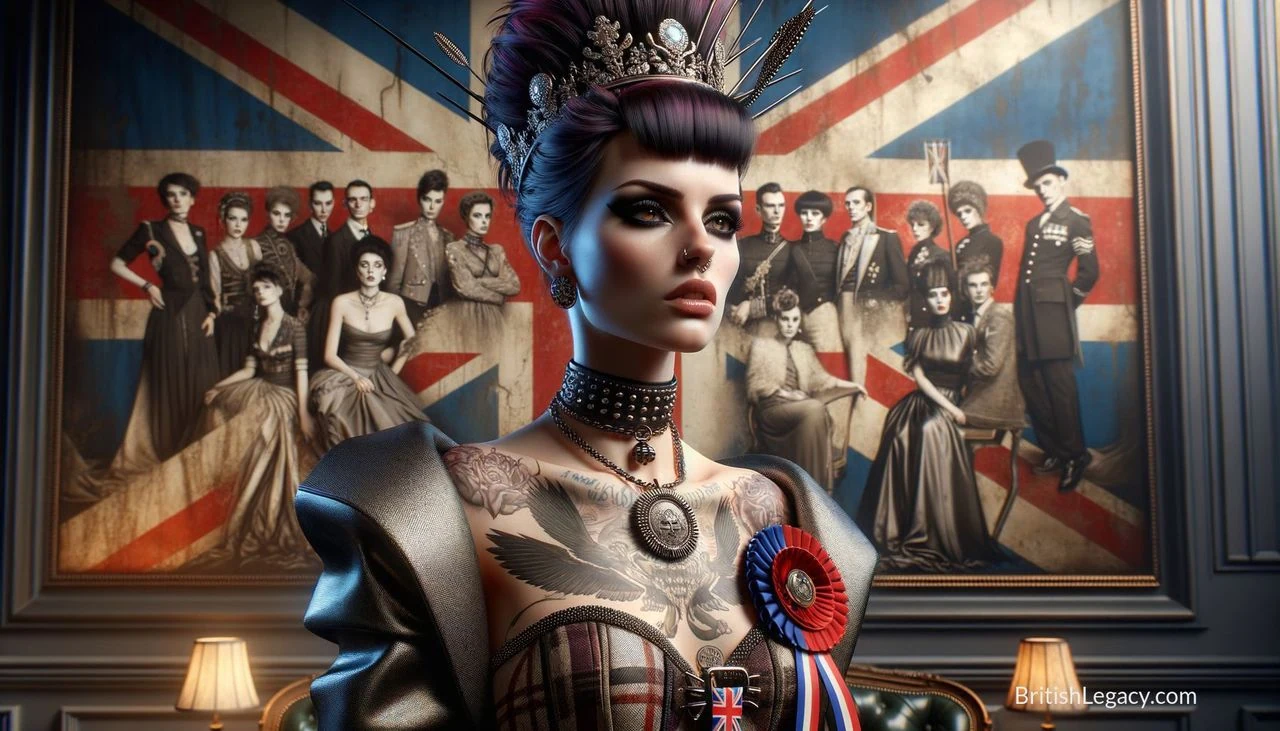
The early shop drew on the clothes and culture of post-war youth, including Teddy Boy style. At Sex, the designs became more deliberately abrasive, taking references from fetish clothing and using rips, rubber and provocative imagery. Seditionaries developed recognisable punk elements: bondage trousers with straps, loosely knitted mohair jumpers, and tops printed with graphics and fastenings that suggested restraint.
These clothes were designed to disturb as well as to sell. Westwood and McLaren used them to challenge conventional standards and provoke a response; Westwood described punk as a way of trying to “put a spoke in the system”. The clothes and the music of the Sex Pistols developed alongside one another, helping give the London punk scene a look that could be recognised beyond the shop. The designs also challenged gender conventions and encouraged experimentation.
Westwood later became disenchanted with a version of punk that adopted its look while ignoring its political intent. As the Sex Pistols era ended, her design interests shifted towards historical dress. That change did not mean abandoning provocation: she continued to bring past styles into conversation with contemporary clothing.
History reworked for the runway
The Pirate collection, shown in 1981, combined references to eighteenth- and nineteenth-century dress, British history and textiles with African prints. It established a way of working that brought historical sources into current fashion rather than treating them as museum pieces. Collections that followed included Savages, Buffalo/Nostalgia of Mud, Punkature and Witches. Between 1981 and 1985, Westwood described her direction as “New Romantic”; for the later period from 1988 to 1991, she used “The Pagan Years”.
Her research into dress history surfaced in details such as corsets, neck ruffs, bustles, breeches and paniers. From 1985 to 1987, she developed the mini-crini, a short, bouffant silhouette inspired by the Victorian crinoline and the ballet Petrushka. Its combination of two very different garment histories—one associated with restriction, the other with the miniskirt’s idea of liberation—made the design more than a revival of an old shape.
In the 1987–88 Harris Tweed collection, Westwood made the Scottish cloth central to her work. The collection is credited with helping revive its use as a fashion fabric, bringing attention to the cloth and its associated industry. She also designed academic gowns for King’s College London, unveiled in 2008, reworking a traditional form while linking it to the college’s past and future. Her other design work included uniforms for Virgin Atlantic, made with recycled polyester as part of an effort to reduce environmental impact.
Business, politics and public life
Westwood built an international fashion business, but its expansion was not a simple story of growth. In 2012, her company reached an agreement to end its long-standing franchise relationship with Manchester-based Hervia after a legal dispute. The following year, Westwood said the business would not expand further, presenting that decision as a response to environmental and sustainability concerns. The contrast between an international label and her criticism of overconsumption became a continuing feature of her public position.
She used fashion and public appearances to promote political causes. In 1989, she appeared on the cover of Tatler dressed in a suit ordered for Margaret Thatcher, under the caption “This woman was once a punk”. In 2005, she worked with Liberty on shirts and babywear bearing the words “I AM NOT A TERRORIST, please don’t arrest me”, raising funds for the civil-rights organisation and drawing attention to habeas corpus. She also campaigned for nuclear disarmament and spoke about climate change and consumerism.
Her environmental advocacy sat alongside criticism of her own business. The supplied Wikipedia account records criticism of the sustainability of some products and of working conditions reported by interns. This tension matters to an accurate account of her activism: her public arguments were influential, but they do not by themselves establish that every part of her company met the standards she advocated.
Westwood also supported WikiLeaks founder Julian Assange, visiting him while he was at the Ecuadorian embassy in London and later in Belmarsh Prison. In 2020, she protested outside the Old Bailey against his possible extradition to the United States. Her activism, like her design, was often direct and conspicuous; it also attracted disagreement, including when the Green Party’s youth wing excluded her from a 2015 campaign tour amid concerns about her company’s tax arrangements.
Honours and later work
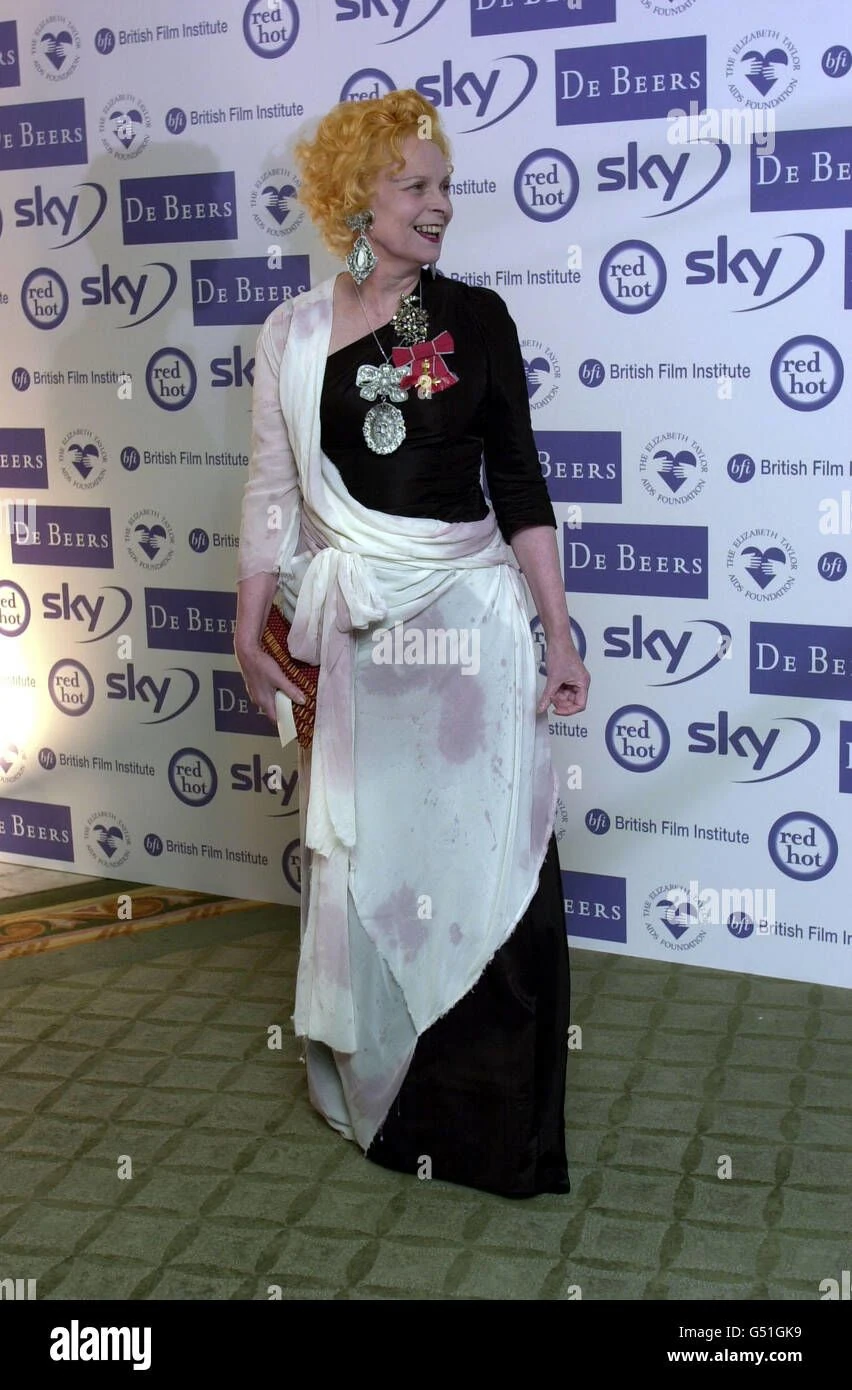
Westwood was appointed Officer of the Order of the British Empire in the 1992 Birthday Honours for services to fashion design, and advanced to Dame Commander in the 2006 New Year Honours for services to British fashion. At the Buckingham Palace ceremony for her OBE, she wore sheer tights and a reinforced bikini top beneath her skirt. She later said that she had meant to show off her outfit by twirling the skirt, rather than anticipating how the photographers would capture the moment.
She was named British Designer of the Year in 1990, 1991 and 2006. Her other recognition included a fellowship at King’s College London and an honorary degree from Heriot-Watt University, which cited her contribution to the industry and use of Scottish textiles. In 2008, the college unveiled 20 gowns and hoods designed by Westwood for its students’ graduation ceremonies.
Westwood died in Clapham, London, on 29 December 2022, aged 81. A private funeral was held in Tintwistle, where she grew up, and a memorial service followed at Southwark Cathedral in London. Her career left a record in clothing, shops, collections and commissions, as well as in the public arguments she chose to attach to them.
Why Vivienne Westwood deserves a place in British Legacy
Westwood’s place in British Legacy rests first on a specific design achievement: she helped make modern punk visible. The King’s Road shop she ran with McLaren connected clothes to music and to a wider youth culture at a moment when both were being used to challenge established expectations. Her work did not simply borrow punk’s familiar signs. The shop’s changing collections, from the early Teddy Boy references to the deliberate confrontations of Sex and Seditionaries, show how a British fashion business helped shape and sell a recognisable cultural movement.
Her later work extended that achievement rather than repeating it. Westwood brought historical dress, Scottish textiles and research into museum garments into contemporary collections, making the past an active part of modern design. The mini-crini and her use of Harris Tweed illustrate different benefits of this approach: a fresh silhouette built from contrasting histories, and renewed attention to a traditional cloth and its industry. Her designs for King’s College London gowns also brought her work into a British academic setting. At the same time, her campaigns connected fashion to civil liberties, disarmament and environmental concerns, even as criticism of her company exposed tensions between advocacy and commercial practice. That combination of design innovation, cultural influence and contested public activism makes her legacy both distinctive and worth examining closely.
Sources
Vivienne Westwood — Wikipedia, revision 1379274637 · Vivienne Westwood — Wikipedia
Adapted in part from Vivienne Westwood by Wikipedia contributors, under CC BY-SA 4.0. Text has been edited and combined with the existing article; this adapted text is shared under the same licence. Contributor history.
.jpg)