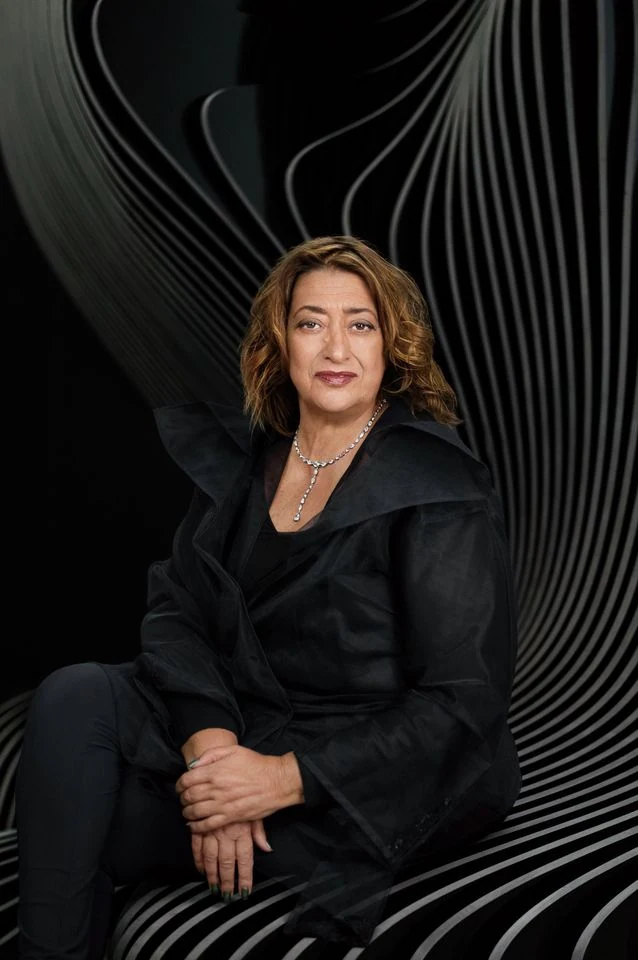
Zaha Hadid’s buildings seem to move even when they are still. Sweeping roofs, sloping walls and intersecting lines turned ideas first explored in drawings and paintings into architecture that challenged the familiar box. Born in Baghdad, she made London the base of her practice and became one of the most influential architects of her generation. Her work in Britain ranged from a landmark venue for the 2012 Olympic Games to a school in Brixton and a museum on the Clyde.
Baghdad, Beirut and the Architectural Association
Hadid was born in Baghdad on 31 October 1950. She studied mathematics at the American University of Beirut before moving to London in 1972 to study at the Architectural Association School of Architecture. There she studied with Rem Koolhaas, Elia Zenghelis and Bernard Tschumi. Her graduation project, a proposed hotel on Hungerford Bridge, used a painted architectural design inspired by the Russian artist Kazimir Malevich.
After graduating in 1977, she worked in Rotterdam with Koolhaas and Zenghelis at the Office for Metropolitan Architecture. She opened her own practice, Zaha Hadid Architects, in London in 1980 and later became a naturalised British citizen. Her architectural drawings were not conventional plans alone: she used painting and abstraction to test how space and form might be organised. The resulting designs, often built from diagonals and forms that appeared to be in motion, stood apart from the postmodern architecture prominent at the time.
In the early years, commissions were scarce and many ambitious proposals remained unrealised. Hadid became known for designs that were widely published but difficult to bring into construction, leading to the description “paper architect”. The proposed Cardiff Bay Opera House, selected by a competition jury in 1994, did not proceed after the funding body declined to support it. Her reputation was built not only through these projects but also through teaching, lectures and striking, colourful drawings. In 1988, her work featured in the Museum of Modern Art’s “Deconstructivism in Architecture” exhibition in New York, helping establish her international profile.
From drawings to built work
The Vitra Fire Station, completed in 1993 at the furniture company’s site in Weil am Rhein, Germany, was Hadid’s first completed building. Its sharp concrete and glass forms gave physical shape to an approach that had previously been seen chiefly on paper. The building served as a fire station for only a short time; it later became an exhibition space. Other early projects included the Bergisel Ski Jump in Innsbruck and the Contemporary Arts Center in Cincinnati. The latter made Hadid the first woman to design an art museum in the United States.
Her practice went on to deliver projects across Europe, Asia and the Middle East. At Rome’s MAXXI, the National Museum of 21st Century Arts, overlapping galleries and bridges create a complex route through the building. The museum won the Stirling Prize in 2010. The Guangzhou Opera House, completed in 2010, was conceived as two forms resembling pebbles within the city; its complex construction also drew criticism over workmanship and exterior tiles. In Baku, the Heydar Aliyev Center’s continuous, curving exterior made a striking contrast with the surrounding buildings. These projects show both the reach of her practice and the way she adapted an individual design language to different sites and uses.
Buildings for British places
Hadid’s contribution to British architecture is visible in buildings with public purposes. The Riverside Museum in Glasgow, which opened in 2011, houses the city’s transport collection beside the River Clyde. Hadid described its form as folds in movement, with the building opening towards both the city and the river. Its angular roofline and zinc-covered exterior make it a recognisable presence on the waterfront.
For the London 2012 Olympic Games, she designed the Aquatics Centre. Its roof, inspired by the movement of water, sweeps over the main pools and rests on three supports. The venue was designed to accommodate 17,500 spectators during the Games. Its construction cost £269 million, three times the original estimate, largely because of the roof’s complexity. The centre opened as the first Olympic building to begin construction and the last to be completed; after the Games, it became a public swimming venue.
In Brixton, the Evelyn Grace Academy brought her approach to a school building. Its Z-shaped form was designed around the movement of pupils and the organisation of the site. It won the Stirling Prize in 2011, making Hadid the first architect to receive the award in consecutive years. Other British projects included the extension to the Serpentine Gallery in Kensington Gardens and the Roca London Gallery in Chelsea Harbour. Together, these works placed her designs in civic and cultural settings, not only in the spectacular commissions for which she became widely known.
Recognition, teaching and design
In 2004, Hadid became the first woman to receive the Pritzker Architecture Prize. She was appointed Commander of the Order of the British Empire in 2002 and Dame Commander in 2012, in both cases for services to architecture. In February 2016, she became the first woman to receive the Royal Institute of British Architects’ Royal Gold Medal in her own right. The award recognised a career that expanded the possibilities of architectural design and placed an Iraqi-born British architect at the centre of international debate about the profession.
Hadid also taught at institutions including the Architectural Association, Harvard, Columbia and the University of Applied Arts Vienna. Her work extended beyond buildings into interiors, furniture and product design. She designed the Mind Zone at London’s Millennium Dome and created furniture and objects in collaboration with design companies and galleries. In 2006 she founded Zaha Hadid Design, a separate design studio. Her practice’s projects and her teaching helped make architectural drawing, model-making and the exploration of complex forms part of a wider conversation about how buildings could be conceived.
Death and a continuing practice
Hadid died in Miami on 31 March 2016, aged 65. Several projects remained under construction or were completed after her death, including the Antwerp Port Authority building, which opened in 2016. Her London practice continued under the name Zaha Hadid Architects. Her legacy also includes the Zaha Hadid Foundation, established in 2013 and operational from 2022, which looks after her archive and supports the study of her work.
Her reputation has never rested on unanimous approval. Her buildings have been praised for their expressive forms and criticised for their expense, complexity or distance from conventional expectations. The London Aquatics Centre’s cost overrun and the construction problems reported at the Guangzhou Opera House are part of that record. They sit alongside projects that became important public buildings and awards that recognised her influence. A rounded account of Hadid must hold both the ambition and the practical demands of making her designs together.
Why Zaha Hadid deserves a place in British Legacy
Hadid belongs in British Legacy because her connection to Britain was built through sustained work, not simply through an honour or a passing association. She moved to London to study in 1972, established her practice there in 1980 and became a naturalised British citizen. From that base she developed a career that changed how architecture could be drawn, discussed and built. Her British projects include the London Aquatics Centre, created for the 2012 Olympic Games; Glasgow’s Riverside Museum, a major public home for the city’s transport collection; and the Evelyn Grace Academy in Brixton. Each put ambitious design to work in a specific public setting.
Her achievements also widened the possibilities visible to architects in Britain and beyond. Hadid was the first woman to win the Pritzker Architecture Prize, received the Stirling Prize twice in consecutive years, and became the first woman to receive the RIBA Royal Gold Medal in her own right. Those milestones matter alongside the buildings themselves: they record a professional career that challenged established expectations in a field where women had long been under-represented. Her teaching, London-based practice and range of British commissions linked international recognition to local institutions and public life. That combination of formal innovation, practical projects and a lasting presence in British architecture makes her story a substantive part of the country’s design legacy.
Sources
Zaha Hadid — Wikipedia revision 1379228498
Adapted in part from Zaha Hadid by Wikipedia contributors, under CC BY-SA 4.0. Text has been edited and combined with the existing article; this adapted text is shared under the same licence. Contributor history.