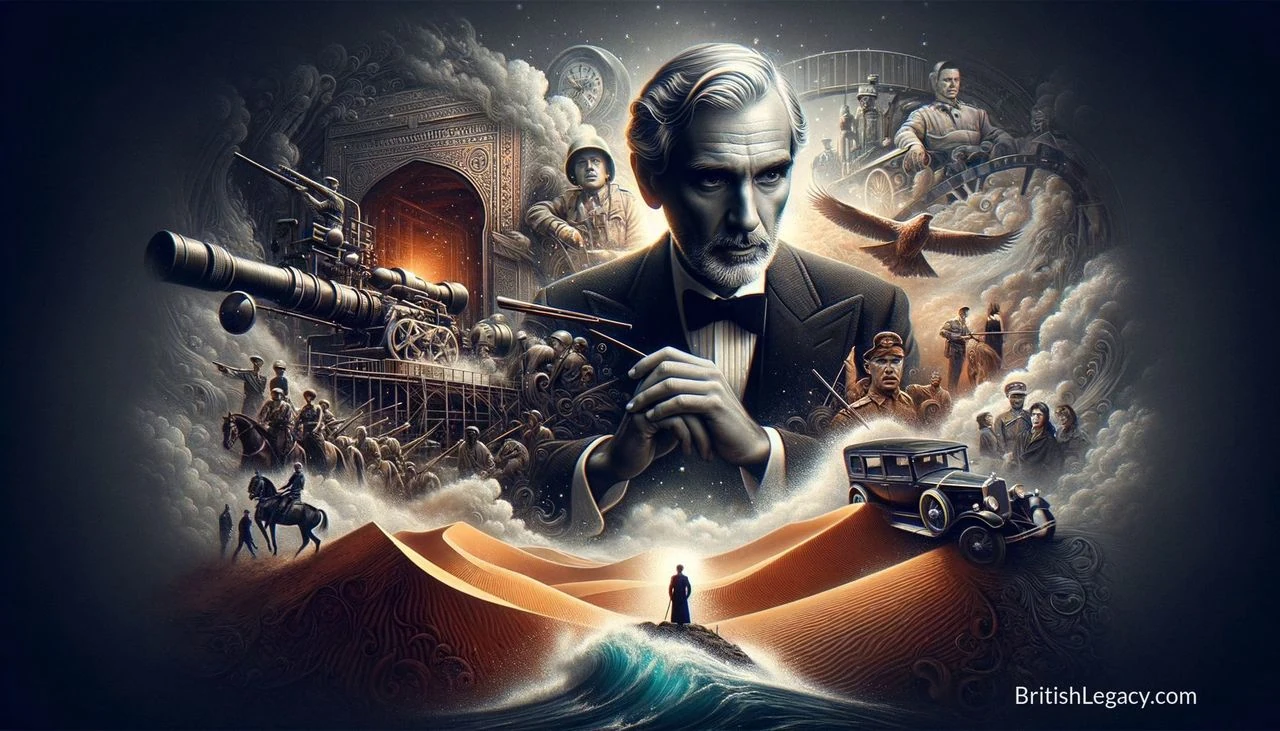
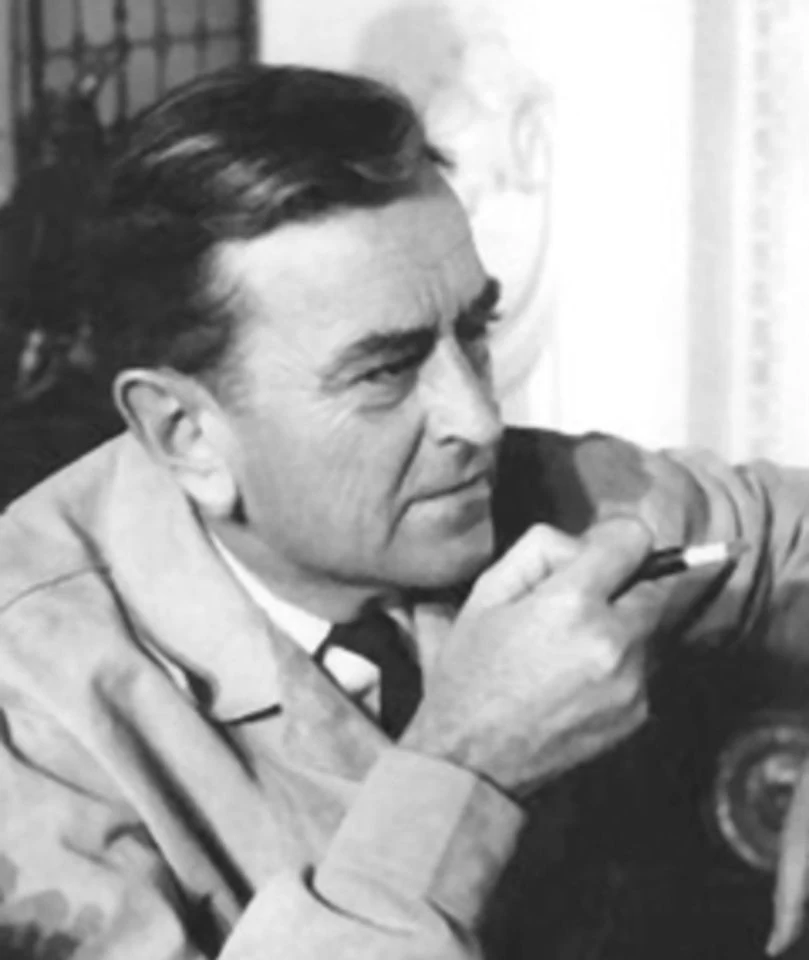
David Lean could make a landscape feel immense without losing sight of the person standing in it. His films ranged from the compressed domestic choices of Brief Encounter to the desert scale of Lawrence of Arabia, yet both depended on the same discipline: shaping images, performances and edits so that private feeling met the pressures of a larger world.
Learning the craft in the cutting room
Lean was born in Croydon, Surrey, on 25 March 1908, to Quaker parents. As a schoolboy at Leighton Park, a Quaker-founded school in Reading, he was an indifferent student. He left in 1926 and joined his father’s accountancy firm as an apprentice. A Brownie box camera, given to him by an uncle when he was ten, had already given him a lasting interest in making and developing films.
In 1927, after an aunt urged him to find work he enjoyed, Lean went to Gaumont Studios. He began with an unpaid trial, was taken on as a teaboy and progressed through clapper work to become a third assistant director. By 1930 he was editing newsreels for Gaumont and Movietone. He moved on to feature films, and by 1942 had edited more than two dozen. His credits included George Bernard Shaw adaptations Pygmalion and Major Barbara, and Powell and Pressburger’s 49th Parallel and One of Our Aircraft Is Missing. The cutting room gave him a practical command of how images and timing could tell a story.
Lean made his directorial debut in 1942 with In Which We Serve, co-directed with Noël Coward. Their collaboration continued in This Happy Breed, Blithe Spirit and Brief Encounter. The last, starring Celia Johnson and Trevor Howard, found drama in an affair that cannot be reconciled with the characters’ existing lives. Its restraint and attention to small shifts in expression offered a striking contrast to the vast settings that would later make Lean famous.
British stories, closely observed
Lean followed Brief Encounter with two adaptations of Charles Dickens: Great Expectations (1946) and Oliver Twist (1948). Both starred Alec Guinness, who became a recurring collaborator. Lean’s films in this period moved between literary adaptation, comedy and contemporary drama, while showing his interest in characters whose hopes collide with social rules and circumstance.
His next films included The Passionate Friends (1949), Madeleine (1950), The Sound Barrier (1952) and Hobson’s Choice (1954). In The Sound Barrier, a screenplay by Terence Rattigan gave Lean a story of aviation and family; Hobson’s Choice, with Charles Laughton, adapted Harold Brighouse’s play. Summertime (1955), filmed on location in Venice with Katharine Hepburn, marked a move towards larger international productions. Lean described it as his favourite of his own films.
His visual approach was not simply a matter of scale. Lean’s editing and carefully arranged settings helped establish what characters could see, know or misunderstand. Stories could shift in perspective without losing their shape, and landscapes could carry dramatic weight rather than serve as decoration. He was known for waiting for the conditions he wanted, including the right light, and for demanding precision from cast and crew. The method could be exacting; its purpose was to make each image serve the story.
From the Burma railway to the Russian Revolution
The Bridge on the River Kwai (1957), based on Pierre Boulle’s novel, brought Lean to a new scale. William Holden and Alec Guinness starred in a story of Allied prisoners of war in a Japanese camp, where a British commander’s determination to build a well-made bridge becomes entangled with his captors’ plans and the prisoners’ survival. The film’s central conflict is not only military: discipline and professional pride become forces that can be difficult to distinguish from cooperation with the enemy. It won seven Academy Awards, including Best Picture and Best Director.
Lean’s next major collaboration with producer Sam Spiegel was Lawrence of Arabia (1962). Peter O’Toole played T. E. Lawrence, the British officer at the centre of a film about wartime alliances and the effort to unite Arab groups in the Arabian Peninsula. Filmed across locations in the Middle East, North Africa and Spain, it set a vast visual frame around a complicated central figure. Maurice Jarre’s score became closely associated with the film, and the production won seven Academy Awards, including Best Picture and Best Director. Lean received his second directing Oscar for it.
Doctor Zhivago (1965), adapted from Boris Pasternak’s novel, placed a love story amid the Russian Revolution and Civil War. Omar Sharif played Yuri Zhivago, a doctor and poet whose relationship with Lara, played by Julie Christie, is shaped by upheaval beyond their control. The film’s romantic score and wintry settings became central to its appeal, and it was Lean’s greatest box-office success. In Ryan’s Daughter (1970), he returned to an intimate relationship set against political conflict, this time in Ireland during the 1916 struggle against British rule. The film received a much harsher critical response than its predecessors, though it succeeded at the box office and won two Academy Awards.
A final film and an unfinished project
After Ryan’s Daughter, Lean spent years considering and developing projects without completing another film. One was an adaptation of Captain Bligh and Mr. Christian, intended first as a two-part production and later reworked. The project lost financial backing, and a serious stroke suffered by its writer, Robert Bolt, added to the difficulties. Lean had overseen casting and the construction of a replica of the Bounty, but left the production; the resulting film, The Bounty, was directed by Roger Donaldson.
Lean returned to directing with A Passage to India (1984), based on E. M. Forster’s novel about colonial conflict in British-occupied India. He wrote and edited the film as well as directing it, and filmed on location in the subcontinent. Its account of a young British woman’s accusation against an Indian doctor placed questions of power, perception and justice at the centre of the drama. The film was warmly received, earned 11 Academy Award nominations and won two. Lean received nominations for directing, editing and writing. It was his last completed film.
He later withdrew from a planned screen version of J. G. Ballard’s Empire of the Sun, which Steven Spielberg went on to direct. Lean’s final major project was an adaptation of Joseph Conrad’s Nostromo. He worked on it for years, but it did not reach production before his death in Limehouse, London, on 16 April 1991, aged 83. He was buried at Putney Vale Cemetery.
Recognition and influence
Lean was appointed CBE in 1953 and knighted in 1984 for services to the arts. The Academy Awards are one measure of the reach of his work: his films won seven Oscars for The Bridge on the River Kwai and seven for Lawrence of Arabia. His career also travelled between British production and international finance, without leaving behind his interest in British literary and social life. Dickens, Noël Coward and Forster were among the writers whose work he brought to the screen.
The British Film Institute’s 1999 list of the top 100 British films included seven of his films: Brief Encounter, Lawrence of Arabia, Great Expectations, The Bridge on the River Kwai, Doctor Zhivago, Oliver Twist and In Which We Serve. Directors including Steven Spielberg, Stanley Kubrick, Martin Scorsese and Ridley Scott have acknowledged his influence. The response to Lean has not been uniform: Ryan’s Daughter drew severe criticism, and some critics have questioned the later epics’ scripts or scale. That disagreement is part of the record of a filmmaker whose choices invited strong reactions.
Why David Lean deserves a place in British Legacy
David Lean’s place in British Legacy rests on more than the size of his productions or the prizes they won. He built a career through the working crafts of editing, writing and directing, then used that command of film language to tell stories rooted in British life and literature. Brief Encounter made the constraints of ordinary respectability a source of drama; Great Expectations and Oliver Twist carried Dickens to international audiences; A Passage to India confronted the unequal relationships of colonial rule. These films give his British connection specific substance: they show a director repeatedly working with British stories, performers and cultural traditions while allowing their conflicts to travel beyond Britain.
Lean also demonstrated how a British director could work on an international canvas without making scale an end in itself. In The Bridge on the River Kwai, the spectacle serves a study of pride and duty; in Lawrence of Arabia, landscape and history intensify the instability of the central figure; in Doctor Zhivago, political upheaval presses on a private love story. His films’ continuing presence on the BFI’s list of notable British films, together with the acknowledged influence he had on later directors, records both national recognition and a wider effect on filmmaking. His legacy is not that every film escaped criticism, but that his choices about image, editing and setting expanded what British cinema could attempt.
Sources
David Lean — Wikipedia, revision 1377611289
Adapted in part from David Lean by Wikipedia contributors, under CC BY-SA 4.0. Text has been edited and combined with the existing article; this adapted text is shared under the same licence. Contributor history.