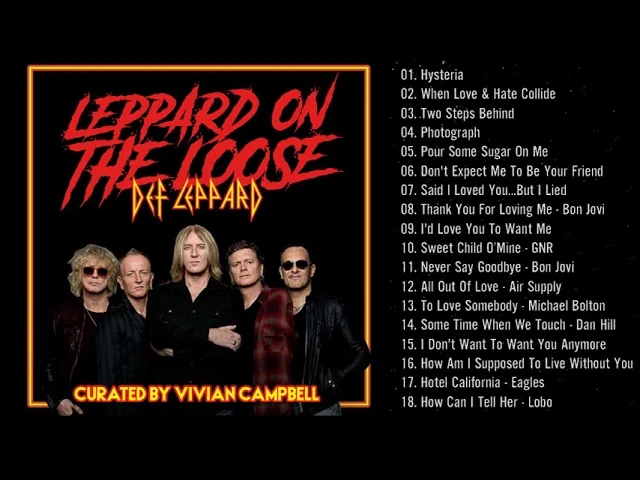
Def Leppard’s story began in Sheffield, where a group of young musicians built a following in the late 1970s before taking their melodic hard rock to audiences around the world. Their career joined the local energy of the new wave of British heavy metal to a carefully shaped, hook-filled sound that reached far beyond the movement’s original audience. The success of Pyromania and Hysteria made them international stars; the work and persistence behind those records explain why the band’s history is more than a sequence of hit singles.
Sheffield beginnings
The band’s origins date to 1976, when Sheffield school students Rick Savage, Tony Kenning and Pete Doubleday formed a group called Atomic Mass. Pete Willis joined in 1977, and Joe Elliott, initially auditioning as a guitarist, became the lead singer. Elliott suggested the name Deaf Leopard; at Kenning’s suggestion, its spelling was altered to Def Leppard. Steve Clark joined in January 1978. The group rehearsed at Portland Works and played its first gig in the dining hall of Westfield School in Mosborough.
Rick Allen joined as drummer in 1978, aged 15, after Kenning left. The band’s three-song The Def Leppard E.P. received valuable attention when BBC Radio 1 DJ John Peel played “Getcha Rocks Off”. By 1979, Def Leppard had developed a following among British hard-rock and heavy-metal listeners and secured a record deal with Phonogram/Vertigo. Their early development connected them to the new wave of British heavy metal, although the band later resisted being confined by that label.
The debut album, On Through the Night, appeared in 1980 and reached the UK top 15. Its attempt to build an American audience unsettled some early fans, a reaction that became conspicuous at the Reading Festival. Rather than settling into one market, the band continued to tour and develop its sound. Their second album, High ’n’ Dry (1981), was produced by Robert John “Mutt” Lange. The video for “Bringin’ On the Heartbreak” became one of the early metal videos shown on MTV, helping the band find a larger audience in the United States.
Pyromania breaks through
During the making of Pyromania, Willis was dismissed in 1982 and replaced by Phil Collen. Released in January 1983 and produced by Lange, the album brought Def Leppard to a new level of success. “Photograph” and “Rock of Ages” both topped the US rock tracks chart and reached the Hot 100’s top 20. The album reached number two on the US album chart and sold six million copies there in 1983 alone, held off the top spot by Michael Jackson’s Thriller. It later received RIAA Diamond certification for US sales exceeding ten million.
“Photograph”, “Rock of Ages” and “Foolin’” helped make the record a major commercial breakthrough. The supplied import includes a short lyric excerpt for each: “You’ve gone straight to my head”; “It's better to burn out than fade away”; and “Is anybody out there? Anybody there?” Its combination of hard-rock force, melodic riffs and layered vocal harmonies gave the band a sound that could work on rock radio and in large venues. The album was less successful at home than in the US, reaching number 18 in the UK, a reminder that the band’s international rise did not follow the same pattern on every chart.
Allen’s return and the making of Hysteria
On 31 December 1984, Allen was involved in a car accident near Sheffield and lost his left arm. After an infection, doctors amputated it. Allen was determined to remain the band’s drummer. He worked with Simmons to develop a custom electronic kit that allowed him to use his legs for some of the parts previously played with his arms. His bandmates supported his return rather than replacing him. He played alongside Jeff Rich during a warm-up tour in 1986, then performed alone at the Monsters of Rock festival in England.
The accident was one of several reasons the follow-up to Pyromania took years to complete. Hysteria was released in August 1987 after more than three years of recording. Its sound, built from electronic drums, carefully layered guitars and harmonised vocals, extended the band’s melodic approach. “Animal” became their first UK top-ten single. In the US, “Pour Some Sugar on Me” reached number two on the Hot 100, while “Love Bites” went to number one. The album topped charts in the UK and several other countries and ultimately sold more than 15 million copies worldwide.
The imported article highlights “Pour Some Sugar on Me”, “Love Bites” and “Hysteria”, with the accompanying short excerpts “Love is like a bomb, baby, c’mon get it on”; “Love bites, love bleeds”; and “Oh, can you feel it? Do you believe it?” The scale of the album’s success reflected a deliberate attention to studio detail, as well as songs that could carry from radio to arena. The album produced a long run of singles and sustained chart presence; the accompanying tour presented the band in the round. In 1989, Def Leppard were nominated for the Brit Award for Best British Group and won two American Music Awards: favourite heavy metal/hard rock artist and album for Hysteria.
Loss, change and a continuing career
Guitarist Steve Clark died in January 1991 from a combination of prescription drugs and alcohol. The remaining members chose to continue, recording Adrenalize as a four-piece, with Collen handling the guitar parts intended for Clark. Released in 1992, the album reached number one in the UK, US, Canada and Australia. Vivian Campbell joined the band later that year, completing the five-member line-up that has remained in place since 1992.
Def Leppard’s subsequent records did not all reproduce the commercial heights of their two defining albums. Retro Active (1993) gathered B-sides and previously unreleased recordings; the acoustic “Two Steps Behind” became a significant international hit. The 1995 collection Vault included “When Love & Hate Collide”, which reached number two in the UK. Slang (1996) took a more stripped-back direction, while Euphoria (1999) returned towards the group’s familiar melodic sound.
The band continued recording and touring into the following decades. Later releases include Def Leppard (2015) and Diamond Star Halos (2022). In 2023, Drastic Symphonies reworked earlier material with the Royal Philharmonic Orchestra and reached number four on the UK albums chart. In 2019, the band was inducted into the Rock and Roll Hall of Fame; the induction included current members and former guitarists Willis and Clark.
A sound made for more than one audience
Def Leppard’s music brought together heavy-metal roots, hard rock, pop structure and vocal harmony. That mixture helped them reach listeners beyond the early British metal audience without leaving guitar-led rock behind. Pyromania and Hysteria are the clearest examples of their studio craft and commercial reach, but the change of direction on Slang and their later orchestral reworking show that the group did not rely on one formula alone.
Their Sheffield identity remained visible throughout that international career. They returned to the city for a major concert at Don Valley Stadium in 1993, and received a Sheffield Legends plaque in 2006. Their history also includes difficult periods: Allen’s accident, Clark’s death, and the uneven reception of later albums. The supplied import also attributes two short statements to the band’s members: Joe Elliott: “Don't lose your passion. If you believe in what you're doing, you'll be successful.” Rick Allen: “The human spirit is an amazing thing, it can overcome an incredible amount.” These are retained as attributed material from the import, not independently verified quotations.
Why Def Leppard deserves a place in British Legacy
Def Leppard deserves a place in British Legacy because its rise from Sheffield connects a specific local music scene to a substantial international achievement. The band formed through the work of young musicians in the city, developed a following among British hard-rock and heavy-metal fans, and became associated with the new wave of British heavy metal. It then built a broader audience through a distinctive blend of heavy guitars, pop-minded melody and layered vocals. The Diamond-certified Pyromania and Hysteria demonstrate how a British band could carry that sound into the American market and the world’s arenas without losing its roots in Sheffield.
The band’s legacy also rests on endurance and adaptation, not only on sales. Allen’s return to the drums after losing an arm was made possible by his own determination, technical changes to his kit and the support of his bandmates. After Clark’s death, the group continued, and later albums explored different approaches while preserving its identity. Its place in the Rock and Roll Hall of Fame recognises an influence that crossed national borders; the Sheffield Legends plaque marks a continuing connection to its home city. Together, those achievements give Def Leppard a clear place in a record of British music: a local band that developed its craft, reached a global audience and continued to evolve over decades.
Sources
Adapted in part from Def Leppard by Wikipedia contributors, under CC BY-SA 4.0. Text has been edited and combined with the existing article; this adapted text is shared under the same licence. Contributor history.