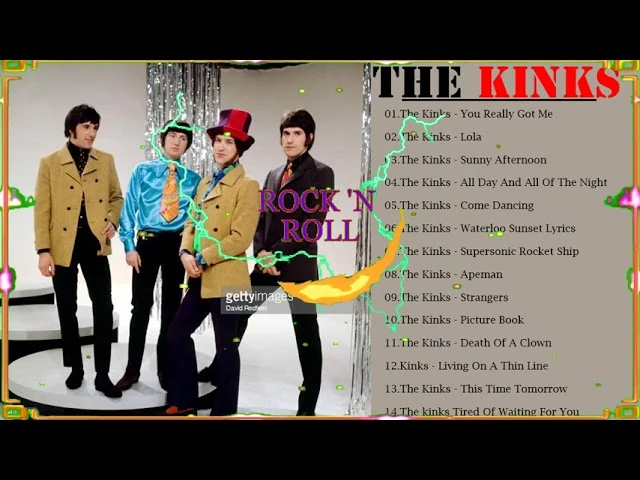
The Kinks began as a group of school friends playing in north London and became one of the defining British rock bands of the 1960s. Their breakthrough, “You Really Got Me”, announced itself with Dave Davies’s jagged guitar sound; what followed was less easily pinned down. Ray Davies wrote about London streets, working lives, changing fashions and ordinary people, while the band moved between hard-driving rock, music hall, folk and more theatrical projects. Their career was not a steady climb: early chart success, an enforced absence from American touring, changing line-ups and later commercial revivals all shaped the music.
From Muswell Hill to the first hit
The Davies brothers grew up in north London, in a large family whose musical tastes ranged from their parents’ music hall to the jazz and early rock and roll enjoyed by their older sisters. At William Grimshaw Secondary Modern School, Ray and Dave formed a band with bassist Pete Quaife and drummer John Start. The group played local venues under several names, including the Ray Davies Quartet, the Ramrods and the Ravens, before settling on the Kinks in 1964. Mick Avory joined on drums before the band signed with Pye Records.
Their first two singles attracted little attention. “You Really Got Me”, written by Ray, changed their prospects. Dave’s distorted guitar sound gave the 1964 recording its forceful signature; the song reached number one in the UK and the American top ten. It was followed by “All Day and All of the Night”, “Tired of Waiting for You” and other successful singles. The riff-driven sound has since been recognised as an influence on hard rock and heavy metal, but it was only one strand of the band’s work.
The Kinks’ early momentum was interrupted after their 1965 American tour, when the American Federation of Musicians refused them permission to perform in the country for several years. The precise cause was not made public; the ban was widely attributed to problems during the tour. That restriction cut the band off from a major market and made their subsequent focus on British subjects and musical traditions particularly distinctive.
Ray Davies turns towards everyday England
From the mid-1960s, Ray Davies moved from hard-driving rock towards character studies and songs of social observation. “A Well Respected Man” and “Dedicated Follower of Fashion” showed this developing approach. “Sunny Afternoon”, a number-one hit in Britain in 1966, placed a wealthy narrator’s complaints about money and tax against a relaxed musical setting. On albums such as Face to Face and Something Else by the Kinks, everyday life became a source of comedy, unease and tenderness.
“Waterloo Sunset” (1967) brought London into focus through a quieter, more reflective song about the Thames, Waterloo station and two lovers crossing a bridge. “Autumn Almanac” found meaning in the habits and small pleasures of ordinary life. The Kinks’ writing did not simply celebrate England: it could be affectionate and satirical at once, attentive to class, conformity and the pressures of modern life.
The Kinks Are the Village Green Preservation Society (1968) gathered songs about English town and village life into a thematic album. It received strong reviews but initially sold poorly. The following year, Arthur (Or the Decline and Fall of the British Empire) continued the group’s engagement with English history and experience. This was ambitious work made during a period of limited commercial success, not a smooth progression from hit to hit.
Changing sound, changing fortunes
In 1970, “Lola” returned the band to wide attention. Its account of a confusing romantic encounter became a British and American top-ten hit. The BBC objected to the original recording’s reference to Coca-Cola under its policy on product placement, so Ray Davies re-recorded the line with “cherry cola”. The song’s story and language have remained among the best-known examples of the Kinks’ willingness to make an unusual character and situation the centre of a pop song.
The band’s next phase was more theatrical. Beginning with Preservation, Ray Davies developed extended stories and stage productions, with an expanded line-up that included a horn section and backing singers. The project brought creative ambition but diminishing popularity. After signing with Arista in 1976, the group returned to a more compact rock sound. Albums including Sleepwalker, Low Budget and Give the People What They Want helped rebuild their following, particularly in the United States. “Come Dancing”, released in 1983, became their biggest American hit since the mid-1960s.
Line-up changes continued throughout the band’s history. Quaife left permanently in 1969; John Gosling joined on keyboards in 1970. Avory departed in 1984 and was replaced by Bob Henrit. The Davies brothers remained central, but tensions between them and the group’s fluctuating commercial fortunes formed part of the story as much as its celebrated songs.
Endings, recognition and influence
The Kinks released their last studio album, Phobia, in 1993 and issued To the Bone on their own Konk label in 1994. Their final public performance came in 1996; the band broke up the following year. The Davies brothers later discussed working together again, but reunion plans did not produce a return to performing as the Kinks.
Recognition continued after the band’s most active years. The original four members were inducted into the Rock and Roll Hall of Fame in 1990, and the Kinks entered the UK Music Hall of Fame in 2005. Their influence reached across musical styles: the Jam and the Pretenders recorded their songs, Van Halen covered “You Really Got Me”, and Britpop bands including Blur and Oasis cited them as an influence. The band’s musical range helps explain that reach, from the stark early guitar sound to the finely drawn characters and English settings of Ray Davies’s later writing.
Why The Kinks deserve a place in British Legacy
The Kinks deserve a place in British Legacy because their work made British places, speech and social experience central to an internationally influential rock career. “You Really Got Me” showed how a direct, distorted guitar sound could change the force of a pop single. The songs that followed demonstrated a different kind of innovation: Ray Davies turned commuters, fashion-followers, tax complaints and suburban routines into compelling subjects. “Waterloo Sunset” gave London a vivid musical portrait, while The Kinks Are the Village Green Preservation Society assembled a wider meditation on English community and change. These achievements connect the band’s musical invention with a close attention to everyday life.
Their legacy also reflects range and resilience. The group moved from early R&B and rock and roll through music hall, folk and theatrical albums, then found a new audience with late-1970s and 1980s rock records. The American touring ban, commercial setbacks and shifting line-ups did not erase their influence: later musicians drew on both their guitar sound and their songwriting. Their songs were covered by artists including the Jam, the Pretenders and Van Halen, while Blur and Oasis carried the Kinks’ influence into the Britpop era. Remembering them in British Legacy recognises not only a run of enduring recordings but a band that helped make English culture and ordinary experience an expansive subject for rock music.
Sources
The Kinks — Wikipedia revision 1378861483
Adapted in part from The Kinks by Wikipedia contributors, under CC BY-SA 4.0. Text has been edited and combined with the existing article; this adapted text is shared under the same licence. Contributor history.