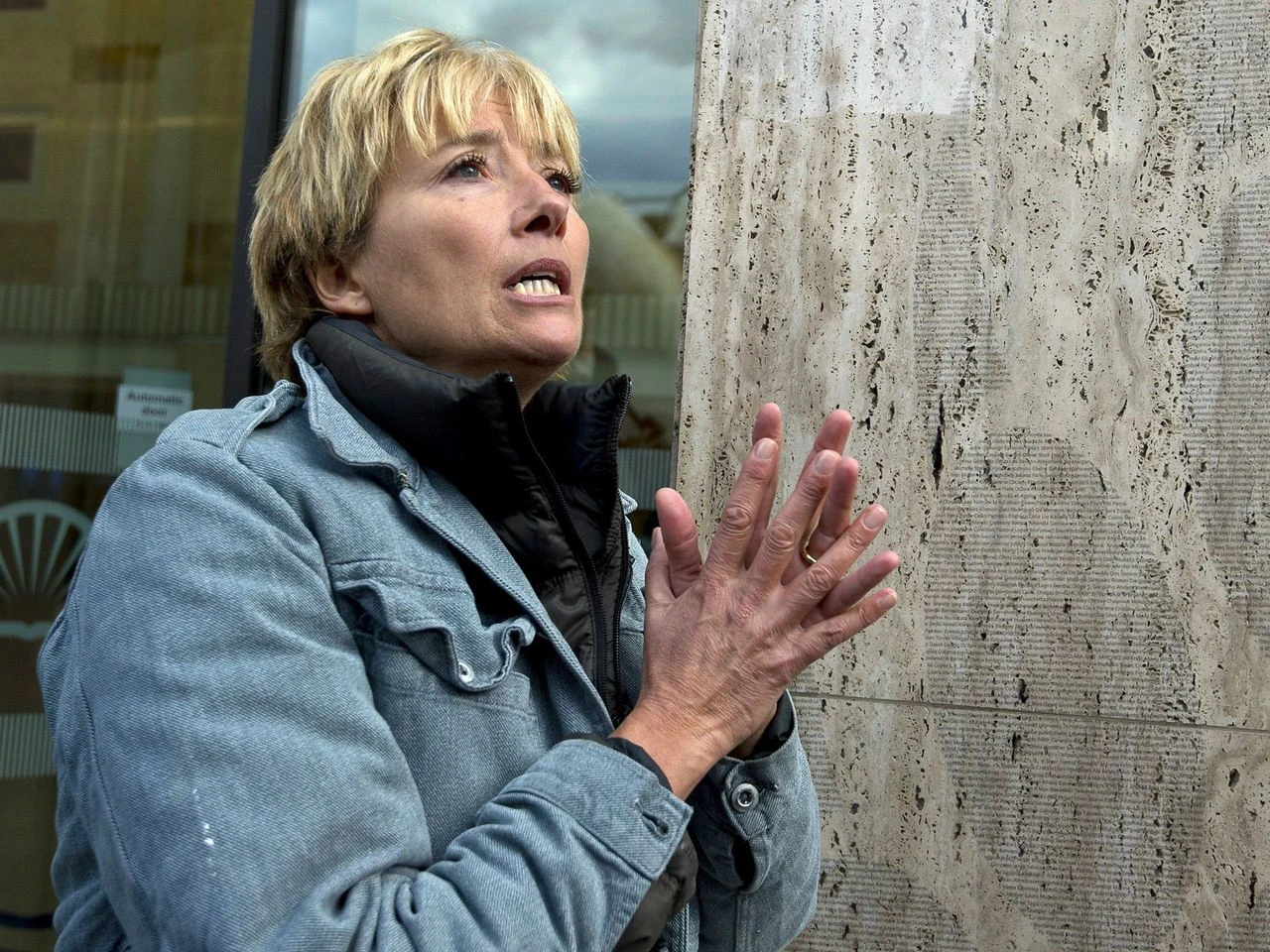
Emma Thompson’s career has moved between stage, television and film, with writing as well as acting at its centre. She won an Academy Award for her performance in Howards End and another for the screenplay of Sense and Sensibility, making her the first person to win Oscars for both acting and screenwriting. Alongside that work, she has taken public roles in human-rights and environmental campaigns. Her story is not simply one of a successful British performer: it is also a record of how a strong comic and literary sensibility has shaped work across several forms.
Cambridge, comedy and a television breakthrough
Born in Hammersmith, London, on 15 April 1959, Thompson grew up in a family of performers. Her father, Eric Thompson, was an actor and writer, and her mother, Scottish actress Phyllida Law, worked on stage and screen. Thompson attended Camden School for Girls before studying English at Newnham College, Cambridge. There she joined the university’s Footlights comedy troupe, serving as its vice-president in 1980 and co-directing its first all-female revue, Woman’s Hour. The following year, her Footlights team won the Perrier Award at the Edinburgh Festival Fringe for The Cellar Tapes.
Her early professional work included radio, stage and television. She toured in a stage production of Not the Nine O’Clock News in 1982, then appeared with Footlights colleagues Stephen Fry and Hugh Laurie in the television comedy Alfresco. A West End revival of the musical Me and My Girl in 1985 brought her a major stage role. In 1987, she came to wider attention in two contrasting BBC series: the Scottish rock-band comedy Tutti Frutti and the wartime drama Fortunes of War. Her performances earned her the British Academy Television Award for Best Actress.
Thompson’s first feature-film appearance came in The Tall Guy (1989), followed by her portrayal of Princess Katherine in Kenneth Branagh’s Henry V. She worked with Branagh on stage and screen, including Dead Again and Much Ado About Nothing. In 1992, James Ivory cast her as Margaret Schlegel in Howards End, an adaptation of E. M. Forster’s novel about class and social change in Edwardian Britain. Thompson won the Academy Award, BAFTA and Golden Globe for Best Actress. The following year, she received two Oscar nominations: Best Actress for The Remains of the Day and Best Supporting Actress for In the Name of the Father.
A screenwriter as well as an actor
Thompson’s work on Sense and Sensibility brought her talents as a writer into the foreground. A lifelong admirer of Jane Austen, she spent five years developing the screenplay from the novel. She also played Elinor Dashwood, the eldest sister whose restraint and judgement guide much of the story. Directed by Ang Lee and co-starring Kate Winslet, the 1995 film was widely praised. Thompson received the Academy Award for Best Adapted Screenplay and a further BAFTA; the Oscar made her the only person to have won Academy Awards for both acting and writing.
Her writing has continued beyond that film. She wrote and starred in the children’s fantasy Nanny McPhee (2005), adapting stories she had read as a child, and returned to the character in a 2010 sequel. She also wrote the screenplay for Effie Gray (2014), in which she played the art critic Elizabeth Eastlake, and co-wrote Bridget Jones’s Baby (2016). In 2012, publishers asked her to write a new Peter Rabbit story to mark the 110th anniversary of Beatrix Potter’s first book. Thompson went on to write three authorised books in the series: The Further Tale of Peter Rabbit, The Christmas Tale of Peter Rabbit and The Spectacular Tale of Peter Rabbit.
Her screen roles have ranged from literary and historical drama to comedy, fantasy and major studio productions. She played a woman facing illness in the television film Wit (2001), appeared in Love Actually (2003), and portrayed Professor Sybill Trelawney in several Harry Potter films. Other credits include Saving Mr. Banks (2013), as author P. L. Travers; Beauty and the Beast (2017), as Mrs Potts; and The Children Act (2017), as a High Court judge. In Late Night (2019), she played a television host confronting the possible end of her programme. She later appeared in Good Luck to You, Leo Grande (2022) and Matilda the Musical (2022). Her television and stage work has included the miniseries Angels in America and a 2014 Lincoln Center production of Sweeney Todd.
Human rights and environmental campaigning
Thompson has used her public profile in campaigning as well as performance. She is chair of the Helen Bamber Foundation, which supports survivors of torture and other forms of human-rights abuse. She is also a patron of the Refugee Council. In 2017, she marched in support of Nazanin Zaghari-Ratcliffe, the Iranian-British charity worker held captive in Iran. Her involvement connects her public work to organisations and campaigns concerned with refugees and survivors of persecution.
Her environmental activity has included support for Greenpeace. In 2009, Thompson and three other Greenpeace members bought land near Sipson, a village threatened by proposals for a third runway at Heathrow Airport, as part of opposition to the expansion. In 2014, she and her daughter Gaia joined a Greenpeace expedition to the Arctic to raise awareness of the risks of oil drilling. Thompson also narrated a 2016 documentary short, The Doubt Machine: Inside the Koch Brothers’ War on Climate Science, about efforts to discredit climate research. In 2019, she supported a London Extinction Rebellion rally; her participation drew criticism because she had flown a long distance to attend. That tension is part of the public record of campaigning, where the act of speaking out can also invite scrutiny of the choices behind it.
Honours and a career across forms
Thompson’s awards reflect the range of her work. Alongside her two Academy Awards, she has received three BAFTA Awards, two Golden Globe Awards and a Primetime Emmy Award. In 2018, she was appointed Dame Commander of the Order of the British Empire for services to drama. She was elected a Fellow of the Royal Society of Literature in 2021. Her writing for children, her screenplays and her acting work have given her a presence beyond any single role or genre.
Her career also links British institutions and stories with audiences around the world. Cambridge Footlights and the Edinburgh Festival Fringe shaped her early comedy; the West End provided a breakthrough stage role; and British television gave her early prominence. Films such as Howards End, The Remains of the Day and Sense and Sensibility brought British literary and social history to international cinema. Her later work has ranged far beyond period drama, but that grounding in language, performance and adaptation remains visible in her choices as both actor and writer.
Why Emma Thompson deserves a place in British Legacy
Thompson merits a place in British Legacy because her achievements are unusually broad and clearly evidenced. She is an award-winning actor, but also a screenwriter whose adaptation of Sense and Sensibility earned the same highest film honour for writing that she had won for acting. That distinction matters: she did not only interpret a classic British novel on screen, but reshaped it for cinema, bringing Austen’s wit and social observation to a new audience. Her subsequent writing for children, including three authorised Peter Rabbit books, further demonstrates that her work reaches beyond performance and film scripts.
Her British connection is rooted in a career built through British training and institutions, from Cambridge Footlights and the Fringe to the West End and BBC television, and in films that have carried British literature and history internationally. It also includes public service beyond the arts. As chair of the Helen Bamber Foundation and a patron of the Refugee Council, Thompson has lent sustained support to organisations working with people affected by torture and displacement. Her Greenpeace activity has brought attention to Heathrow expansion and Arctic oil drilling. These commitments do not make her work above criticism; the debate over her flight to a climate protest shows why public advocacy is judged against personal conduct. Together, her craft, writing and campaigning make a more substantial legacy than celebrity alone.
Sources
Emma Thompson — Wikipedia, revision 1379702148
Adapted in part from Emma Thompson by Wikipedia contributors, under CC BY-SA 4.0. Text has been edited and combined with the existing article; this adapted text is shared under the same licence. Contributor history.