
Dua Lipa’s career has moved from London songwriting sessions to the top of the UK charts and stages around the world. Her rise is marked by a sequence of clear turning points: a debut album that produced the number-one single “New Rules”, the disco-inflected success of Future Nostalgia, and a later return to number one with Radical Optimism. Her work also reflects a life shaped by more than one home: she was born in London to Kosovan Albanian parents, spent part of her childhood in Pristina and returned to the capital as a teenager to pursue music.
London beginnings and a return to music
Lipa was born in London on 22 August 1995, the eldest child of Anesa and Dukagjin Lipa, who were from Pristina. Her father, a musician, was the lead singer and guitarist of the Kosovan rock band Oda. Lipa began singing at five. She grew up in West Hampstead, attended Fitzjohn’s Primary School and took weekend singing lessons at the Sylvia Young Theatre School from the age of nine.
In 2008, after Kosovo declared independence, she moved with her family to Pristina. She attended Mileniumi i Tretë School and learned more about Albanian. At 15, she returned to London on her own, living with a family friend. She attended Parliament Hill School and later resumed part-time study at Sylvia Young. Alongside her education, she posted song covers on YouTube and SoundCloud and worked as a model. A performance in an ITV advertisement for The X Factor in 2013 helped bring her to the attention of a producer and manager.
That year, Lipa signed with Tap Management while working in a cocktail bar. She began writing and recording, and “Hotter than Hell”, co-written during this period, helped lead to a record deal with Warner Bros. Records in 2014. Her first single, “New Love”, appeared in 2015. “Be the One” followed that year and found success across Europe. These early releases established the foundations of a career built around her voice as well as her songwriting.
A debut, then a defining dance-pop album
Lipa’s self-titled debut album arrived in June 2017. It reached number three on the UK Albums Chart, while “New Rules” became her first UK number-one single. Its direct account of setting boundaries after a relationship ended connected with a broad audience, and the video helped make the song one of the most recognisable releases of her early career. She also performed at Glastonbury in 2017 and recorded “Bridge over Troubled Water” with other artists for a charity single supporting families affected by the Grenfell Tower fire.
In 2018, Lipa received five Brit Award nominations, the most of any artist that year, and won British Female Solo Artist and British Breakthrough Act. She and Calvin Harris released “One Kiss” in April; it topped the UK Singles Chart for eight consecutive weeks and became the UK’s best-selling song of the year. Later that year, she collaborated with Silk City on “Electricity”, which won the Grammy Award for Best Dance Recording in 2019.
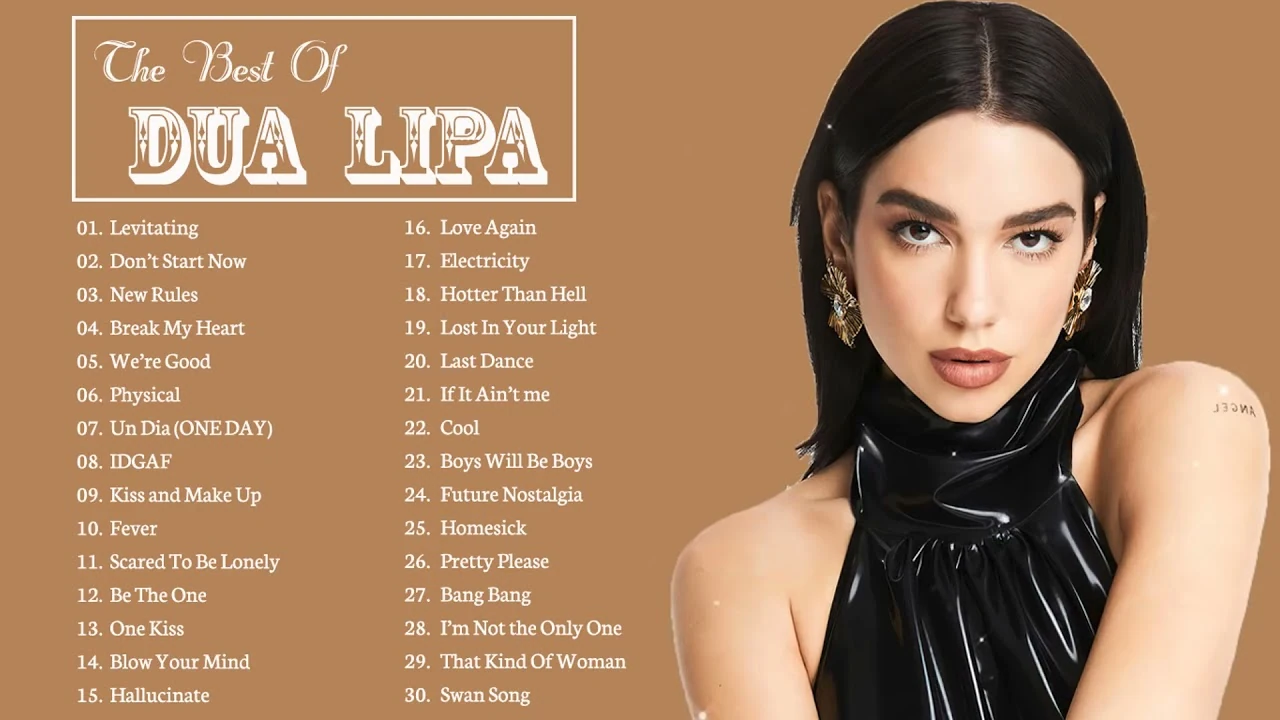
Future Nostalgia, released in 2020, brought a more overtly dance-oriented sound, drawing on the pop and disco music Lipa had listened to as a teenager. Its lead single, “Don’t Start Now”, reached number two in both the UK and the United States. After debuting at number two in Britain, the album moved to the top of the UK Albums Chart the following week. Its run of singles included “Physical”, “Break My Heart” and “Levitating”. The album won the Brit Award for British Album of the Year and the Grammy for Best Pop Vocal Album. These successes placed Lipa among the British artists whose recorded work travelled widely during a period when live performances were heavily disrupted.
Beyond the recording studio
Lipa has continued to work across music, screen and live performance. “Dance the Night”, released for the 2023 film Barbie, became a UK number-one single; she also made her acting debut in the film as Mermaid Barbie. She later appeared in the 2024 spy film Argylle. Her third studio album, Radical Optimism, followed in May 2024 and debuted at number one in the UK. Its singles included “Houdini”, “Training Season” and “Illusion”. In June that year, she headlined the Pyramid Stage at Glastonbury Festival.
Her projects also include Service95, a lifestyle newsletter and accompanying podcast launched in 2022. In 2016, she and her father co-created the Sunny Hill Foundation to support people in Kosovo experiencing financial hardship. The foundation’s work included the Sunny Hill Festival, first held in Pristina in 2018 as a fundraising event. The festival connected her public profile with a practical project in the country where her family had lived and to which she returned as a child.
Lipa’s musical identity is rooted in pop, with disco and house among the sounds associated with her work. She has cited artists including Kylie Minogue, Pink, Nelly Furtado, Jamiroquai and Prince as influences. Her career has also included fashion partnerships and modelling, but it is the progression between songs, records and performances that best explains her public profile: an early run of singles, an album that consolidated her sound, and later work that expanded her presence beyond recordings.
Recognition and representation
Lipa’s honours include seven Brit Awards and three Grammy Awards. Her early Brit wins recognised both her as an individual performer and her arrival as a new British artist; later awards acknowledged the achievement of Future Nostalgia. Her accolades reflect success in both the UK industry and the wider international music business, rather than a career confined to one chart or one album.
She has also spoken publicly about women’s equality and LGBT rights. At the 2018 Brit Awards, she welcomed the presence of women on stage and among the winners. Her public work has included support for a UK campaign calling for a ban on conversion therapy and appearances at events such as Sydney’s Gay and Lesbian Mardi Gras. Alongside these commitments, her connection to Kosovo remains visible through the Sunny Hill Foundation and festival. These strands of her public life are distinct, but together they show how she has used a large musical audience to draw attention to causes and communities important to her.
Why Dua Lipa deserves a place in British Legacy
Dua Lipa deserves a place in British Legacy because her career offers a clear account of how an artist raised and educated in London can shape contemporary British pop while drawing on a wider family and cultural history. The evidence of that achievement is concrete: a UK number-one with “New Rules”, sustained chart success with Future Nostalgia, major British and international awards, and headline performances including Glastonbury. Her route into the industry—singing lessons, online covers, early songwriting and a record deal—also gives the story its human scale without obscuring the work behind the success.
Her contribution is not limited to songs or awards. The Sunny Hill Foundation and its festival connect her profile to support for people in Kosovo, while her advocacy has included public support for women’s equality and LGBT rights. These activities add substance to her cultural reach: a career that crosses borders, but remains connected to London through her beginnings and to Kosovo through family, childhood and ongoing charitable work. That combination makes her British legacy specific rather than generic. Lipa’s story documents the international reach of a British pop career and the ways an artist can use that reach to sustain connections beyond the music industry.
Sources
Adapted in part from Dua Lipa by Wikipedia contributors, under CC BY-SA 4.0. Text has been edited and combined with the existing article; this adapted text is shared under the same licence. Contributor history.
.jpg)