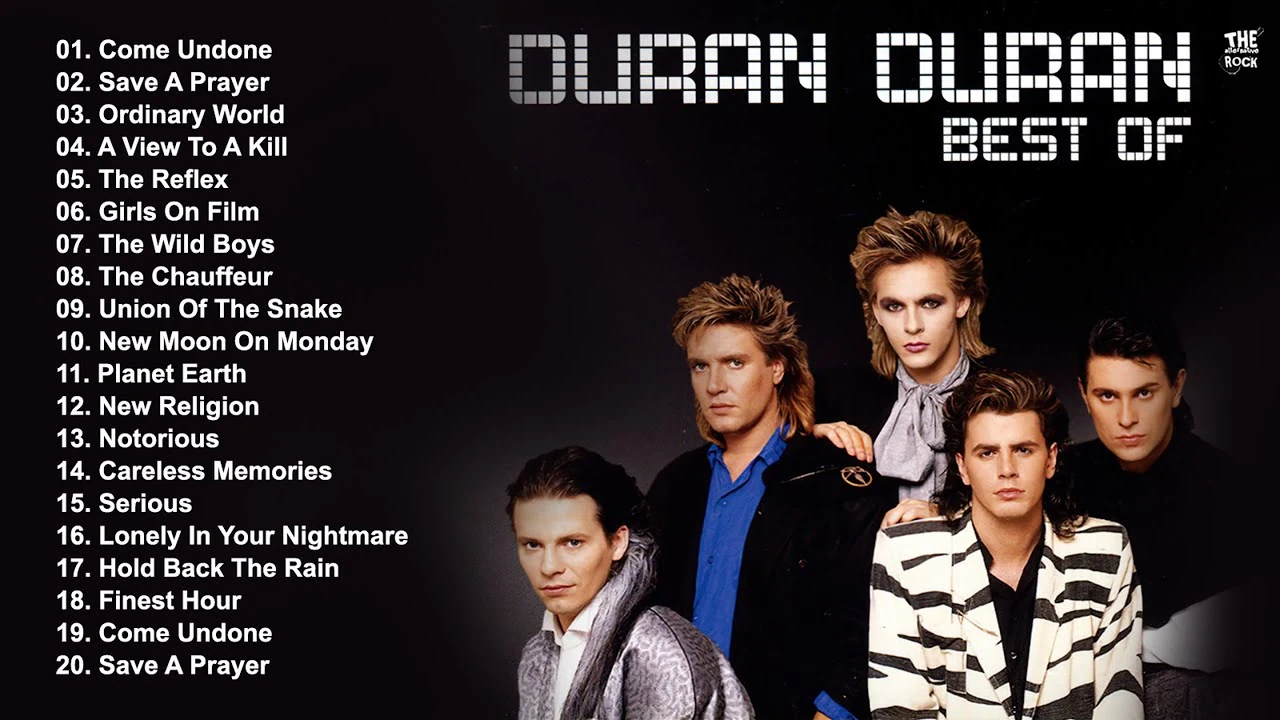
Duran Duran began in Birmingham in 1978, where keyboardist Nick Rhodes and guitarist John Taylor set about building a band that would combine pop songs with a distinctive visual identity. Early changes to the line-up preceded the arrival of singer Simon Le Bon, guitarist Andy Taylor and drummer Roger Taylor. By the early 1980s, the five had become one of the most visible British groups of their generation. Their success rested on more than image: songs including “Planet Earth”, “Rio” and “Ordinary World” carried the band through changing musical fashions, departures and reunions.
A band takes shape in Birmingham
Rhodes and John Taylor formed Duran Duran with singer and bassist Stephen Duffy. The name came from Dr Durand Durand, the character played by Milo O’Shea in the science-fiction film Barbarella. The three played their first gig at Birmingham Polytechnic in April 1979. Bassist Simon Colley joined soon afterwards, but he and Duffy left that June.
The group continued to change. Andy Wickett became its singer, Roger Taylor joined as drummer and John Taylor moved from guitar to bass. Guitarist Andy Taylor travelled from Newcastle to audition after seeing an advertisement in Melody Maker. In May 1980, Simon Le Bon, a London singer and drama student, was recommended to the band by someone working at Birmingham’s Rum Runner nightclub. The completed line-up of Le Bon, Rhodes and the three Taylors first performed together there in July.
The Rum Runner was more than a venue. Its owners became the band’s managers, and the members worked there as doormen, DJs and bar staff when they were not rehearsing. They wrote and developed material in Birmingham and London, then attracted record-company interest while supporting Hazel O’Connor on tour. In December 1980, they signed with EMI and went to London to record their debut album with producer Colin Thurston.
Albums, singles and the video era
The self-titled Duran Duran was released in 1981. “Planet Earth” reached number 12 in the UK singles chart; “Girls on Film” reached number five. The latter’s video, made by directing duo Godley & Creme, used provocative imagery and was heavily edited for MTV. It helped establish the band’s interest in video as a form with its own visual language, not merely a record of musicians performing.
The second album, Rio, arrived in 1982. It entered the UK chart at number four and reached number two the following week. Three of its singles—“Hungry Like the Wolf”, “Save a Prayer” and “Rio”—became UK top-ten hits. Their videos, directed by Russell Mulcahy, gave the songs cinematic settings and storylines. “Her name is Rio and she dances on the sand” became one of the group’s most recognisable lines, a compact example of the song’s vivid, immediate appeal.
The band’s videos also helped open a path into the United States. At first, Rio did not find the same audience there as it had in Britain. The album was remixed and reissued in the US, where MTV put “Hungry Like the Wolf” and other Duran Duran videos into heavy rotation. The single and album subsequently climbed the American charts; Rio eventually reached number six and spent 129 weeks on the US chart. MTV’s need for compelling new videos and Duran Duran’s cinematic approach proved well matched.
The group’s sound was not limited to one formula. Alongside synthesiser-led pop, it used dance and rock influences, and the members made extended “night versions” of songs for club audiences. In 1983, “Is There Something I Should Know?” became their first UK number-one single. That year’s Seven and the Ragged Tiger was their first UK number-one album. A Nile Rodgers remix of “The Reflex” became a number one in both the UK and the United States.
Side projects and a changing line-up
Success brought relentless touring and recording. Rather than move straight into another Duran Duran album, members explored two side projects. John and Andy Taylor joined singer Robert Palmer and Chic drummer Tony Thompson in the rock-funk group Power Station. Le Bon and Rhodes formed Arcadia, whose album So Red the Rose featured a range of collaborators, including Sting, Herbie Hancock and David Gilmour. Duran Duran regrouped to record “A View to a Kill” for the James Bond film of the same name. The single topped the US chart and reached number two in the UK.
The band also appeared on the 1985 Live Aid bill in Philadelphia. After that performance, the original five did not play live together again until 2003. Roger Taylor left in 1986, and Andy Taylor also departed. Le Bon, Rhodes and John Taylor continued as the group’s core, with guitarist Warren Cuccurullo and drummer Sterling Campbell joining as full-time members in 1989. Notorious (1986) and Big Thing (1988) marked a change in personnel and sound; the band’s late-1980s and early-1990s records found more moderate success than its breakthrough releases.
A second self-titled album, commonly called The Wedding Album, brought a renewed commercial response in 1993. Its singles “Ordinary World” and “Come Undone” became international hits. “Ordinary World” received an Ivor Novello Award for songwriting. John Taylor left in 1997, leaving Le Bon, Rhodes and Cuccurullo to continue as a trio. They released Medazzaland and Pop Trash before a further change brought the original five back together.
Reunion and continuing work
In 2001, John, Roger and Andy Taylor rejoined Le Bon and Rhodes. The reunited band tested its audience on tour before securing a new record deal. Astronaut, released in 2004, reached number three in the UK. The group received the Brit Award for Outstanding Contribution to Music that year and the Ivor Novello Award for Outstanding Contribution to British Music in 2005. Andy Taylor left again in 2006.
Duran Duran continued to record and tour through further changes in its working line-up. Later albums included All You Need Is Now (2010), Paper Gods (2015), Future Past (2021) and Danse Macabre (2023). The band’s return to Birmingham was particularly visible in 2022: it performed at the Platinum Party at the Palace and headlined the opening ceremony of the Birmingham Commonwealth Games. That year it was inducted into the Rock and Roll Hall of Fame. Le Bon, Rhodes, Roger Taylor and John Taylor attended the ceremony; Andy Taylor was absent.
Why Duran Duran deserves a place in British Legacy
Duran Duran deserves a place in British Legacy because its career links a particular British city and club scene to a major shift in international pop. The band formed and developed in Birmingham, where the Rum Runner provided a place to rehearse, perform and work. From that local beginning, its songs reached audiences in Britain and overseas. Its American breakthrough was not simply a matter of record promotion: the group’s carefully made videos suited MTV’s emerging format and helped bring British new wave to viewers beyond the reach of radio. The band treated visual presentation as part of its musical work, while retaining songs strong enough to endure beyond their first moment of exposure.
Its legacy also lies in a career that outlasted its original period of chart dominance. Membership changed, commercial fortunes fluctuated, and the group explored different sounds before the classic five-piece line-up reunited. Albums such as Astronaut and the later releases show that the band continued to make new work rather than rely solely on its 1980s catalogue. Its appearance at the 2022 Birmingham Commonwealth Games opening ceremony made its connection to the city of its formation tangible for a later audience. Together, the songs, the video work, the international reach and the continuing relationship with Birmingham make Duran Duran a significant part of Britain’s popular-music story.
Sources
Duran Duran — Wikipedia, revision 1377849107
Adapted in part from Duran Duran by Wikipedia contributors, under CC BY-SA 4.0. Text has been edited and combined with the existing article; this adapted text is shared under the same licence. Contributor history.