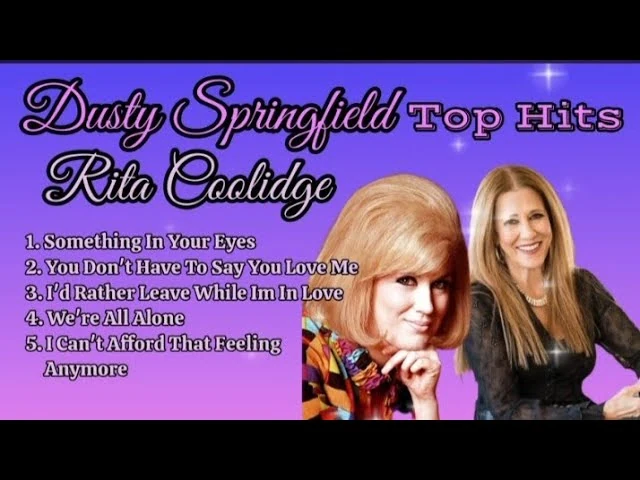
Dusty Springfield’s voice could make a pop song sound intimate and unsettled at once. Born Mary Isobel Catherine Bernadette O’Brien in West Hampstead on 16 April 1939, she moved from vocal groups to a solo career that brought British hits and success in the United States. Her best-known recordings include “You Don’t Have to Say You Love Me” and “Son of a Preacher Man”; her work also helped bring American soul and Motown performers to British television audiences.
Learning her craft in groups
Springfield grew up in a music-loving family, first in High Wycombe and later in Ealing. Her father encouraged her to recognise rhythms, and she listened to American jazz and popular song. After leaving school, she sang with her brother, Dion O’Brien, in local folk clubs. In 1958 she answered an advertisement in The Stage and joined the Lana Sisters, adopting the stage name Shann Lana. The group gave her experience in harmonising, microphone technique, recording and television performance.
In 1960, she left the Lana Sisters and formed the folk-pop trio the Springfields with her brother, who performed as Tom Springfield, and Tim Feild, later replaced by Mike Hurst. The group took its name after rehearsing in a field in Somerset. Its recordings included “Island of Dreams” and “Say I Won’t Be There”, both of which reached number five in the UK in 1963. The Springfields also found an audience in the United States with “Silver Threads and Golden Needles”.
The trio’s work took Springfield beyond the folk and country material with which it began. A visit to the United States, including Nashville, and hearing the Exciters’ “Tell Him” helped shape her move towards pop informed by rhythm and blues. She left the group after its final concert in October 1963 and began recording as a solo artist.
A solo voice, and a place on television
Her first solo single, “I Only Want to Be with You”, appeared in November 1963. With its prominent horns, backing singers and strings, it reached number four in the UK in January 1964 and number 12 in the United States. The success established a transatlantic pattern: Springfield’s records did not always chart in the same way on both sides of the Atlantic, but she became one of the British performers with a substantial American following.
Her first solo album, A Girl Called Dusty, followed in 1964. It included songs by other writers as well as “Somethin’ Special”, a song Springfield wrote. A series of singles brought further UK and US chart appearances. Among them, “I Just Don’t Know What to Do with Myself”, written by Burt Bacharach and Hal David, reached number three in the UK. “You Don’t Have to Say You Love Me”, adapted into English lyrics by Vicki Wickham and Simon Napier-Bell, became her first UK number one in 1966 and reached number four in the United States.
Springfield was also a visible presence on British television. She presented episodes of the ITV music programme Ready Steady Go! and hosted music series for the BBC and ITV. In April 1965, she hosted The Sound of Motown, a special edition of Ready Steady Go! featuring leading Motown acts, including the Supremes, Martha and the Vandellas, the Temptations and Stevie Wonder. The programme gave these performers an early national television showcase in Britain. Springfield’s enthusiasm for the music was more than a matter of repertoire: she helped bring its artists before a British audience.
Her own television work included the BBC series Dusty in 1966 and 1967 and the ITV programme It Must Be Dusty in 1968. Her performances and public image made her a recognisable figure of the Swinging Sixties. The peroxide-blonde beehive, dark eye make-up and evening gowns formed part of that image, but the recordings depended on the flexibility of her voice: she worked across pop, soul, jazz, country and ballads.
Memphis and a defining recording
In the late 1960s, Springfield’s position in the British music business was less secure. The charts were changing, her association with Bacharach and David had weakened, and much of her live work was on the touring circuit of clubs, hotels and cabarets. She signed with Atlantic Records in the United States and travelled to Memphis to record with producers Jerry Wexler, Tom Dowd and Arif Mardin, backed by the Sweet Inspirations and the Memphis Boys.
The sessions produced Dusty in Memphis, released in 1969. Its lead single, “Son of a Preacher Man”, had appeared the previous November. Written by John Hurley and Ronnie Wilkins, it reached number nine in the UK and number 10 in the United States. The album did not initially match the single’s chart success, but it became one of Springfield’s most enduring works. The United States Library of Congress added it to the National Recording Registry in 2020, recognising recordings considered culturally, historically or aesthetically significant.
Springfield’s career did not then follow a straightforward path back to the top of the charts. Her releases in the 1970s achieved more modest results, and she spent periods away from the public eye. Albums included A Brand New Me, Cameo, It Begins Again and Living Without Your Love. In 1982 she released White Heat, an album shaped by new-wave music. These changes show a singer continuing to work through shifting styles even when her commercial fortunes were less certain.
A late return and recognition
In 1987, Springfield returned to the upper reaches of the charts through her collaboration with the British duo Pet Shop Boys. “What Have I Done to Deserve This?”, a duet with Neil Tennant, reached number two in both the UK and the United States. The collaboration led to further Pet Shop Boys-produced recordings: “Nothing Has Been Proved”, written for the film Scandal, and “In Private”. Her 1990 album Reputation brought another UK top 20 studio-album placing.
Springfield’s final studio album, A Very Fine Love, was released in 1995. She had begun recording in Nashville in 1994, when she became ill and was diagnosed with breast cancer. The cancer later returned. She died in Henley-on-Thames on 2 March 1999, aged 59. An Officer of the Order of the British Empire for services to popular music was conferred on her shortly before her death; friends collected the award on her behalf. She was inducted into the Rock and Roll Hall of Fame two weeks after her death, and later into the UK Music Hall of Fame.
Why Dusty Springfield deserves a place in British Legacy
Springfield’s place in British music rests on more than a sequence of hit singles. She carried a British solo career into the American charts at a time when the British Invasion was drawing attention to performers from the UK. “I Only Want to Be with You” and “You Don’t Have to Say You Love Me” demonstrate the breadth of that achievement, while “Son of a Preacher Man” and Dusty in Memphis show how she could make material recorded with American musicians central to her own catalogue. Her success did not depend on remaining within one sound: she moved from folk-pop group work through soul-inflected records to a late-career partnership with Pet Shop Boys.
Her contribution to British popular culture also extended beyond her records. As a presenter on Ready Steady Go!, she helped put Motown artists before a national television audience, connecting British viewers with music that would influence subsequent listening and performance. Her own television programmes made her a regular public presence, while her unmistakable stage style and emotionally direct singing helped define the image associated with the Swinging Sixties. Later honours, including the OBE and her inductions into music halls of fame, recognise a career whose influence reached across decades. Remembering Springfield in British Legacy means recognising both a major British recording artist and a performer who helped widen the audience for soul music in Britain.
Sources
Dusty Springfield — revision 1378854130 · Dusty Springfield
Adapted in part from Dusty Springfield by Wikipedia contributors, under CC BY-SA 4.0. Text has been edited and combined with the existing article; this adapted text is shared under the same licence. Contributor history.