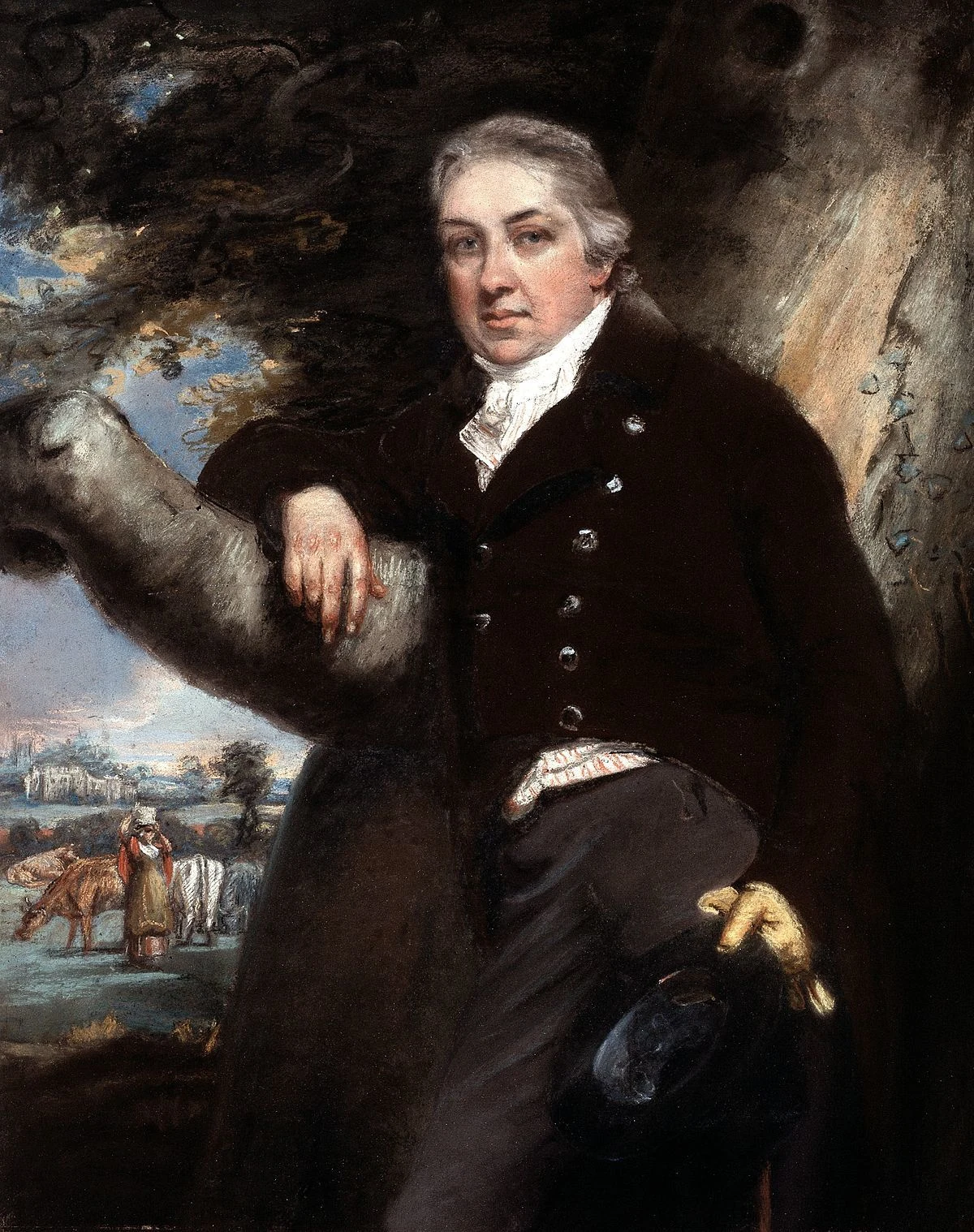
Edward Jenner’s work on smallpox vaccination began with an observation about cowpox: milkmaids who had contracted the milder disease appeared less likely to catch smallpox. In 1796, he tested that idea by inoculating eight-year-old James Phipps with material from a cowpox sore. The experiment became a landmark in the development of vaccination, a practice that would ultimately contribute to the eradication of smallpox.
A country physician in Gloucestershire
Jenner was born in Gloucestershire in 1749, the son of a vicar. He entered medicine through an apprenticeship with a country surgeon before studying surgery and anatomy at St George’s Hospital in London. He later returned to Berkeley, where his medical practice and observations of rural life brought him into contact with the experience of local people.
Smallpox was a serious threat in eighteenth-century Europe, causing deaths as well as lasting disfigurement. Jenner’s attention turned to reports that milkmaids who had caught cowpox seemed protected from it. Cowpox was relatively mild by comparison, and the apparent difference between the two diseases suggested a possible means of protection. The idea did not yet amount to proof, but it gave Jenner a question he could investigate.
The 1796 experiment and vaccination
In 1796, Jenner took material from a cowpox sore on the hand of milkmaid Sarah Nelmes and inoculated it into the arm of James Phipps, then eight years old. The supplied account says that Phipps was later exposed to smallpox and did not become ill. Jenner’s procedure gave practical form to the observation about cowpox and helped establish the method that came to be called vaccination, a name derived from the Latin vacca, meaning cow.
Jenner published his findings and advocated the use of the procedure. His work met scepticism and opposition, but vaccination gained wider acceptance. The process was a response to a particular disease, rather than a modern vaccine programme: its historical importance lies in showing how an observation about one infection could inform protection against another. Jenner’s contribution became an important starting point for the development of vaccination, although later vaccines and public-health work depended on much more than his experiment alone.
From a medical procedure to a public-health landmark
Smallpox was declared eradicated by the World Health Organisation in 1980. That global achievement followed a long campaign and the work of many people; it should not be attributed to Jenner alone. His vaccination method nevertheless belongs to the history that made protection against smallpox possible. The distinction matters: Jenner did not eradicate the disease, but his work helped open a route towards a preventive practice that was later adopted on a much larger scale.
The supplied account describes vaccination as having saved millions of lives and identifies Jenner’s approach as foundational to later vaccine development. Those claims express the reach of his influence, while the specific evidence presented here centres on his observation, the 1796 experiment, publication and the eventual eradication of smallpox. This more precise account recognises both the significance of Jenner’s contribution and the collective nature of the public-health achievement that followed.
Why Edward Jenner deserves a place in British Legacy
Jenner’s place in British Legacy rests on a particular achievement, not on a general claim of national character. Working as a country physician in Gloucestershire, he turned an observation associated with local experience into an experiment with consequences far beyond his own practice. His work helped establish vaccination as a means of preventing disease and became an important part of the history leading to the eventual eradication of smallpox.
That legacy is worth presenting with care. Jenner’s experiment was a beginning, not the whole story: the eradication of smallpox required later vaccination programmes and collective public-health action. Remembering both points gives a fuller account of how medical progress happens. Jenner’s contribution shows the value of noticing a pattern, testing an idea and sharing findings; the later global campaign shows how such knowledge can be extended through organised work. Together, these details explain why a physician practising in rural England has a place in a British account of medicine’s influence on public health.