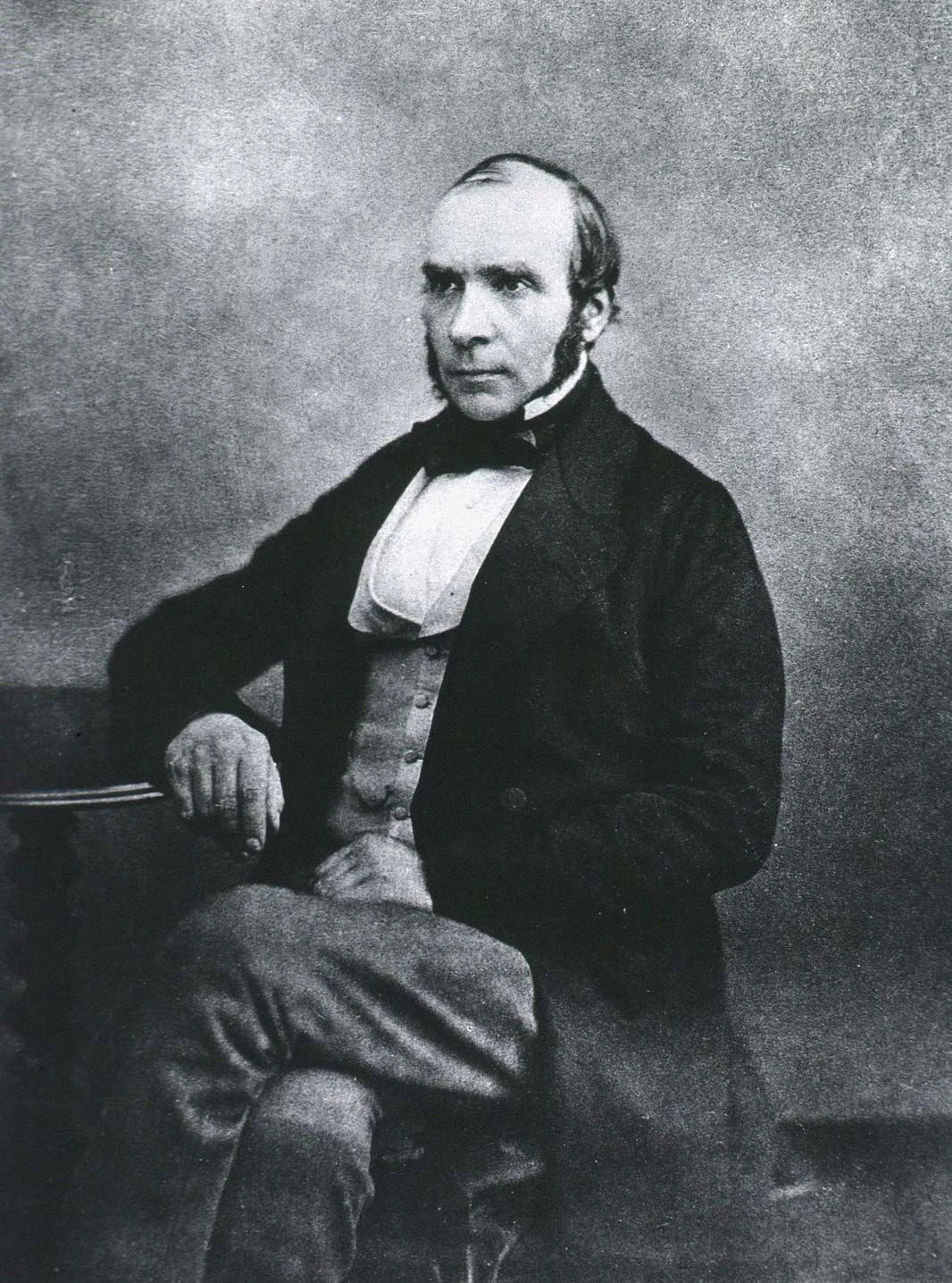
John Snow’s investigation of cholera in Soho is often remembered through a single image: a pump handle removed from a London street. The episode was more complex than that familiar shorthand. Snow mapped cases, spoke to residents and compared water supplies to argue that cholera was being spread through contaminated water, not bad air. His work became a landmark in epidemiology, but it was one part of a career that also helped make the use of ether and chloroform in surgery and childbirth more considered and established.
From York to medical practice in London
Snow was born in York on 15 March 1813, the first of nine children of William and Frances Snow. His father worked as a labourer at a coal yard and later became a farmer. Snow grew up in a poor neighbourhood exposed to flooding and unsanitary conditions. At 14, he began a medical apprenticeship with William Hardcastle near Newcastle-upon-Tyne. His early training brought him into contact with cholera: while working as an apprentice in 1832, he treated victims of an outbreak in the mining village of Killingworth.
Snow worked as an assistant to a colliery surgeon in County Durham and Yorkshire before enrolling at the Hunterian School of Medicine in London in 1836. He began work at Westminster Hospital the following year, became a member of the Royal College of Surgeons of England in 1838, graduated from the University of London in 1844 and was admitted to the Royal College of Physicians in 1850. He established a practice in Soho, at 54 Frith Street, and took part in the Westminster Medical Society, where members discussed clinical and scientific questions.
Cholera remained a subject of study throughout his career. Snow was also a founding member of the Epidemiological Society of London, established in 1850 in response to the cholera outbreak of 1849. Medical practice, professional discussion and direct experience of epidemics shaped his approach: he sought to test explanations against observation rather than accept them solely because they were widely held.
Anaesthesia and the work of making it safer
Snow’s medical work extended well beyond cholera. From 1843, he experimented with ether and studied its effects on breathing. After ether was introduced to Britain, he published a practical guide to its use in 1847. He became a leading anaesthetist, developing equipment to administer ether and studying the dosage and effects of both ether and chloroform. Chloroform was potent and required particular care.
In 1848, after a 15-year-old patient, Hannah Greener, died following chloroform administration for a toenail operation, Snow investigated the death and reported his conclusions in a letter to The Lancet. He argued for greater care in administering the drug. His work included obstetric as well as surgical anaesthesia: he treated 77 obstetric patients with chloroform and favoured controlled administration that did not necessarily render a woman fully unconscious.
On 7 April 1853, Snow administered chloroform to Queen Victoria during the birth of her eighth child, Prince Leopold. He did so again at the birth of Princess Beatrice in 1857. The Queen’s use of chloroform helped broaden acceptance of anaesthesia in childbirth, though Snow’s contribution rested on years of practical work and published observation, not on royal approval alone. He did not patent his anaesthetic work; he published his findings and continued his investigations.
Following the evidence in Soho
In the mid-nineteenth century, many people attributed illnesses such as cholera to miasma: harmful air or vapours. Snow doubted this explanation. He set out his argument for a different mode of transmission in an 1849 essay, then developed it in a more detailed 1855 treatise drawing on the Soho epidemic of 1854. He did not know the later germ theory of disease, but he believed the pattern of cases pointed to contaminated water.
With help from local curate Henry Whitehead, Snow spoke to residents and examined where deaths had occurred in relation to the Broad Street pump, now on Broadwick Street. He used a dot map to display the cluster of cases and statistics to compare cholera rates among households supplied by different water companies. Homes served by the Southwark and Vauxhall Waterworks Company, which drew water from polluted stretches of the Thames, had a cholera rate fourteen times that of homes supplied by the Lambeth Waterworks Company, which drew from the cleaner, upriver site at Seething Wells.
Snow presented his findings to the parish board of guardians, and the pump handle was removed on 8 September 1854. The removal became an enduring symbol of public-health action, but it should not be mistaken for proof that the intervention alone ended the outbreak. Snow observed that the epidemic had already declined before the handle was taken away and that people were leaving the area. The strength of his case lay in the accumulated evidence about water and illness, rather than in a simple claim that one act immediately stopped the epidemic.
His explanation was not promptly accepted. Officials later replaced the handle and rejected his account. In 1866, during another cholera outbreak, William Farr—previously an opponent of Snow’s explanation—recognised the role of contaminated water and advised people not to drink unboiled water. Snow’s findings contributed to changes in London’s water and waste systems and influenced public-health thinking beyond the city.
Other investigations, final years and remembrance
Snow’s interests included other medical and public-health questions. In 1857, he published a pamphlet on the adulteration of bread as a cause of rickets, an early contribution to epidemiology that has received less attention than his cholera work. Across these subjects, he collected observations and used them to investigate possible causes.
Snow never married. He suffered a stroke while working in his London office on 10 June 1858 and died six days later, aged 45. He was buried in Brompton Cemetery. Speculation that his premature death was related to exposure to anaesthetic gases is not established by the supplied account and is not presented as fact.
His name remains attached to places and institutions commemorating his work. A plaque marks the Broad Street pump site, where the pump’s position is indicated by red granite; a nearby public house and the John Snow Society also bear his name. The society’s annual Pumphandle Lecture uses the pump-handle story to draw attention to continuing challenges in public health. In York, a memorial featuring a pump with its handle removed stands near his birthplace, and a plaque commemorates him at the west end of the Park Inn in North Street.
Recognition has also extended into medical education and professional life. The Royal College of Anaesthetists includes Snow among its heraldic supporters, and the Association of Anaesthetists of Great Britain and Ireland awards a John Snow bursary for undergraduate research in anaesthesia. These commemorations reflect both strands of his work: the investigation of disease and the development of anaesthetic practice.
Why John Snow deserves a place in British Legacy
John Snow’s place in British history rests on practical work that connected medical observation with the conditions in which people lived. In Soho, he did not rely on a theory simply because it was widely accepted. He used residents’ accounts, mapped deaths and compared water supplies to make a case for a different explanation of cholera. His reasoning helped establish an approach to investigating outbreaks that remains central to epidemiology: look for patterns, test explanations against evidence and identify conditions that can be changed. The pump handle is a memorable symbol, but the lasting achievement was the investigation behind it—and the insistence that public-health decisions should be informed by evidence.
Snow’s legacy is broader than the cholera inquiry. His careful study of ether and chloroform, his attention to their administration and his contribution to obstetric anaesthesia helped make medical procedures less painful and the use of anaesthetics more considered. His career joined clinical practice, research and public-health argument at a time when those fields were still developing. The water-supply comparison in Soho made the link between living conditions and illness visible in evidence that could be used to challenge prevailing explanations. The memorials in London and York, the recognition from British anaesthetic institutions and the continuing lecture named for him keep that work in public view. Remembering Snow is not a claim that one individual solved every problem; it is recognition of how patient investigation can challenge assumptions and contribute to better understanding of health.
Sources
Adapted in part from John Snow by Wikipedia contributors, under CC BY-SA 4.0. Text has been edited and combined with the existing article; this adapted text is shared under the same licence. Contributor history.