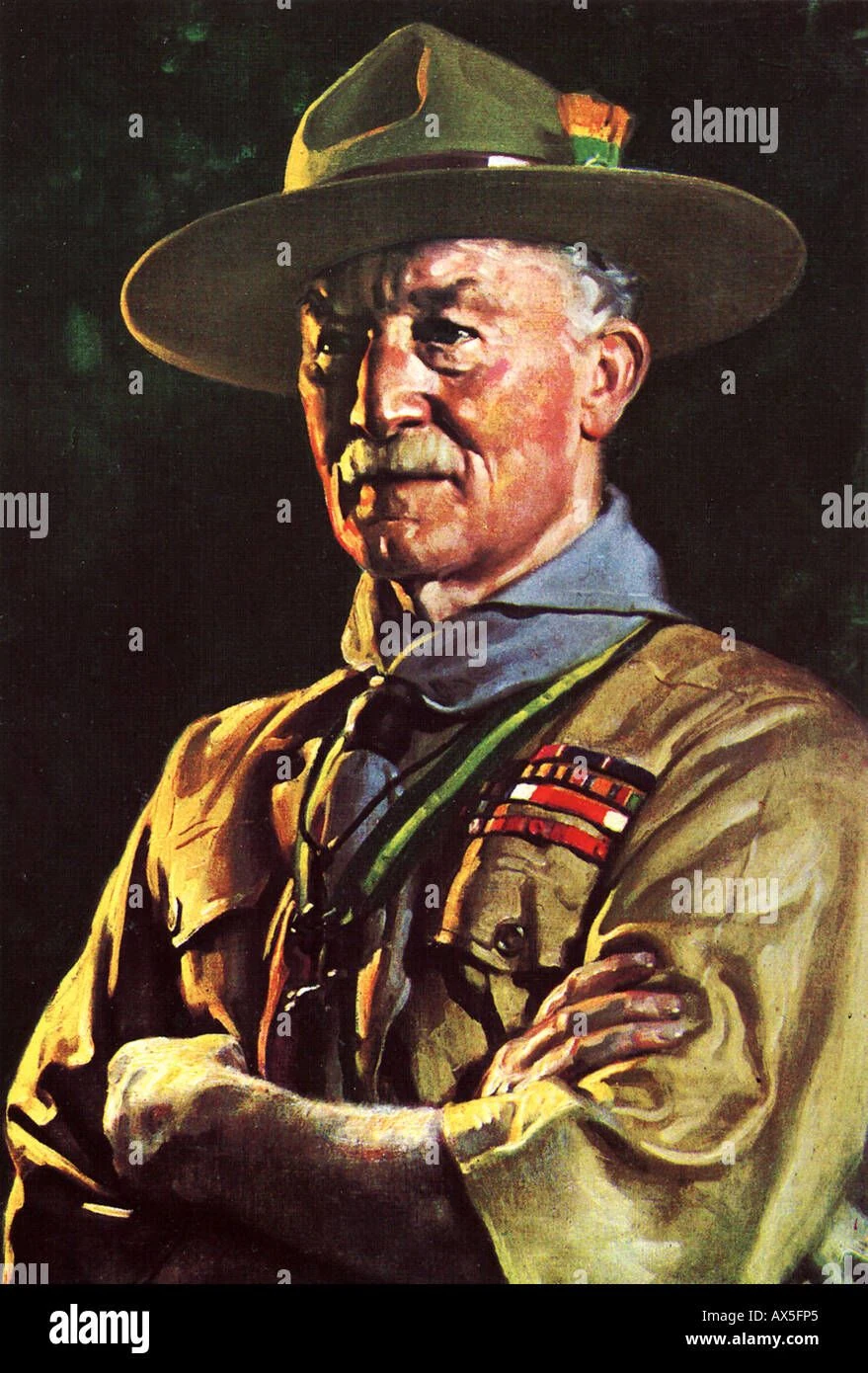
Robert Baden-Powell’s route from the British Army to youth education ran through a military training manual. Its practical lessons in observation and scouting attracted readers beyond the soldiers for whom it was written. In 1907, he tested how those ideas might work with boys at a camp on Brownsea Island, Dorset. The following year, Scouting for Boys helped turn the experiment into a movement that spread across Britain and beyond.
A soldier who wrote for a wider audience
Born in Paddington, London, on 22 February 1857, Robert Stephenson Smyth Baden-Powell was the son of Baden Powell, a professor of geometry at the University of Oxford, and Henrietta Grace Smyth. His father died when he was three. He attended Rose Hill School in Tunbridge Wells before winning a scholarship to Charterhouse, then in the City of London and later in Surrey. At school he developed an interest in drawing and outdoor pursuits, including stalking and cooking game in nearby woods.
Baden-Powell joined the 13th Hussars in 1876 and served in India and Africa. His military career included campaigns in South Africa and the Gold Coast, as well as intelligence and reconnaissance work. He published Reconnaissance and Scouting in 1884. A later manual, Aids to Scouting for N.-C.Os and Men, gathered lessons from military training. After returning to Britain, he discovered that this work had found readers among teachers and youth organisations, not only soldiers.
His reputation was shaped by the 217-day siege of Mafeking during the Second Boer War. Baden-Powell commanded the British garrison in the South African town until it was relieved in May 1900. The siege brought him national attention and promotion to major-general. The episode also had a human cost and a more complicated military record than a simple tale of heroism suggests. The supplied account notes criticism of his decisions, including the consequences for African soldiers and civilians, and records that historian Thomas Pakenham later revised his view of the rationing of the African garrison.
Among the duties performed during the siege were those of the Mafeking Cadet Corps, made up of white boys below fighting age. They carried messages and assisted in hospitals, among other tasks. Baden-Powell later used their example in Scouting for Boys, although the source does not establish that he had formed the corps or paid it close attention at the time. His return to Britain in 1903 brought him to the post of Inspector-General of Cavalry. He was promoted to lieutenant-general in 1907 and retired from the Army in 1910.
Brownsea Island and a movement in print
The military manual’s unexpected popularity gave Baden-Powell a reason to reshape his material for young readers. In August 1907, he held an experimental camp on Brownsea Island. About twenty boys attended: some came from local Boys’ Brigade companies, while others were sons of his friends who attended public schools. The camp tested ideas about practical skills, outdoor activity and training in scouting; it was not yet a national organisation.
Scouting for Boys appeared in 1908, initially in six instalments. It drew on his earlier publications and his experience of military scouting, but addressed boys rather than recruits. Its rapid readership helped give shape to a movement that had already begun to form spontaneously as boys organised Scout troops. By the end of 1908, Scouting had become a nationwide phenomenon, and it soon spread internationally. Baden-Powell’s role was not simply to announce a new organisation: he supplied a set of ideas and a publication that young people and groups could put into practice.
The movement continued to grow after its launch. A Scout rally at Crystal Palace in 1909 brought Baden-Powell face to face with girls who had organised themselves as Scouts. In 1910, he and his sister Agnes established the Girl Guides Association. The account of the movement’s origins therefore includes the initiative of girls themselves, as well as the work of the Baden-Powells. His wife, Olave, whom he married in 1912, later became World Chief Guide and played a major role in Guiding.
Building organisations, not just writing books
Baden-Powell continued to guide Scouting and Guiding for decades. At the 1937 World Scout Jamboree, he said farewell to Scouting and retired from public Scouting life. By 1922, there were more than a million Scouts in 32 countries; by 1939, the number had risen to more than 3.3 million, according to the supplied Wikipedia account. Those figures show how far the movement had travelled from a small camp on an island off Dorset.
His writing helped sustain that expansion. Alongside Scouting for Boys, he produced books and handbooks for Scouts, Guides and their leaders, including The Wolf Cub’s Handbook, Girl Guiding and Aids to Scoutmastership. He also wrote about his military experiences, drew and painted, and made sketches that appeared in his books. His work was practical and varied: it ranged from military instruction to guidance for youth organisations and illustrations intended to explain or enliven the text.
Scouting’s history was not isolated from the wider politics of the twentieth century. The supplied account records that Nazi Germany banned Scouting in 1934 and treated it as a rival to the Hitler Youth. It also describes Baden-Powell’s views and meetings in the 1930s, including diary entries about Mussolini and Hitler. These details complicate any uncomplicated portrait of him as a universal champion of democratic values. They belong alongside, rather than in place of, the documented history of the organisations he helped establish.
His final years and the movement’s reach
In 1939, Baden-Powell and Olave moved to a cottage near Nyeri in Kenya, where he had previously gone to recuperate. He died there on 8 January 1941, aged 83, and was buried at St Peter’s Cemetery in Nyeri. His grave was later declared a national monument by the Kenyan government. Olave returned to England in 1942; after her death in 1977, her ashes were taken to Kenya and buried beside her husband.
Baden-Powell’s public recognition included appointment to the Order of Merit in 1937. He also received honours from other countries and awards connected with Scouting, including the first Bronze Wolf Award, presented in 1935. His reputation, however, rests less on the accumulation of awards than on the organisations and publications through which his ideas travelled. The Scout and Guide movements have changed over time; claims that they uniformly embody particular modern ideals should not be confused with the more firmly documented fact of their international reach and continuing development.
Why Robert Baden-Powell deserves a place in British Legacy
Baden-Powell’s place in British Legacy rests on a specific achievement: he helped turn military training material into a form of youth education that young people and organisations could adopt for themselves. The 1907 Brownsea Island camp tested those ideas in a British setting; Scouting for Boys, published in 1908, carried them to a far wider readership. The result was not confined to Britain. The movement’s growth from locally formed troops to millions of Scouts across dozens of countries shows the reach of a programme first developed and published here.
His legacy also includes the Girl Guides Association, founded with his sister Agnes in 1910 after girls had already begun organising as Scouts. That history recognises both the Baden-Powells’ role and the initiative of the young people who helped shape the movement. Scouting and Guiding offered structured opportunities to learn practical skills and take part in organised youth groups; their scale made those opportunities influential well beyond their British beginnings. A balanced account should also retain the difficult history: Baden-Powell’s military career, his views, and the unequal colonial setting in which parts of it unfolded cannot be reduced to a celebration of service. British Legacy can recognise the lasting institutional achievement without treating the man or the movements as beyond criticism.
Sources
Robert Baden-Powell, 1st Baron Baden-Powell — revision 1376672777
Adapted in part from Robert Baden-Powell, 1st Baron Baden-Powell by Wikipedia contributors, under CC BY-SA 4.0. Text has been edited and combined with the existing article; this adapted text is shared under the same licence. Contributor history.