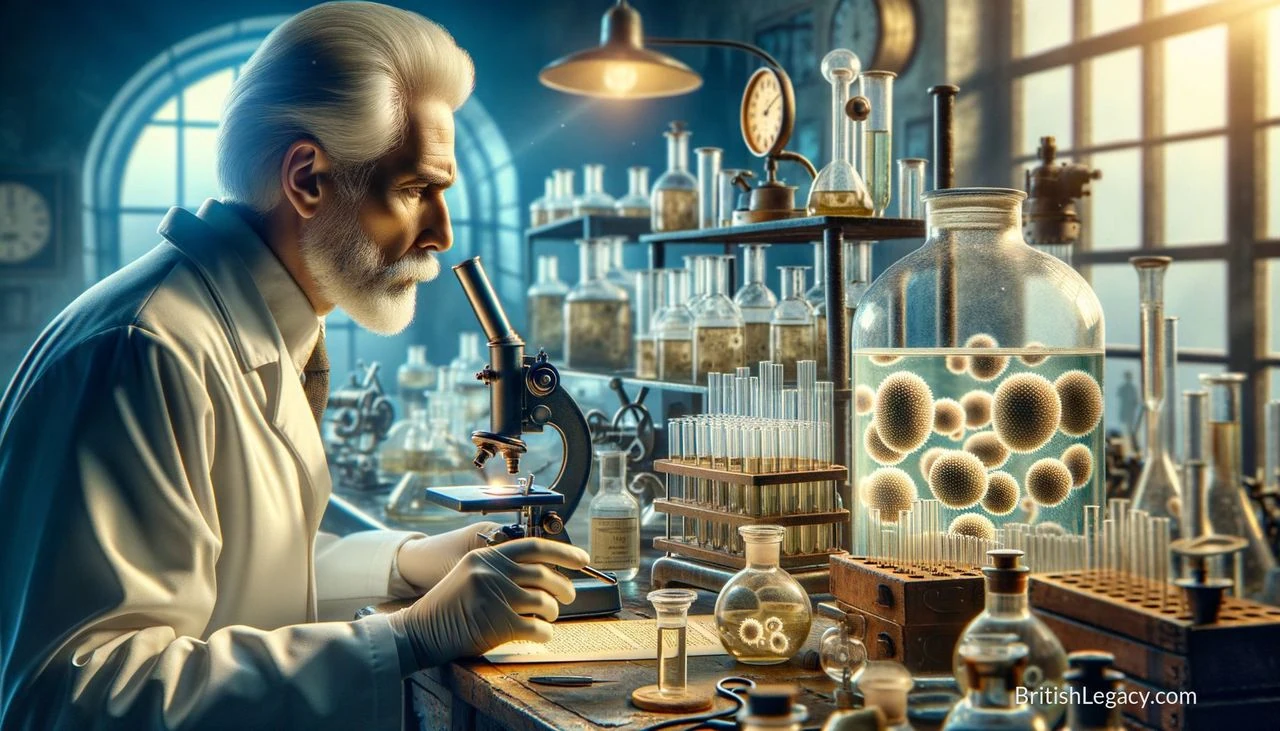
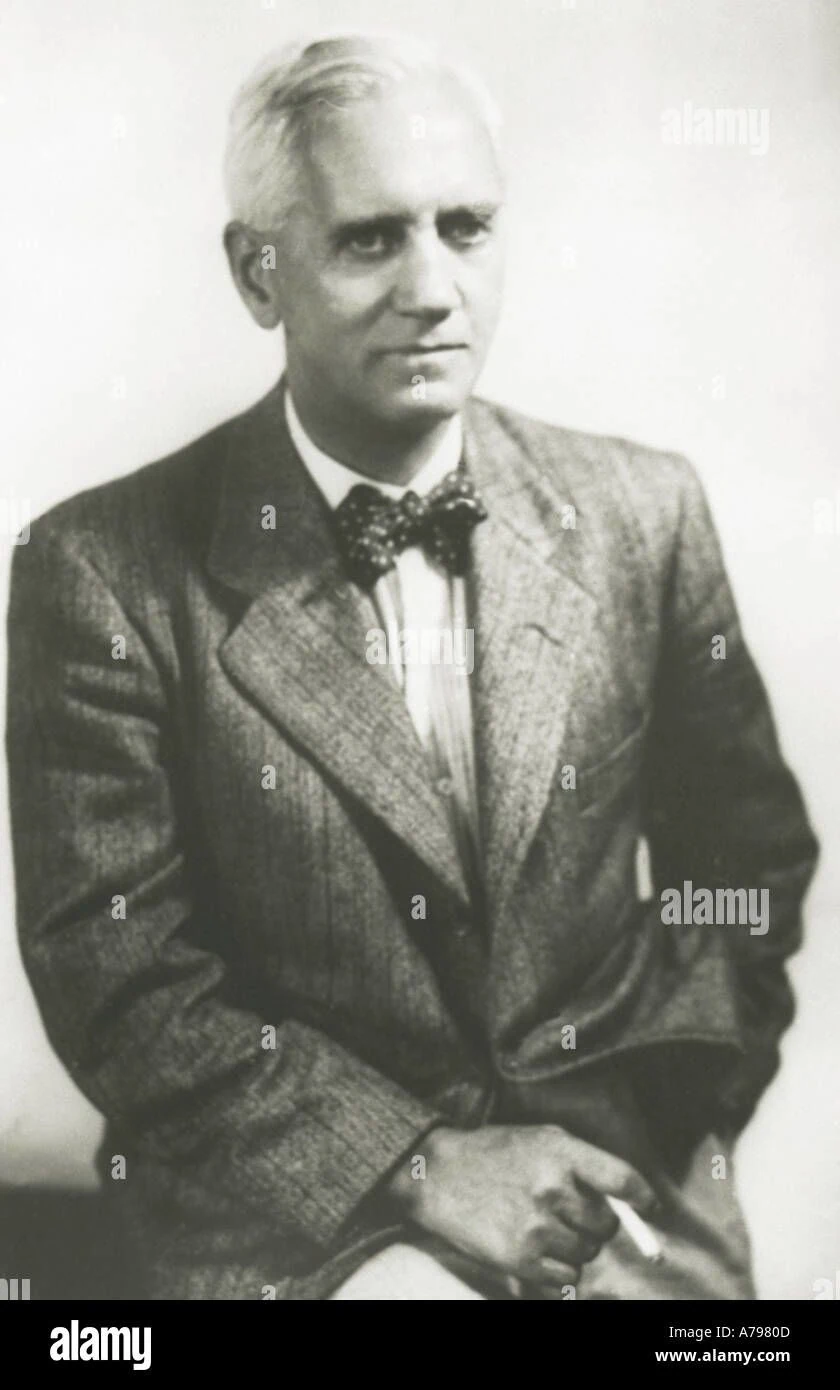
In 1928, Alexander Fleming returned to his laboratory at St Mary’s Hospital in London and found a mould growing on a culture plate of staphylococci. Bacteria had disappeared close to the mould, while colonies farther away remained. Fleming investigated the effect and named the active substance penicillin. The observation was his; making penicillin into a medicine that could be produced and used at scale required years of further work by Fleming and other scientists.
From Ayrshire to St Mary’s
Fleming was born on 6 August 1881 at Lochfield farm near Darvel, Ayrshire. He was the third of four children of farmer Hugh Fleming and Grace Stirling Morton. His father died when Alexander was seven. Fleming attended Loudoun Moor School and Darvel School, then won a two-year scholarship to Kilmarnock Academy. At 13 he moved to London, where he attended the Royal Polytechnic Institution.
After four years working in a shipping office, Fleming inherited money from an uncle. His elder brother Tom, a doctor, encouraged him to follow a medical career. In 1901 he enrolled at St Mary’s Hospital Medical School, qualifying in 1906. He had initially considered surgery, but a place in the hospital’s research department drew him towards bacteriology. He became an assistant to Sir Almroth Wright, whose work concerned vaccine therapy and immunology. Fleming gained a bacteriology degree with a gold medal in 1908 and went on to lecture at St Mary’s.
During the First World War, Fleming served in the Royal Army Medical Corps, working in battlefield hospitals in France. There he saw soldiers die of infections in their wounds. His observations led him to question the use of antiseptics: in deep wounds, he argued, they could do more harm than good, because they might damage the body’s defences without reaching bacteria sheltered in the wound. His 1917 account in The Lancet drew on experiments he devised to explain the problem.
Two discoveries at St Mary’s
Fleming’s work on antibacterial substances began before the penicillin discovery. In 1921, he found that nasal mucus could inhibit bacterial growth. He tested other bodily fluids and identified the active substance as an enzyme, which he named lysozyme. The discovery did not lead to a treatment: the enzyme acted against relatively harmless bacteria, rather than the disease-causing organisms he hoped to control. It nevertheless formed an early part of his research into how bacteria could be checked.
The penicillin observation came in September 1928. Fleming had inoculated culture plates with staphylococci before leaving for a holiday. On his return, he noticed that one plate had been contaminated by a fungus. The bacterial colonies nearest to it had been destroyed, while those farther away continued to grow. Fleming cultivated the mould and tested the substance it produced against different organisms. He found it affected several disease-causing bacteria, though not all. In March 1929 he gave the substance the name penicillin; later research identified the mould as Penicillium rubens.
Fleming published his findings in 1929, but the paper attracted little attention. The substance was difficult to isolate and produce in useful quantities. He continued investigating it, but the practical challenge of turning a mould-derived substance into a stable medicine remained unresolved. His early discovery should not be mistaken for the completion of the drug’s development.
From laboratory finding to medicine
That next stage was taken up by a team at the University of Oxford. Howard Florey, Ernst Chain, Edward Abraham, Norman Heatley and colleagues worked on purifying and stabilising penicillin, developing methods that made animal tests and clinical trials possible. Their results in 1940 encouraged work towards larger-scale production. Fleming had kept and distributed the original mould and continued to study penicillin; the Oxford team’s work made it possible to use the substance as a treatment.
Penicillin’s medical promise became clear during the war. In 1942, Fleming treated Harry Lambert, who was critically ill with streptococcal meningitis, using a sample supplied by Florey. Lambert recovered. The case helped draw attention to the drug’s potential, and the British government established a committee to organise production. Collaboration with American companies helped increase supplies. By the Allied landings in Normandy in 1944, enough penicillin had been produced to treat wounded Allied troops.
Fleming also warned that careless use could encourage resistant bacteria. In speeches and in his 1945 Nobel lecture, he cautioned against taking too little penicillin or using it for too short a time. His warning addressed a consequence of the medicine’s success: bacteria exposed to inadequate doses could become harder to treat. Antibiotics were not a licence for indiscriminate use.
Honours and a lasting record
Fleming shared the 1945 Nobel Prize in Physiology or Medicine with Florey and Chain. He was elected a Fellow of the Royal Society in 1943 and knighted in 1944. In 1951 he became rector of the University of Edinburgh for a three-year term. His London laboratory at St Mary’s Hospital is preserved as the Alexander Fleming Laboratory Museum, keeping the setting of his discovery accessible to visitors.
Fleming died at his London home on 11 March 1955, aged 73. His ashes were buried in St Paul’s Cathedral. He had married Sarah Marion McElroy in 1915; after her death, he married Amalia Koutsouri-Vourekas in 1953. The history of penicillin is sometimes reduced to a lucky accident, but Fleming himself referred to the public story of his sole responsibility as the “Fleming myth”. His discovery, the work that followed and the shared effort behind the medicine belong together.
Why Alexander Fleming deserves a place in British Legacy
Fleming’s place in British history rests on a specific achievement: at St Mary’s Hospital in London, he recognised that a mould could destroy bacteria and pursued the observation far enough to identify and name penicillin. His earlier research on lysozyme and his wartime investigation of antiseptics show that the discovery was part of a sustained career in bacteriology, not an isolated moment of luck. He also published his findings and preserved and shared the mould, leaving material for other researchers to investigate.
The story matters just as much for what happened next. Fleming did not, on his own, turn penicillin into a medicine that could be manufactured and distributed. Florey, Chain, Heatley, Abraham and their colleagues developed methods for purification and production; wartime cooperation helped bring supplies to Allied forces. Recognising that collective work gives a more accurate account of scientific progress and honours the contribution of British research institutions and collaboration. Penicillin transformed the treatment of bacterial infections, while Fleming’s warnings about resistance remain a practical reminder that a powerful treatment can lose its effectiveness if used carelessly. His legacy combines discovery, scientific teamwork and an enduring public-health lesson.
Sources
Alexander Fleming — Wikipedia, revision 1375868973
Adapted in part from Alexander Fleming by Wikipedia contributors, under CC BY-SA 4.0. Text has been edited and combined with the existing article; this adapted text is shared under the same licence. Contributor history.