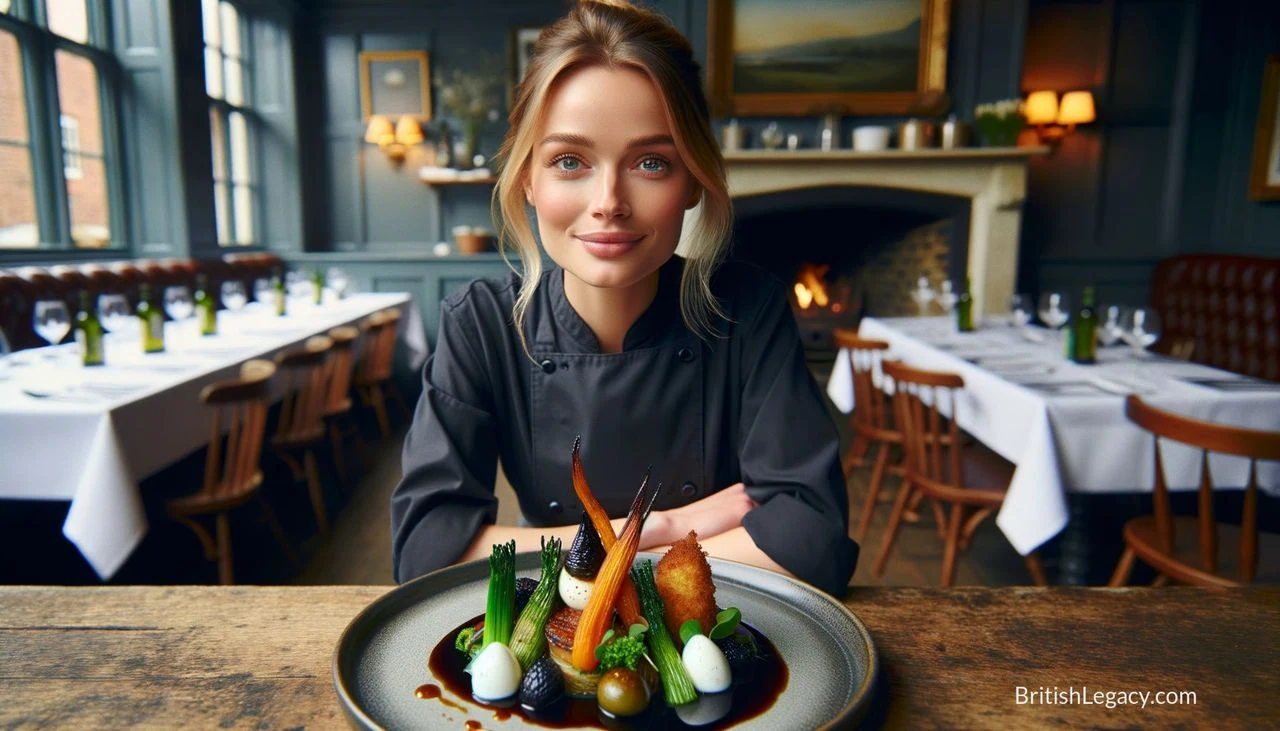
Emily Watkins’s career has taken her from helping in her mother’s country-house hotel in Dorset to professional kitchens in Florence and at The Fat Duck, then to a restaurant of her own in Gloucestershire. At The Kingham Plough, she cooked familiar British dishes with twists and local ingredients. Her 2014 appearance on Great British Menu brought that approach to a national television audience; the restaurant, which she later sold, remains the defining venture of her career.
An early interest becomes a profession
Watkins grew up around food. Her mother ran a country-house hotel in Dorset, where Watkins and her sisters sometimes helped. Although she was interested in cooking, she was initially steered away from making it her profession. She went to university and then spent six months working in an office. That first route did not hold her: she left and travelled to Italy, hoping to find a kitchen willing to take on a chef without experience.
In Florence, she found work at Ristorante Beccofino. She began front of house, spending two days a week in the kitchen, before moving fully into a cooking role after two months. Within two years she had become a junior sous chef and learnt to speak Italian fluently. The move gave her a practical start in professional cooking and experience in a different culinary setting, before she returned to England.
From The Fat Duck to Gloucestershire
In 2002, Watkins joined The Fat Duck, working on the sauce section under Heston Blumenthal. The restaurant received its third Michelin star during her time there. She left in 2005 after a hip injury caused by standing all day and became a private chef in London. Two years later, she moved to Gloucestershire. Her sister told her that a local pub, the Plough Inn, was for sale, presenting an opportunity to establish a restaurant rather than continue working for others.
At 28, Watkins opened The Kingham Plough with business partner Adam Dorrien Smith. She built a menu around local ingredients and twists on well-known British dishes. The restaurant’s setting in a village pub and its cooking brought together two strands of her career: experience gained in professional kitchens and a focus on food with a clear connection to its surroundings.
The original account associates Watkins with dishes including rabbit ballotine, pork belly, potted Cornish crab, grilled asparagus salad and sticky toffee pudding. Those examples suggest the range of the food attributed to her, from familiar British comfort dishes to preparations featuring seasonal produce. They are best understood as examples associated with the restaurant’s cooking, rather than as a verified, permanent list of signature dishes.
Recognition on television and at the restaurant
In 2014, Watkins competed in the BBC Two series Great British Menu and reached the final. Her fish course, “Fight them on the beaches”, was selected to be served at St Paul’s Cathedral for the 70th anniversary of the D-Day landings. The dish drew on family history: one grandfather had worked at the War Office, while the other served aboard HMS Valiant and was later a prisoner of war. The course connected a competition menu with a particular commemorative occasion and with stories from her own family.
The Kingham Plough received recognition for its cooking, including three AA rosettes, and was placed ninth in Estrella Damm’s list of the UK’s top 50 gastropubs in 2016. Watkins sold the restaurant to Matt and Katie Beamish in 2019. That sale marks an important boundary in her story: the restaurant was the project she opened and developed, but it should not be described as her current venture.
Work, family and a demanding profession
Watkins has four children with her husband, Miles Lampson. When chef Monica Galetti questioned whether female chefs could combine demanding kitchen work with having children, Watkins spoke about the tension between the two. She said that her husband might feel she had put work before her family, while also expressing satisfaction with her career. She had wanted both to be a chef and a mother, and described the restaurant business as her “baby”. Her account offers a specific view of the pressures involved in running a restaurant alongside family life, rather than an abstract claim that the two are easily reconciled.
The details of her career also resist a simple story of steady ascent. She changed direction after university, found her first kitchen job abroad, left The Fat Duck after an injury, and later took the risk of opening a restaurant with a business partner. Television recognition came alongside the practical work of establishing a business. Selling The Kingham Plough brought that chapter to a close, but the combination of restaurant work, competition cooking and public discussion of family and work gives a fuller picture than a list of accolades alone.
Why Emily Watkins deserves a place in British Legacy
Watkins’s place in British Legacy rests on the documented shape of her contribution to British food. At The Kingham Plough, she made local ingredients and reworked British dishes central to a restaurant she opened with Adam Dorrien Smith. Her career had taken her through kitchens in Florence and at The Fat Duck, but the Gloucestershire pub gave her the chance to establish her own approach in a distinctly British setting. Recognition from the AA and her restaurant’s position in a national gastropub ranking show that this work reached beyond the local dining room.
Her appearance on Great British Menu adds another dimension. The fish course selected for the D-Day anniversary was not simply a competition entry: it drew on the service and wartime experience of her grandfathers and was served at St Paul’s Cathedral. That example links food, family memory and public commemoration without losing sight of the craft of cooking. Watkins’s account of balancing professional ambition and motherhood, meanwhile, makes visible a challenge faced in a demanding industry. Together, these achievements explain her British connection through specific work: a restaurant built around British dishes and local produce, national recognition for her cooking, and a contribution to a public occasion through food.
Sources
Adapted in part from Emily Watkins by Wikipedia contributors, under CC BY-SA 4.0. Text has been edited and combined with the existing article; this adapted text is shared under the same licence. Contributor history.